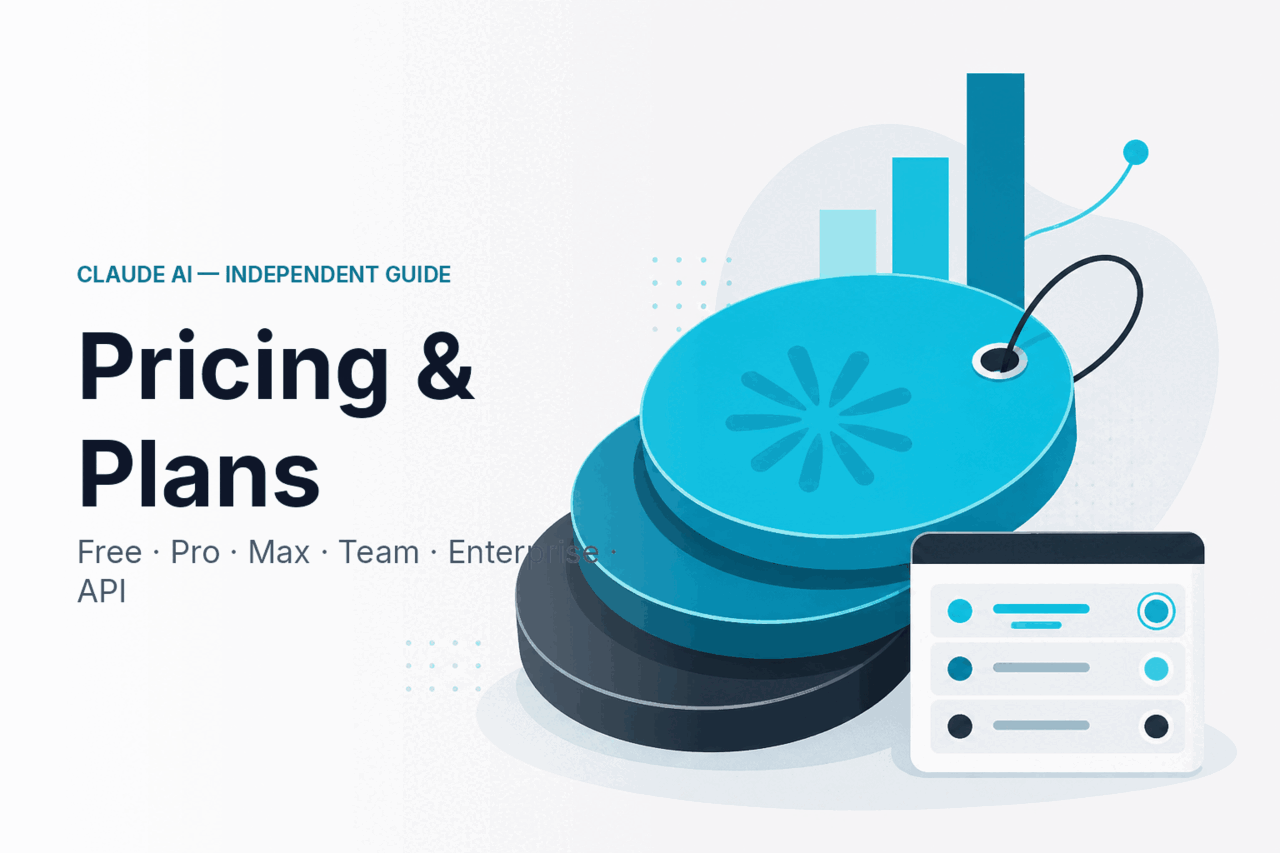
Claude AI pricing starts at $0 for Free and $20/month for Pro ($17/month billed annually). For higher-capacity individual use, Max starts at $100/month. Team Standard is $25/seat/month ($20 annual); Team Premium is $125/seat/month ($100 annual). Enterprise uses a $20/seat base plus metered API rates. On the API, the current models are Claude Fable 5, Opus 4.8, Sonnet 5, and Haiku 4.5, billed per million tokens.
c-ai.chat is an independent guide to Claude AI, not Anthropic and not claude.ai. We check this page against the official Claude pricing page, Anthropic’s API pricing docs, and the model overview. For capability context beyond price, use our Claude AI guide, Claude features guide, Claude models guide, and Claude API docs guide.
- Free · $0/month · Sonnet 5 + Haiku 4.5
- Pro · $20/month or $17/month annual · adds Opus 4.8, Fable 5, Claude Code, Cowork
- Max · from $100/month · 5x–20x Pro usage
- Team Standard · $25/seat/month or $20/seat/month annual
- Team Premium · $125/seat/month or $100/seat/month annual
- Enterprise · $20/seat base plus API rates
- API · listed rates run from $1/M input to $50/M output
- Sonnet 5 · $2/$10 per M introductory through 2026-08-31, then $3/$15
- Prompt caching · cache reads cost about 10% of base input (up to 90% off)
- Batch API · 50% off input and output
Table of contents
- Subscription plans
- API pricing
- Cost optimisation
- Real-world cost examples
- Plan advice by user type
- Pricing comparison
- Common pricing mistakes
- How we keep this page current
- Frequently asked questions
- Sources
Subscription plans
Claude subscriptions cover app access. API usage is billed separately by tokens through Anthropic’s developer platform. Many serious users need both: a subscription for human work and an API budget for software workloads.
Free, Pro, and Max are mainly individual plans. Team Standard and Team Premium add team-oriented billing and administration. Enterprise is for governed deployment and uses a $20/seat base plus API rates. App plans use plan access plus usage limits; they are not a fixed daily message allowance.
Free
$0/month
For trying Claude
- Includes Sonnet 5 and Haiku 4.5
- Session-based usage limits (about 5-hour resets) plus weekly limits
- Web, iOS, Android, and desktop access
- Useful for occasional questions and prompt tests
- API usage is billed separately
Pro
$20/month
$17/month with annual billing · for regular individual use
- Everything in Free, plus Opus 4.8 and Fable 5
- Adds Claude Code, Cowork, and Projects
- Higher practical capacity than Free
- Best first upgrade for frequent users
- API usage is billed separately
Max
From $100/month
For individual power users
- 5x or 20x Pro usage capacity
- For users who regularly hit Pro limits
- Higher output limits, early access, and priority traffic
- Not an API discount tier
- Check the official pricing page for capacity details
Team Standard
$25/seat/month
$20/seat/month with annual billing · for small teams
- Seat-based team access
- Shared workspace, SSO, and admin controls
- Claude Code included
- Central billing
- API usage is billed separately
Team Premium
$125/seat/month
$100/seat/month with annual billing · for higher team capacity
- Higher-capacity Team tier
- Priority traffic and expanded admin controls
- Claude Code included
- Seat-based access and team billing
- API usage is billed separately
Enterprise
$20/seat base + API rates
For governed deployment
- Enterprise base seat cost plus metered API usage
- SCIM, audit logs, RBAC, and spend controls
- Data residency and central administration
- Contract-led deployment
- Review Anthropic’s Trust Center before purchase
Free is the right first stop if you only need occasional answers or quick tests. Pro is the default paid plan for individuals who use Claude several times a week, and it is where Opus 4.8, Fable 5, Claude Code, and Cowork unlock. Max is for users who already know Pro is too restrictive.
Team and Enterprise are about management as much as usage. Team Standard is the first team tier to evaluate. Team Premium raises the seat price for teams that need more capacity. Enterprise fits buyers with contract, governance, security, or procurement requirements.
Feature lists can change. Confirm plan-specific details on the official Claude pricing page before buying.
API pricing
The Claude API is billed by tokens, not by subscription seats. Input tokens are the prompt, system instructions, conversation history, files, tool definitions, and retrieved context you send to Claude. Output tokens are the text Claude returns.
Use this formula: input tokens divided by 1,000,000, multiplied by the model’s input price, plus output tokens divided by 1,000,000, multiplied by the model’s output price. Prices are quoted per million tokens. To estimate a specific workload, use our Claude API cost calculator.
The current Claude API models are Fable 5, Opus 4.8, Sonnet 5, and Haiku 4.5. Fable 5, Opus 4.8, and Sonnet 5 each have a 1,000,000-token context window and up to 128,000 output tokens. Haiku 4.5 has a 200,000-token context window and up to 64,000 output tokens. For capability details beyond price, see our Claude models guide and Claude API docs guide.
| Model | Best fit | Input price | Output price | Context | Max output |
|---|---|---|---|---|---|
| Claude Fable 5 | Most capable, widely released | $10/M tokens | $50/M tokens | 1,000,000 tokens | 128,000 tokens |
| Claude Opus 4.8 | Complex agentic coding & enterprise | $5/M tokens | $25/M tokens | 1,000,000 tokens | 128,000 tokens |
| Claude Sonnet 5 | Default model (Free & Pro) | $2/M tokens* | $10/M tokens* | 1,000,000 tokens | 128,000 tokens |
| Claude Haiku 4.5 | Fast, lower-cost work | $1/M tokens | $5/M tokens | 200,000 tokens | 64,000 tokens |
Sonnet 5 introductory pricing. Sonnet 5 is currently offered at an introductory API rate of $2/M input and $10/M output. This introductory rate runs through 2026-08-31; afterward, Sonnet 5 reverts to its standard rate of $3/M input and $15/M output. Every other price on this page is a standard rate.
Mythos 5 is invitation-only. Claude Mythos 5 is offered to approved customers through Anthropic’s Project Glasswing for defensive-cybersecurity workflows. It is not available self-serve. Where documented, it shares Fable 5’s 1,000,000-token context window, 128,000-token output limit, and $10/$50 per-million-token pricing.
Legacy API models
The models below are still available and still priced, but they are no longer current. Anthropic advises migrating to the current lineup. Pages about these models keep their historical details.
| Legacy model | Input price | Output price | Superseded by |
|---|---|---|---|
| Claude Opus 4.7 | $5/M tokens | $25/M tokens | Opus 4.8 |
| Claude Sonnet 4.6 | $3/M tokens | $15/M tokens | Sonnet 5 |
For rough planning, 1 token is about 4 English characters or about 0.75 words. Treat that as an estimate only. Code, tables, markup, non-English text, and dense data can tokenize differently.
Control output cost with max_tokens, concise instructions, stop conditions, and narrower task design. You do not pay for unused output capacity, but a high max_tokens setting allows longer answers. Long answers can dominate the bill because output tokens cost more than input tokens on every current model.
Sonnet 5
the default model on Free and Pro — and $2/$10 per million tokens on the API through 2026-08-31, then $3/$15.
Cost optimisation
Most waste comes from resending the same context, asking for longer answers than needed, using a larger model for simple work, or running immediate requests for jobs that could wait. The main levers are prompt caching, Batch API, long-context planning, and model routing.
Prompt caching
Prompt caching reduces the cost of repeated input. Cache reads cost about 10% of the base input price, which is up to a 90% discount on cached input tokens. The discount applies to the cached input portion only, not to output tokens or new input tokens.
On Sonnet 5 at the standard $3/M input rate, cache reads cost about $0.30/M. Writing to the cache costs a premium over standard input — per Anthropic’s prompt-caching pricing, roughly 1.25x base input for a 5-minute cache and 2x for a 1-hour cache; confirm the current multipliers in the API pricing docs. Use caching when the same long prefix will be reused enough times to justify the write cost.
Batch API
Batch API gives a 50% discount on both input and output tokens for asynchronous processing. It fits jobs that do not need an immediate response: classification, extraction, enrichment, summarisation queues, evaluation runs, and support-ticket triage.
Split workloads by urgency. Keep user-facing chat on the standard API path. Move offline jobs to Batch API when delayed completion is acceptable.
Long context
A 1,000,000-token context window changes capacity, not cost accounting. If you send 800,000 input tokens to Sonnet 5 at the standard $3/M rate, the input cost is 0.8M × $3/M = $2.40 before output and discounts. The same input on Opus 4.8 costs 0.8M × $5/M = $4.00.
Use retrieval, chunking, document routing, summaries, and caching so Claude reads only the context it needs. Long context is useful, but every input token still counts.
Model routing
Start with the smallest model that clears your quality bar. Haiku 4.5 is the low-cost option for high-volume structured tasks. Sonnet 5 is the default for most everyday and production work. Opus 4.8 is built for complex agentic coding and enterprise workloads, and Fable 5 is the most capable widely released model for the hardest problems.
Real-world cost examples
Real Claude costs depend on volume, model choice, output length, cache reuse, and whether the job can run in batch. A few long Opus 4.8 or Fable 5 generations can cost more than thousands of short Haiku 4.5 classifications.
The examples below use simple assumptions so you can copy the method. Replace the token counts with your own logs before setting a production budget.
Caching examples show steady-state cache reads. If your cache prefix changes often, add cache-write costs: Anthropic’s prompt caching charges a premium on the write (about 1.25x base input for a 5-minute cache and 2x for a 1-hour cache); confirm current multipliers in the API pricing docs.
Worked example
A solo developer running 1,000 Sonnet 5 API chats per day
The total bill does not fall by 90% because output tokens still cost $15/M. The cached input portion falls from $4.50 to $0.45, before cache-write costs. These figures use Sonnet 5’s standard $3/$15 rate; through 2026-08-31, introductory pricing ($2/$10) is lower — the same uncached day would be $4.00 input + $5.00 output = $9.00.
Worked example
A 10-person agency on Team Standard
This is not a replacement calculation. Team seats buy shared human app access and administration. The API budget covers software automation, which should be estimated separately. Blended figures use Sonnet 5’s standard $3/$15 rate.
Worked example
A startup using Haiku 4.5 for high-volume support triage
Haiku 4.5 is the right starting point when the task is high-volume, structured, and tolerant of a smaller model. For offline triage, Batch API cuts the token cost in half.
Plan advice by user type
Pricing comparison
At the app layer, compare the subscription price, usage limits, workspace controls, integrations, and the models you actually receive. Claude Pro at $20/month sits in the same broad category as other paid assistant subscriptions, but the right choice depends on the work you do and the limits you hit.
At the API layer, compare task cost rather than brand or headline token price. Run the same prompt set through each candidate model. Record input tokens, output tokens, latency, quality, retry rate, and engineering effort. Then compare the cost of a successful result.
Claude is often a strong fit when long context, careful writing, coding support, prompt caching, and safety posture matter. It may be the wrong default if your workflow needs native image generation or is already tuned around another provider’s SDK. For more context, see our Claude resources.
Buy Claude when
- You need long context for large documents, codebases, or research packets.
- You can use prompt caching to reduce repeated input cost.
- Your own quality tests favour Claude for the task.
- The Claude API fits your developer workflow.
- You value a careful safety posture for customer-facing or internal tools.
Use another tool when
- You need native image generation.
- A simpler, cheaper model clears your quality bar.
- Your monitoring, prompts, and cost controls already depend on another provider.
- Your team needs integrations that Claude does not offer.
Common pricing mistakes
- Buying Max before Pro is a real constraint. Upgrade after real work regularly hits Pro’s practical ceiling.
- Treating a subscription as an API allowance. A plan buys app access. The API bills software usage by token.
- Assuming Sonnet 5’s introductory price is permanent. The $2/$10 rate is introductory through 2026-08-31; budget for the standard $3/$15 rate afterward.
- Ignoring output tokens. Output costs more than input on Fable 5, Opus 4.8, Sonnet 5, and Haiku 4.5.
- Sending the full document every turn. Long context is useful, but every input token still counts.
- Using a 1-hour cache write when 5-minute reuse is enough. The 1-hour write costs about 2x base input. The 5-minute write costs about 1.25x.
- Choosing Opus 4.8 or Fable 5 for every task. Sonnet 5 is the default for most work. Haiku 4.5 is better for many high-volume simple tasks.
- Skipping Batch API for offline jobs. If no one is waiting for the answer, the 50% discount can matter more than immediate completion.
How we keep this page current
c-ai.chat is independent. We are not Anthropic, we do not impersonate claude.ai, and we do not process Claude purchases. To maintain this page, we check the official Claude pricing page, the API pricing docs, and the model overview. We verify every price against Anthropic’s primary sources and re-check temporary pricing — such as Sonnet 5’s introductory rate — on or before its stated end date.
We also use official Anthropic properties such as anthropic.com, trust.anthropic.com, and status.claude.com for company, trust, and service context. The post meta above this article shows the publication date and the most recent update. If this guide and the official pricing page differ, treat claude.com/pricing as the authority. For account-specific billing rules, use Anthropic’s official support site.
Frequently asked questions
Is Claude AI really free?
Yes. Claude has a Free plan at $0/month that includes Sonnet 5 and Haiku 4.5, with session-based usage limits (roughly 5-hour resets) plus weekly limits. It is useful for trying Claude, testing prompts, and occasional work.
Which Claude models are current?
Fable 5 (most capable, widely released), Opus 4.8 (complex agentic coding and enterprise), Sonnet 5 (the default on Free and Pro), and Haiku 4.5 (fast, low cost). Mythos 5 is invitation-only through Project Glasswing. Opus 4.7 and Sonnet 4.6 are legacy models — still available, but superseded by Opus 4.8 and Sonnet 5.
Why is Sonnet 5 cheaper right now?
Sonnet 5 is billed at an introductory API rate of $2/M input and $10/M output through 2026-08-31. After that date it reverts to the standard rate of $3/M input and $15/M output. Budget for the standard rate for any workload that runs past the introductory window.
Is Claude Pro worth $20/month?
Pro is worth $20/month if Claude saves you time most workdays. The annual-billing equivalent is $17/month, and Pro adds Opus 4.8, Fable 5, Claude Code, and Cowork. If you only ask a few casual questions each week, Free may be enough.
How much does Claude Max cost?
Max starts at $100/month and provides 5x or 20x Pro usage. It is for individual power users who outgrow Pro. It does not reduce API token rates.
What is the difference between Team Standard and Team Premium?
Team Standard is $25/seat/month or $20/seat/month with annual billing. Team Premium is $125/seat/month or $100/seat/month with annual billing. Both include Claude Code. Start with Standard if you mainly need team access and administration, then compare Premium if capacity becomes the issue.
How is Team different from Enterprise?
Team is a seat-based plan for shared app access and administration. Enterprise uses a $20/seat base plus API rates and fits governed deployment, procurement, security review, and contract-led rollout.
How do I estimate Claude API cost?
Use this formula: input tokens divided by 1,000,000 multiplied by the model’s input price, plus output tokens divided by 1,000,000 multiplied by the model’s output price. For Sonnet 5 at its standard $3/$15 rate, 2M input tokens cost $6.00 and 0.5M output tokens cost $7.50, for a total of $13.50. Our Claude API cost calculator runs this for you.
Does prompt caching save 90%?
It can save up to 90% on cache-read input tokens because cache reads cost about 10% of the base input price. The total bill may fall by less if output tokens dominate, the repeated prefix is small, or cache-write overhead is high. Cache writes cost roughly 1.25x base input for 5-minute writes and 2x for 1-hour writes.
Does c-ai.chat sell Claude subscriptions?
No. c-ai.chat is an independent guide to Claude AI by Anthropic. We do not resell Claude, manage subscriptions, issue API keys, provide account access, or speak for Anthropic. For the official product, use claude.ai.
Independent guide. Not affiliated with Anthropic. For the official Claude product, visit claude.ai.
Facts verified: 2026-07-13