Conversation and drafting
For emails, memos, outlines, scripts, and rewrites.
- Tone variants without changing the core facts
- Summaries at different lengths
- Briefs, checklists, tables, and action lists
Claude AI features include chat, writing help, document analysis, image understanding, code assistance, extended thinking, 1M-token context on supported models, and developer-controlled tool use; c-ai.chat is an independent Claude AI guide, not Anthropic, so we focus on what each capability does and what you should verify before relying on it.
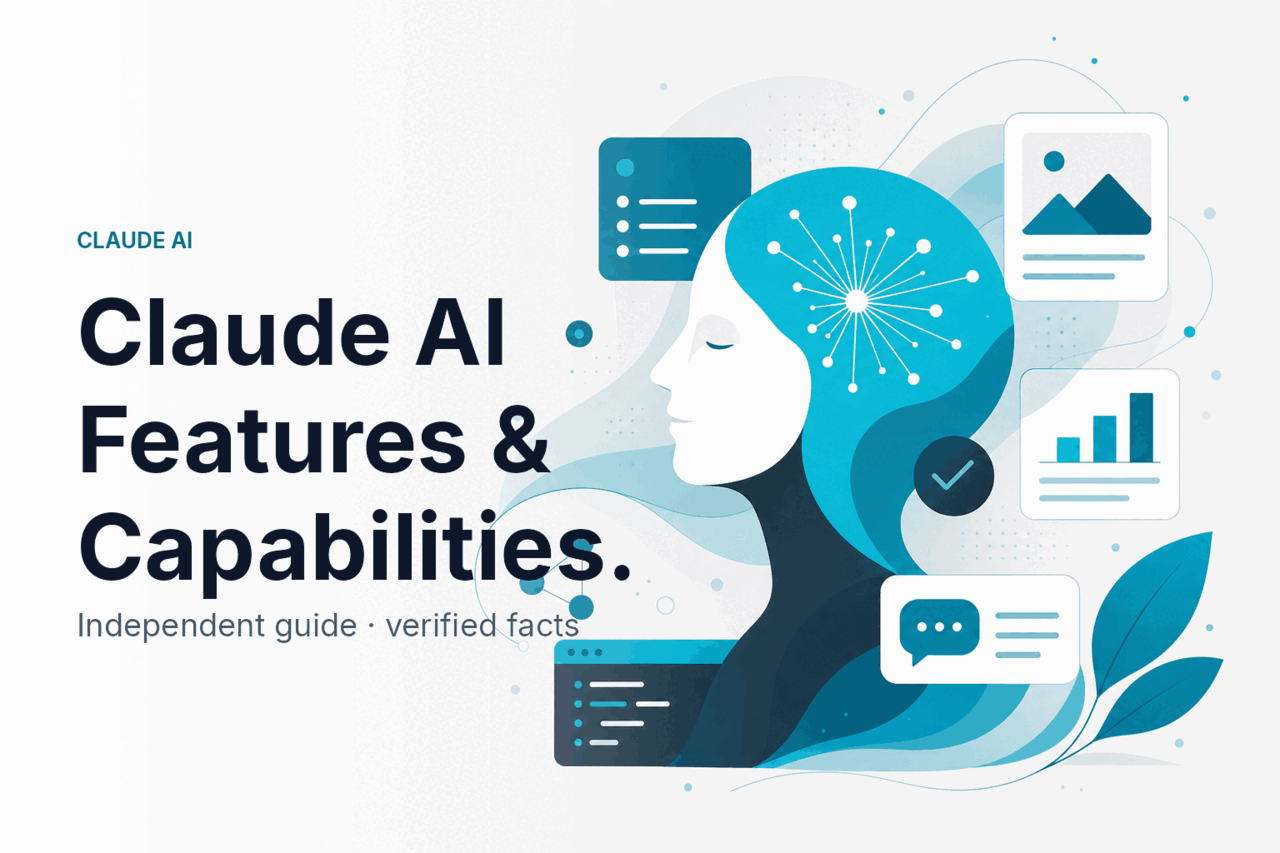
Table of contents
Claude is made by Anthropic. The official product is claude.ai. Claude can read supplied context, transform it, reason over it, and return text, tables, code, JSON, or tool requests. Access varies by app, workspace, API, plan, and model, so check official Claude plans and our Claude pricing guide when limits or prices matter.
| Control | Facts to check | Why it matters |
|---|---|---|
| Plans | Free: $0. Pro: $20/mo, or $17/mo with annual billing. Max: from $100/mo. Team Standard: $25/seat/month, or $20/seat/month with annual billing. Team Premium: $125/seat/month, or $100/seat/month with annual billing. Enterprise: $20/seat base plus API rates. | Plans affect usage limits, workspace controls, admin features, and feature access. |
| API models | Opus 4.7: $5 input / $25 output per million tokens, 1M context. Sonnet 4.6: $3 input / $15 output per million tokens, 1M context, 128K max output. Haiku 4.5: $1 input / $5 output per million tokens. | Model choice affects context size, output length, latency, reasoning quality, and cost. |
| API cost controls | Prompt caching gives 90% off cached input. Batch API gives 50% off input and output tokens. | These help with repeated prompts and asynchronous jobs. They do not improve accuracy. |
Evaluate Claude by the job, not the feature label. The useful pattern is simple: give source context, name the task, set the output shape, and verify important claims.
For emails, memos, outlines, scripts, and rewrites.
For PDFs, policies, contracts, specs, and research notes.
For decisions with constraints, trade-offs, and edge cases.
For explaining, writing, testing, and refactoring code.
For screenshots, diagrams, forms, charts, and visible text.
For product features, internal tools, and controlled agents.
For writing, Claude works better when you provide source material and a clear target. “Write a sales email” is vague. “Turn this transcript into a 180-word follow-up email for a CFO, preserve the three named risks, and include one question at the end” gives Claude a job you can judge.
For analysis, Claude can separate facts from recommendations, build tables from messy notes, identify contradictions across documents, and propose next steps. Use it for first-pass work on policies, product requirements, research notes, meeting transcripts, and customer feedback. Do not make it the only reviewer for legal, financial, medical, safety, or regulated decisions.
For code, Claude can generate examples, explain unfamiliar repositories, draft tests, review diffs, and propose refactors. It can produce plausible code that is still insecure or wrong. Run the code, test edge cases, check dependencies, and use the Claude API docs for product integrations instead of automating a browser session.
| Capability | Strong use | What to verify |
|---|---|---|
| Writing and editing | Briefs, emails, reports, outlines, tone rewrites | Facts, claims, audience fit, final wording |
| Long document review | Contracts, specs, policies, logs, transcripts | Quotes, references, omissions, source order |
| Software work | Code explanation, tests, migrations, refactors | Builds, tests, vulnerabilities, licensing |
| Product integration | Chatbots, internal copilots, agent workflows | Auth, audit logs, tool scopes, failure handling |
| Plan selection | Choosing web app, team workspace, or API access | Usage limits, model access, admin controls |
| Assistant comparison | Testing Claude against other AI tools | Same prompts, same files, same success criteria |
For broader comparisons, prompt patterns, and practical setup notes, use our Claude resources.
Paste the relevant text, upload the file, or connect the tool that contains the facts. Claude performs better when it does not need to guess.
State whether you want a draft, critique, extraction, comparison, test plan, decision memo, or final answer.
Ask for bullets, a table, JSON, a checklist, or a short memo. For structured workflows, specify field names such as risk, evidence, and owner.
For document work, request quotes, page references, section names, or “not found” labels instead of unsupported claims.
Use Claude to improve a draft, then verify facts, calculations, permissions, and downstream effects before you act.
Claude can process images and documents in supported interfaces and API workflows. For PDFs, it can read text, reason over tables, extract key clauses, draft summaries, and answer questions about the file. For images, it can describe visible content, read legible text, interpret charts or screenshots, and compare design states.
Use these features as an assistant, not as a formal OCR engine or expert reviewer. Image reasoning can fail with small text, skewed scans, overlapping labels, chart scales without units, low contrast, or anything requiring exact measurement. PDF results improve when you ask for page or section references, exact quotes, and a table of uncertain items. For implementation details, check Anthropic’s documentation for vision and PDF support.
Worked example
Review a supplier PDF before a renewal call
This is the right pattern: Claude narrows the review, and a responsible person confirms the decision.
Extended thinking lets supported Claude models spend more reasoning effort before answering. It is designed for tasks where a quick answer may miss a constraint, skip a dependency, or reduce several options to one shallow recommendation. Anthropic documents extended thinking in its developer docs, including how developers can configure reasoning budgets in API workflows.
Use extended thinking for architecture decisions, difficult debugging, multi-step analysis, math-heavy reasoning, policy interpretation, and plans with trade-offs. Skip it for routine rewriting, short summaries, simple extraction, or work where speed matters more than analysis. It can increase latency and token use.
A 1M-token context window means supported Claude models can accept a very large prompt: long PDFs, a codebase extract, transcripts, logs, or a research bundle. It does not mean perfect recall. Long inputs still need structure. Add a file map, name the sources, ask Claude to cite sections, and split high-risk work into passes. Anthropic’s model overview and API pricing docs list 1M context for Opus 4.7 and Sonnet 4.6; our Claude models guide explains how to choose by context, speed, output length, and cost.
1M tokens
long-context input on Opus 4.7 and Sonnet 4.6
Tool use is how Claude moves from text generation to software workflows. In the Messages API, a developer describes tools with names, input schemas, and constraints. Claude can request a tool call when it needs external data or wants to take an action, such as searching a database, fetching account status, calculating shipping, creating a ticket, or running a sandboxed test. Your application executes the tool and sends results back. Claude does not automatically reach into your systems; you choose the tools, permissions, and final action path. Anthropic documents this pattern in its tool use docs.
Agents build on tool use by letting Claude plan and act across several steps, usually with checks around state changes. Model Context Protocol, or MCP, standardises how clients connect Claude to tools and data sources through servers. Use agents for internal assistants, code workflows, support triage, data preparation, and repetitive operations where every action can be logged. Keep approvals for payments, deletes, outbound messages, account changes, and regulated workflows. For production systems, prompt caching can cut cached input token costs by 90%, and the Batch API gives 50% off input and output tokens for asynchronous jobs.
Worked example
Support triage agent with human approval
This keeps Claude useful without giving it unchecked authority over customer records.
Claude is most useful when you give it rich context and ask for a structured result: source-linked summaries, rewrite options, code changes, risk lists, research plans, and tool-driven workflows. It is weakest when you treat it as an unchecked oracle or an autonomous actor with broad permissions. Use Claude for careful language work, document-heavy reasoning, coding support, and controlled agents. Keep humans, tests, and system-of-record checks in the loop for decisions that matter.
The main Claude AI features are natural-language chat, drafting and editing, file analysis, image understanding, coding help, long-context reading on supported models, extended thinking, and API tool use. Workspaces can also add shared context, access management, and admin controls depending on plan.
Yes, in supported interfaces and API workflows. Claude can answer questions about PDFs, extract information, compare documents, describe images, read legible text in images, and reason over screenshots or charts. Accuracy depends on file quality, layout, prompt clarity, and model capability. For important work, ask Claude to quote exact source text and identify uncertain items.
Claude can use web or research features when they are enabled in the official product and available on your plan. In API workflows, Claude does not browse by default. Developers provide retrieval, search, or browser-like tools if they want Claude to use live information. Check cited sources directly before relying on them.
Extended thinking lets supported Claude models spend more reasoning effort before responding. It helps with planning, trade-off analysis, multi-step debugging, complex math, and careful interpretation of constraints. It can take longer and use more tokens, so use it when answer quality matters more than speed.
It means supported Claude models can accept very large inputs in one context window, such as long documents, codebase exports, transcript sets, or log bundles. Opus 4.7 and Sonnet 4.6 support 1M-token context. Large prompts still need structure, file names, section labels, and verification passes.
Yes, through developer-controlled tool use. A developer defines tools, input schemas, and permissions. Claude can request a tool call, your application executes it, and Claude uses the returned result to continue. MCP and agent patterns extend this into richer workflows. Keep scopes, logs, approvals, and failure handling in place.
Claude is useful for explaining code, drafting functions, writing tests, refactoring, finding likely bugs, and turning requirements into implementation plans. It can still produce insecure or incorrect code. Run tests, inspect dependencies, review generated changes, and keep humans responsible for production deployments.
Yes. Free, Pro, Max, Team, and Enterprise plans differ on usage limits, model access, admin controls, and workspace features. See our Claude pricing guide for the current side-by-side, or Anthropic’s pricing page for the source of truth.
Independent guide. Not affiliated with Anthropic. For the official Claude product, visit claude.ai.
Hand-picked from the cluster — the pages we recommend first.