
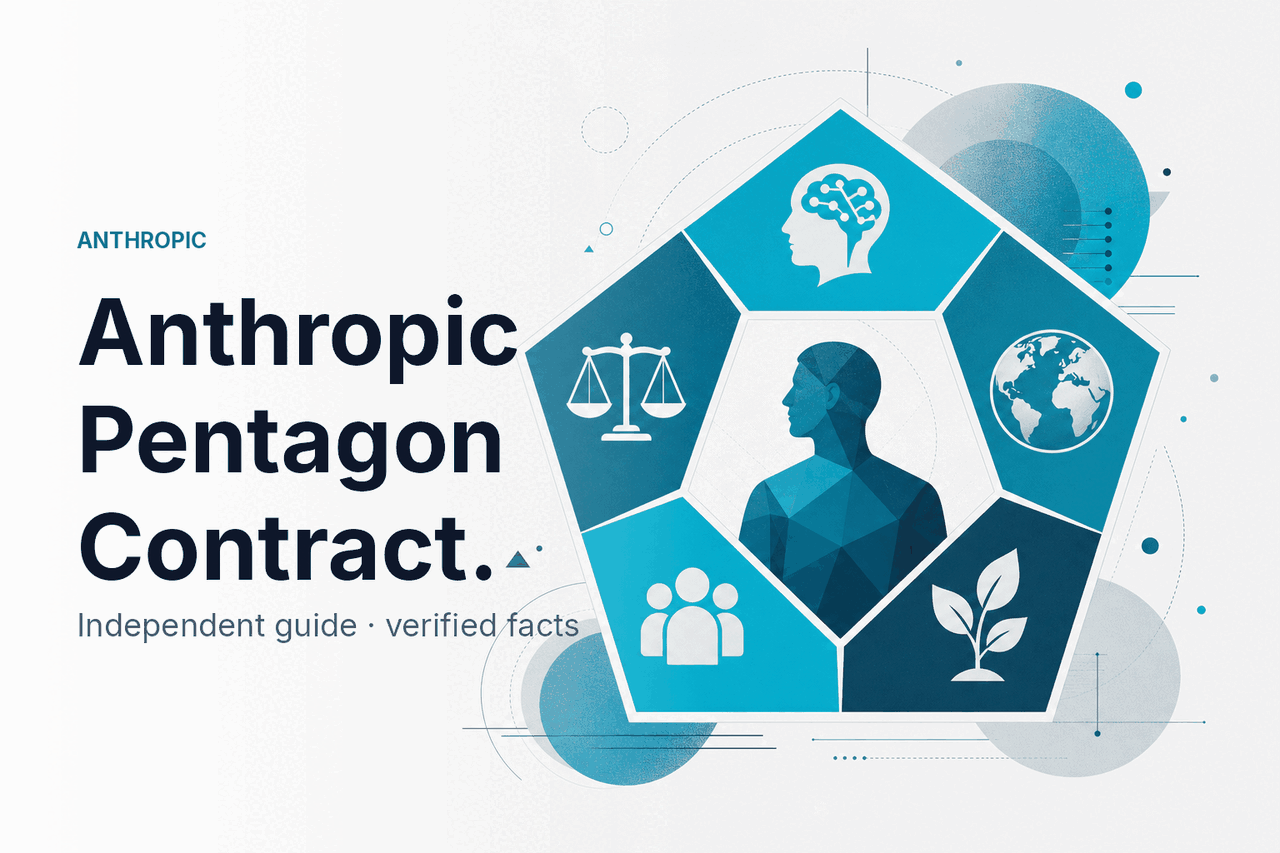
“Anthropic Pentagon” usually means questions about Anthropic’s public-sector or defense work; it is not a separate Claude product, and this independent Claude resource hub explains the public facts and the limits of what is known.
- The short answer
- What Anthropic actually is
- People and leadership
- Products, pricing, and revenue
- FAQ
- The honest take
- Sources
The short answer
Anthropic is the company behind Claude. The Pentagon angle is about possible government and defense access to AI systems, not a public “Pentagon edition” of Claude.
- Company: Anthropic, the maker of Claude.
- Product: Claude is available through claude.ai, business plans, and the API.
- Public status: Anthropic publishes product, model, trust, and platform information.
- Public limit: Anthropic does not publish a full list of Pentagon workflows, contract clauses, or deployment environments.
The cleanest way to read the story is this: Anthropic builds Claude, and government buyers can evaluate or buy AI tools through enterprise, cloud, procurement, and platform routes. Public Anthropic materials describe Claude, model access, safety work, trust controls, and developer documentation. They do not provide a complete public map of every Department of Defense use case.
That distinction matters. A company can sell into government without publishing sensitive operational details. It can also support regulated use without creating a separate public product. If you searched for “anthropic pentagon,” the useful question is not whether Claude has a military-themed interface. It does not. The useful question is what Anthropic sells, what is documented, and what remains non-public.
| Question | Plain answer |
|---|---|
| Is “Anthropic Pentagon” a product? | No. It is a search phrase about Anthropic, Claude, and U.S. defense or government use. |
| Does Claude have a public DoD-only version? | Not as a named public consumer product on claude.ai. |
| Can government buyers use Claude? | Claude can be accessed through business, enterprise, API, and partner routes, subject to contracts, policy, and deployment requirements. |
| Are all contract details public? | No. Public pages do not describe every agency workflow, procurement term, or security configuration. |
What Anthropic actually is
Anthropic is an AI research and product company that builds Claude, with a stated focus on reliable and steerable AI systems.
Anthropic was founded by former OpenAI researchers, including Dario Amodei and Daniela Amodei. Its public positioning centres on AI safety, model behaviour, evaluations, and responsible deployment. The company describes itself as an AI safety and research company, and it presents Claude as both a consumer assistant and an enterprise AI system.
Anthropic is also structured as a public-benefit corporation. That does not make every decision public. It does mean Anthropic has made safety, policy, and trust part of its public identity. For a government buyer, that matters. The buyer is not only choosing a chatbot. It is evaluating model behaviour, data controls, uptime, auditability, vendor risk, and contract fit.
What is public
- Anthropic’s company mission and product line.
- Claude model families and developer documentation.
- Trust, status, support, and platform pages.
- Major commercial partnerships announced by Anthropic.
What is not fully public
- Every government procurement document.
- Agency-specific prompts, workflows, or use cases.
- Security architecture for each sensitive deployment.
- Non-public contract terms and operational restrictions.
This is why broad claims about an “Anthropic Pentagon contract” need care. Some readers are asking whether Anthropic is becoming a defense contractor. Others want to know whether Claude is used by the U.S. military. Others are comparing Anthropic with OpenAI, Google, and other AI vendors. The public answer is narrower: Anthropic is a major AI company whose products can be relevant to government and defense buyers, but the Pentagon story is not a standalone Claude product.
If you are new to Claude, start with our Claude features guide. If you are comparing current model options, use our Claude models guide.
People and leadership
Anthropic is closely associated with Dario Amodei, Daniela Amodei, and a leadership group drawn from AI research, policy, security, and enterprise software.
Dario Amodei is Anthropic’s chief executive and one of its best-known public voices. His background is in AI research, with public writing and interviews focused on frontier model capabilities, risk, evaluations, and the pace of AI development.
Daniela Amodei is Anthropic’s president and another central figure in the company’s public identity. Her role is often described through operations, policy, business development, and the work of turning a research company into a durable organisation.
Other visible leaders cover policy, product, security, and go-to-market work. These roles matter for government buying because model quality is only one part of the decision. Buyers also examine security programs, compliance posture, deployment models, customer support, procurement readiness, and executive accountability.
The key point is simple. Anthropic is not an anonymous model lab. It is a high-profile AI company with named founders, public executives, public research positions, and a growing commercial operation. That makes any government work more visible, and more contested, than a routine software sale.
Products, pricing, and revenue
Anthropic earns revenue by selling access to Claude through subscriptions, business plans, enterprise agreements, and metered API use.
- claude.ai: The official web and app experience for individual users and teams.
- Business plans: Managed Claude access for organisations that need team controls and support.
- Enterprise agreements: Contracted access for larger organisations with procurement, support, and security requirements.
- Claude API: Developer access through the Anthropic platform for building Claude into products and internal workflows.
- Claude Code: A developer tool for code understanding, edits, debugging, and project work.
For public-sector and defense buyers, the API and enterprise routes are usually more relevant than a personal chat subscription. A government organisation needs access controls, usage monitoring, support terms, data-handling commitments, procurement fit, and security review. A single employee can test Claude in a browser. An agency deployment needs a formal path.
Free
$0
Entry-level access for individual use.
Pro
$20/month or $17/month annual
Paid individual access with higher usage than Free.
Max
From $100/month
Higher-capacity individual access.
Team Standard
$25/seat or $20/seat annual
Team access for organisations.
Team Premium
$125/seat or $100/seat annual
Higher-tier team access.
Enterprise
$20/seat base plus API rates
Contracted access for larger organisations.
API pricing is metered by tokens. Published model pricing includes Opus 4.7 at $5 input and $25 output per million tokens, with a 1M-token context window; Sonnet 4.6 at $3 input and $15 output per million tokens, with a 1M-token context window and 128K maximum output; and Haiku 4.5 at $1 input and $5 output per million tokens. Prompt caching gives 90% off cached input. Batch API usage gives 50% off both directions.
| Route | Typical user | Why it matters for the Pentagon question |
|---|---|---|
| claude.ai | Individual users and small teams | Useful for understanding the interface, but not enough to describe government deployment. |
| Business plans | Companies, teams, and institutions | Adds organisational controls that are more relevant to managed use. |
| API platform | Developers and product teams | Lets organisations build Claude into internal or external systems. |
| Cloud and partner channels | Large enterprises and public-sector buyers | Can support procurement, infrastructure, and compliance requirements. |
| Trust and status pages | Security, legal, and operations teams | Help buyers evaluate availability, security posture, and vendor operations. |
Example
A policy team might use Claude to summarise unclassified public comments. A software team might use Claude Code to review internal code. A procurement office might evaluate the API for a controlled workflow. Those are different access routes with different security and contract requirements.
For personal comparisons, see our Claude pricing guide. For developer details, use our Claude API guide alongside Anthropic’s official documentation.
FAQ
Is Anthropic part of the Pentagon?
No. Anthropic is a private AI company, not a Pentagon office or government agency. It may sell products to public-sector or defense-related buyers, but that does not make it part of the Department of Defense.
Does the Pentagon use Claude?
Public materials do not give outside readers a complete list of every Pentagon use case. The fair answer is that Claude is relevant to government buyers, and any specific defense use depends on contracts, access rules, security approvals, and agency policy.
Is Claude approved for classified work?
Do not assume that. Classified workloads require specific environments, authorisations, and controls. A public Claude account at claude.ai should not be treated as a classified system.
Why would a defense organisation want Claude?
Likely uses resemble other large-organisation AI workflows: document analysis, coding support, summarisation, knowledge retrieval, planning support, and internal productivity. The sensitive part is the data, policy setting, human review, and operational context.
Is there a public Pentagon-only Claude app?
No. Anthropic has not presented a named public Pentagon-only Claude app on claude.ai. Government access would normally be handled through business, enterprise, API, cloud, or procurement channels.
Where should I check official Claude availability?
Use Anthropic’s official product and platform pages. Start with claude.ai for the consumer product, platform.claude.com for developers, trust.anthropic.com for trust information, and status.claude.com for service status.
For user-level questions, see our Claude FAQ.
The honest take
The phrase “anthropic pentagon” is useful only if you translate it into a clearer question. If the question is “Did Anthropic create a public Pentagon-only Claude app?” the answer is no. If the question is “Could Anthropic sell Claude-related services into defense or government settings?” the answer is yes, through enterprise, API, cloud, and procurement routes.
The boundary is evidence. Anthropic’s official pages tell you what Claude is, what the developer platform supports, how the company presents trust and safety, and where users can access the product. They do not give a full public inventory of Pentagon deployments. For most readers, the Anthropic Pentagon story should be read as a government-AI procurement story, not as a new Claude feature.
Last updated: 2026-05-12
This article is part of the Anthropic hub on c-ai.chat.