
The anthropic responsible scaling policy is Anthropic’s public framework for evaluating and controlling increasingly capable AI systems before and after deployment; if you want the wider company context behind that policy, start with our Anthropic guide, then use the sections below for the company background, leadership, products, and the related questions people usually mean when they search this topic.
- The short answer
- What Anthropic actually is
- People and leadership
- Products and revenue
- Other questions readers ask
- The honest take
The short answer
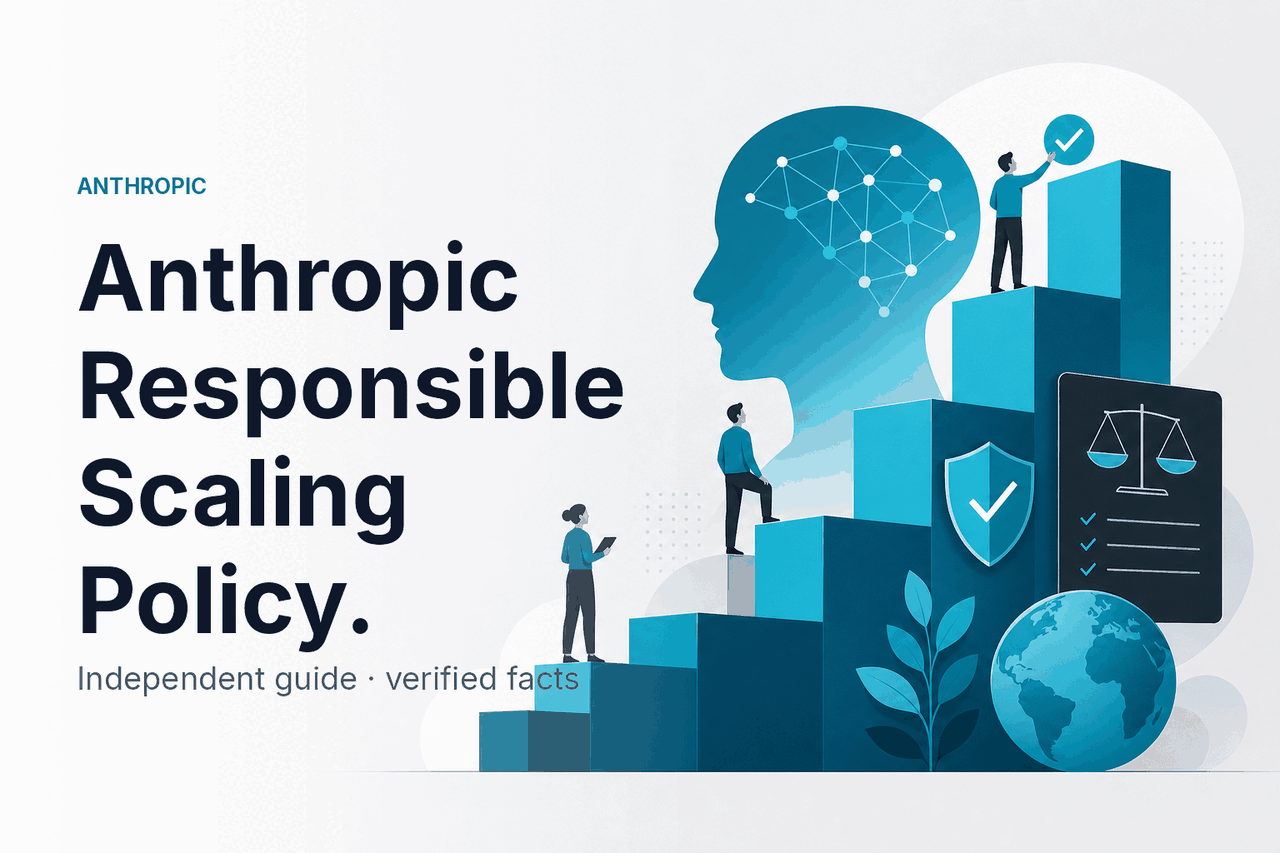
Anthropic Responsible Scaling Policy refers to Anthropic’s safety-and-governance rulebook for deciding how it develops, tests, deploys, and restricts advanced AI systems as capabilities increase.
In practice, the policy matters because it sets thresholds for stronger safeguards, more security controls, and tighter release decisions when model risk rises. It is part of how Anthropic explains its approach to frontier-model safety on anthropic.com and related trust materials, but it is not the same thing as Claude itself. Claude is the product; the Responsible Scaling Policy is one of the company policies behind how systems are handled.
- Founded · 2021
- Founders · Dario and Daniela Amodei, plus early OpenAI alumni
- HQ · San Francisco
- Funding · Multi-billion-dollar backing; private-company valuation reported at tens of billions
If your search intent was broader than policy alone, the short version is simple: Anthropic is the company that makes Claude. We cover Claude basics in what Claude AI is, and we track official announcements and changes in our news coverage.
What Anthropic actually is
Anthropic is a US AI company focused on building general-purpose language models and the safety systems around them. It was founded in 2021 by former OpenAI researchers and operators, with Dario Amodei as CEO and Daniela Amodei as president among the best-known founders. The company’s public identity has consistently paired product work with AI safety research, constitutional AI, alignment, evaluations, and governance commitments published through its main site and company news pages on anthropic.com.
The company is best known for Claude, which exists both as a consumer assistant at claude.ai and as an API platform for developers at platform.claude.com. Over time, Anthropic has expanded from a research-heavy startup into a large commercial AI company with consumer subscriptions, business plans, API revenue, and enterprise sales. Its official announcements, partnerships, safety updates, and product launches are typically published through the company site’s news section and product documentation.
Anthropic is the company. Claude is the product family. The Responsible Scaling Policy is part of the company’s governance framework for advanced AI systems.
That distinction matters because searchers often mix up “Anthropic,” “Claude,” and “claude.ai” as if they were the same thing. They are related, but not identical. If you just need the broad company explainer, our Anthropic overview covers the basics in one place, while our FAQ handles common product and account questions.
People and leadership
Anthropic’s public leadership profile is still closely tied to its founders, especially Dario and Daniela Amodei. Both are central to how the company presents its strategy: capable models, commercial deployment, and stronger safety controls as systems improve.
- Dario Amodei — Co-founder and CEO. He is the most visible public voice on Anthropic’s model strategy, AI safety arguments, scaling outlook, and policy positioning. Before Anthropic, he held senior research leadership roles at OpenAI.
- Daniela Amodei — Co-founder and President. She has been a key operator in the company’s growth, partnerships, and organisational build-out, and she is often cited alongside Dario in major company announcements.
- Jack Clark — Co-founder and policy-focused leader, widely known for public writing and commentary on AI governance, safety, and industry implications. He has long been one of Anthropic’s most recognisable public-facing figures.
- Jared Kaplan — Co-founder and scientist, often associated with research direction, model scaling, and technical work that underpins Anthropic’s products and safety evaluations.
Why leadership matters here
- Anthropic’s policy documents are tied to named leaders, not anonymous corporate copy
- The company publicly frames safety as part of product strategy
- Founders still shape the external message around release decisions
What not to assume
- A public safety policy does not tell you every internal process
- Leadership statements are not a substitute for technical documentation
- Corporate commitments still need outside scrutiny and ongoing updates
If you are comparing leadership visibility across AI labs, Anthropic stands out for putting safety language and governance ideas near the centre of its public narrative. That does not prove outcomes by itself, but it does help explain why searches for the anthropic responsible scaling policy are really searches about the company’s decision-making model, not just a single PDF or webpage.
Products and revenue
Anthropic sells AI access in several forms: direct consumer subscriptions, developer API usage, team plans, enterprise contracts, and workflow features around the Claude ecosystem.
- Claude consumer app — The main assistant experience on web and mobile through claude.ai. Plans include Free at $0/month, Pro at $20/month or $17/month annual, and Max from $100/month.
- Claude API — Programmatic access through platform.claude.com. Current headline model pricing includes Opus 4.7 at $5/M input and $25/M output, Sonnet 4.6 at $3/M input and $15/M output, and Haiku 4.5 at $1/M input and $5/M output.
- Claude Code — A coding-focused product experience included in higher tiers such as Pro, aimed at software workflows rather than casual chat alone.
- Cowork — A collaborative workflow feature named on Claude pricing pages as part of the broader product set for paid users.
- Skills — Reusable capabilities and workflow building blocks within the Claude ecosystem, positioned as part of Anthropic’s broader product surface.
| Product area | What it is | How Anthropic makes money |
|---|---|---|
| Claude app | Consumer and professional AI assistant | Subscriptions |
| Claude API | Developer access to Claude models | Per-million-token usage pricing |
| Team plans | Shared workspace and admin features | Per-seat pricing |
| Enterprise | Custom deployment and governance controls | Seat fees plus usage at API rates |
| Code and workflow tools | Specialised productivity features inside Claude | Bundled into higher-value plans |
90% off
cached input tokens with prompt caching
On the API side, Anthropic also pushes cost controls rather than just headline model power. Official pricing materials note prompt caching at 90% off cached input and Batch API at 50% off both input and output directions. That matters for real adoption because it changes the effective cost profile for repeated prompts, large back-end jobs, and long-running workflows.
Public revenue figures are not presented by Anthropic in the same way public companies report them, so any exact revenue number should be treated cautiously unless Anthropic states it directly. The safe statement is that Anthropic operates at large commercial scale, with consumer, developer, team, and enterprise revenue streams plus major strategic backing. For official pricing and plan structure, the authoritative reference remains claude.com/pricing.
Other questions readers ask
Searches for anthropic responsible scaling policy often sit next to broader company-intent questions. Here are the ones that come up most often.
If your next question is practical rather than corporate, our Claude FAQ is the faster route. If you want company changes and launch tracking, use the news section.
The honest take
The honest answer is that Anthropic Responsible Scaling Policy is important because it shows how Anthropic wants to be judged as an AI company: not only by model quality, but by the thresholds and controls it applies as systems get stronger. That is a meaningful distinction in a market where many people know the chatbot name but not the company behind it.
Still, a public policy is only one piece of the picture. The useful way to read it is alongside Anthropic’s actual products, docs, trust materials, and release behaviour. If you want to use Claude, go to the official product. If you want to understand the company behind it, keep Anthropic separate from Claude in your mental model.
Independent guide. Not affiliated with Anthropic. For the official Claude product, visit claude.ai.
Last updated: 2026-05-12