
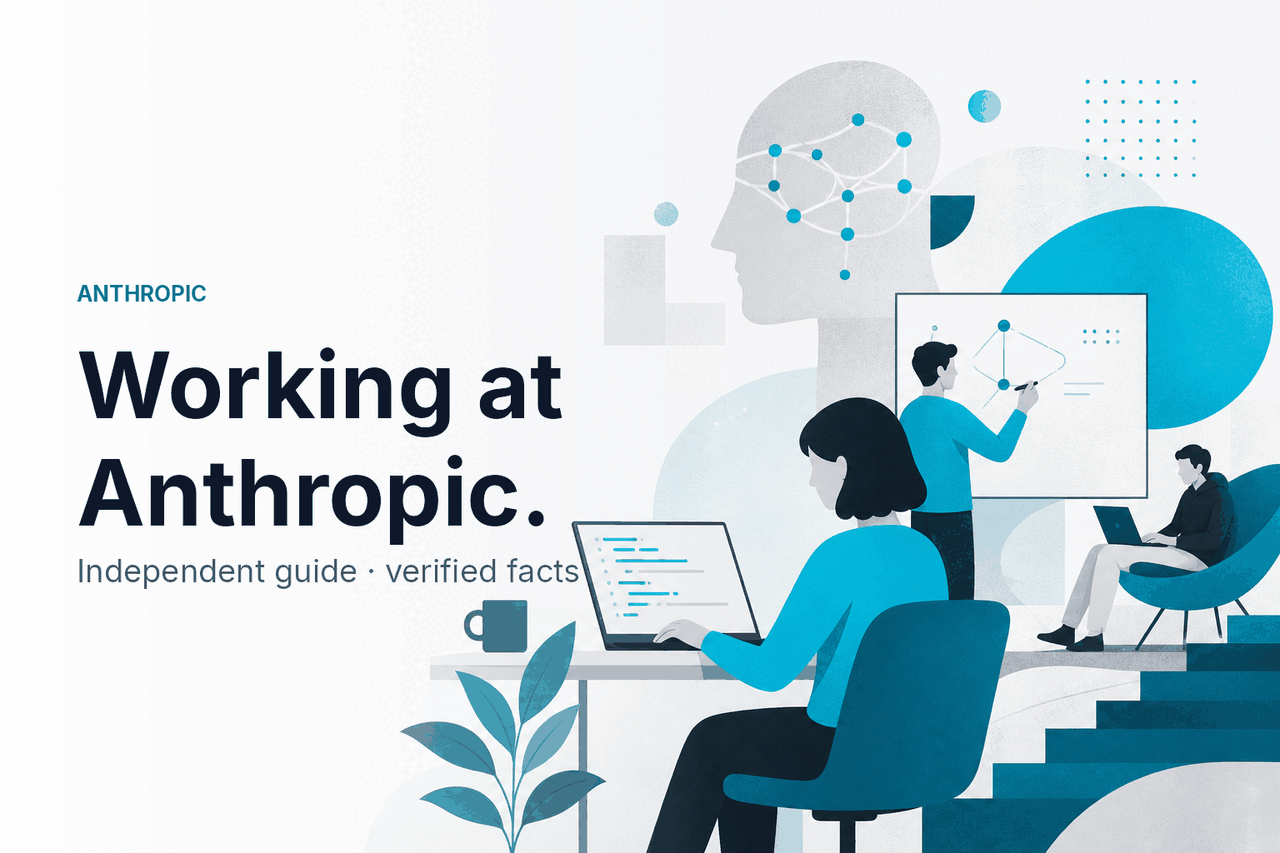
Working at Anthropic means joining the company behind Claude, an AI lab focused on building and deploying AI systems with an emphasis on safety, research, and commercial products; this guide explains what Anthropic is, who leads it, what it sells, and the practical context job seekers usually want. For broader context, start with our Anthropic company guide.
- The short answer
- What Anthropic actually is
- People and leadership
- Products and revenue
- Other questions readers ask
- The honest take
The short answer
Anthropic is a private AI company that makes Claude, sells API access to its models, and hires across research, engineering, product, operations, policy, and go-to-market functions. If you are looking into working at Anthropic, the key point is simple: it is not just a research lab anymore. It is a product and infrastructure company too, with a public consumer app, enterprise offerings, and a fast-growing developer platform.
- Founded 2021
- Founders Dario Amodei, Daniela Amodei and other former OpenAI researchers
- HQ San Francisco
- Funding Multi-billion-dollar backing from major strategic and financial investors
That matters because the experience of working there likely depends on the role. A frontier-model researcher will face different day-to-day work from a product manager shipping Claude features, a sales engineer supporting API customers, or a security lead handling enterprise controls. Anthropic’s official company pages at anthropic.com and its news posts provide the clearest picture of how the company presents its mission, product direction, and hiring priorities.
What Anthropic actually is
Anthropic is the maker of Claude, the chatbot and model family available through claude.ai and the Claude API platform. The company was founded in 2021 by former OpenAI leaders and researchers, including Dario Amodei and Daniela Amodei. From the start, Anthropic positioned itself around AI safety research and the development of reliable, steerable models. Its public materials consistently frame the company as both a research organisation and a commercial AI provider.
That dual identity shows up in its public announcements. On Anthropic’s site and news pages, the company regularly discusses model launches, enterprise features, policy positions, infrastructure partnerships, and safety work alongside consumer product updates. In practice, that means Anthropic is no longer a narrow lab operating in the background. It is a company with a visible product surface, business customers, platform revenue, and a growing operational footprint. If you want the product-side context before evaluating jobs there, our guides on what Claude AI is and the latest Claude and Anthropic news can help fill in that picture.
| Area | What it means at Anthropic |
|---|---|
| Research | Training, evaluating, and aligning frontier AI models |
| Product | Shipping Claude experiences for web, mobile, desktop, and workplace use |
| Platform | Serving developers and enterprises through the Claude API |
| Operations | Security, finance, recruiting, legal, policy, and internal systems needed to scale |
For candidates, the practical takeaway is that Anthropic sits somewhere between a research lab, a software company, and an enterprise infrastructure vendor. That mix usually creates high expectations around technical quality, written communication, and judgment. It also means there is likely less separation than in older tech companies between “research” and “product reality”: model capability, pricing, safety constraints, customer needs, and infrastructure cost all connect directly.
People and leadership
Anthropic’s leadership is most strongly associated with its founders, especially Dario Amodei and Daniela Amodei. They are the two names job seekers usually encounter first, and for good reason: both were central figures in the company’s formation and public direction.
- Dario Amodei is Anthropic’s co-founder and chief executive officer. Before Anthropic, he was a leading research figure at OpenAI. Publicly, he is most associated with model scaling, safety, governance, and the strategic case for building powerful AI systems responsibly.
- Daniela Amodei is Anthropic’s co-founder and president. Her background spans operations, policy, and organisational leadership. In practice, she is often seen as a key architect of how Anthropic runs as a company, not just as a research effort.
- Jack Clark, a co-founder, has long been one of Anthropic’s most visible public voices on policy, AI governance, and industry analysis. Many readers know him from policy writing and commentary as much as from company leadership.
- Mike Krieger has been publicly visible in Anthropic leadership and product discussions. For candidates evaluating the company’s product maturity, that matters because it signals focus on execution and product design, not only model research.
This is not a complete org chart, and it should not be read as one. The useful point for someone researching working at Anthropic is that the company’s visible leaders span research, operations, product, and policy. That usually indicates a company trying to scale without pretending everything is purely a science problem. It also suggests cross-functional work is likely normal rather than exceptional.
Likely fit if you want
- High-context work close to frontier AI decisions
- A company where research and product teams both matter
- Strong written communication and principled debate
Potential mismatch if you want
- A slow-moving, highly layered corporate structure
- Narrow ownership with little cross-functional overlap
- Work far removed from safety, policy, or model constraints
If you are comparing Anthropic with the broader Claude ecosystem, our homepage at c-ai.chat and company background page on Anthropic give the wider context without relying on hiring-page language.
Products and revenue
Anthropic sells access to Claude through consumer subscriptions, team and enterprise plans, and API usage. That mix matters for employment research because it shows where the company’s incentives are: model quality alone is not enough. Anthropic also has to support distribution, reliability, pricing, enterprise procurement, and developer adoption.
- Claude consumer product — The chat app on web, desktop, and mobile, with Free, Pro, and Max plans on claude.com/pricing.
- Claude API — Paid model access for developers and businesses through platform.claude.com, with model pricing published by Anthropic.
- Claude Code — Coding-focused workflows and tooling tied to the Claude product lineup.
- Cowork — Collaborative product features aimed at helping users work with Claude across tasks and teams.
- Skills — Reusable capabilities and workflow-oriented features that extend how Claude can be used in practical tasks.
On the model side, Anthropic’s public pricing shows a clear commercial ladder. Claude Opus 4.7 is the flagship model at $5 per million input tokens and $25 per million output tokens. Claude Sonnet 4.6 is the default choice for many use cases at $3 input and $15 output per million tokens. Claude Haiku 4.5 is the lower-cost option at $1 input and $5 output per million tokens. Anthropic also documents cost controls such as prompt caching, with 90% off cached input tokens, and Batch API pricing with 50% off both input and output directions.
90% off
cached input tokens with prompt caching
| Anthropic offering | How it makes money | Why it matters for jobs |
|---|---|---|
| Claude Free / Pro / Max | Consumer subscription revenue | Drives product, design, growth, support, and infrastructure work |
| Team and Enterprise plans | Seat-based contracts and enterprise expansion | Creates demand for security, admin tooling, sales, customer success, and compliance |
| Claude API | Usage-based token pricing | Supports platform engineering, documentation, developer relations, and reliability work |
| Model features and tooling | Retention, upsell, and business adoption | Links research output to practical shipping pressure |
Anthropic is private, so full revenue details are not disclosed in the way a public company would report them. Still, the public signals are clear enough: this is a large-scale commercial AI company, not an academic lab. It has broad enterprise ambitions, visible infrastructure costs, and a business model built around subscription and usage revenue. Anyone thinking about working there should assume commercial execution is central to the company’s future.
Other questions readers ask
People searching for working at Anthropic usually want a few adjacent answers too. These are the practical questions that tend to sit in the same search cluster.
The honest take
Working at Anthropic is likely attractive if you want to be close to important AI product and model decisions at a company that still treats safety, governance, and model behaviour as first-order concerns. The tradeoff is that this is probably not the place to expect low-pressure ambiguity, slow cycles, or a clean wall between research ideals and commercial realities. Anthropic’s public footprint shows a company under real shipping pressure.
So the plain answer is this: Anthropic looks like a serious place to work if you want high-stakes AI work with visible products, enterprise customers, and strong technical expectations. It is less compelling if you want a narrow role isolated from product demands or a company that can afford to move slowly. If your main interest is the product itself rather than the employer, start with Claude directly or use our broader guides to compare the ecosystem first.
Independent guide. Not affiliated with Anthropic. For the official Claude product, visit claude.ai.
Last updated: 2026-05-12