
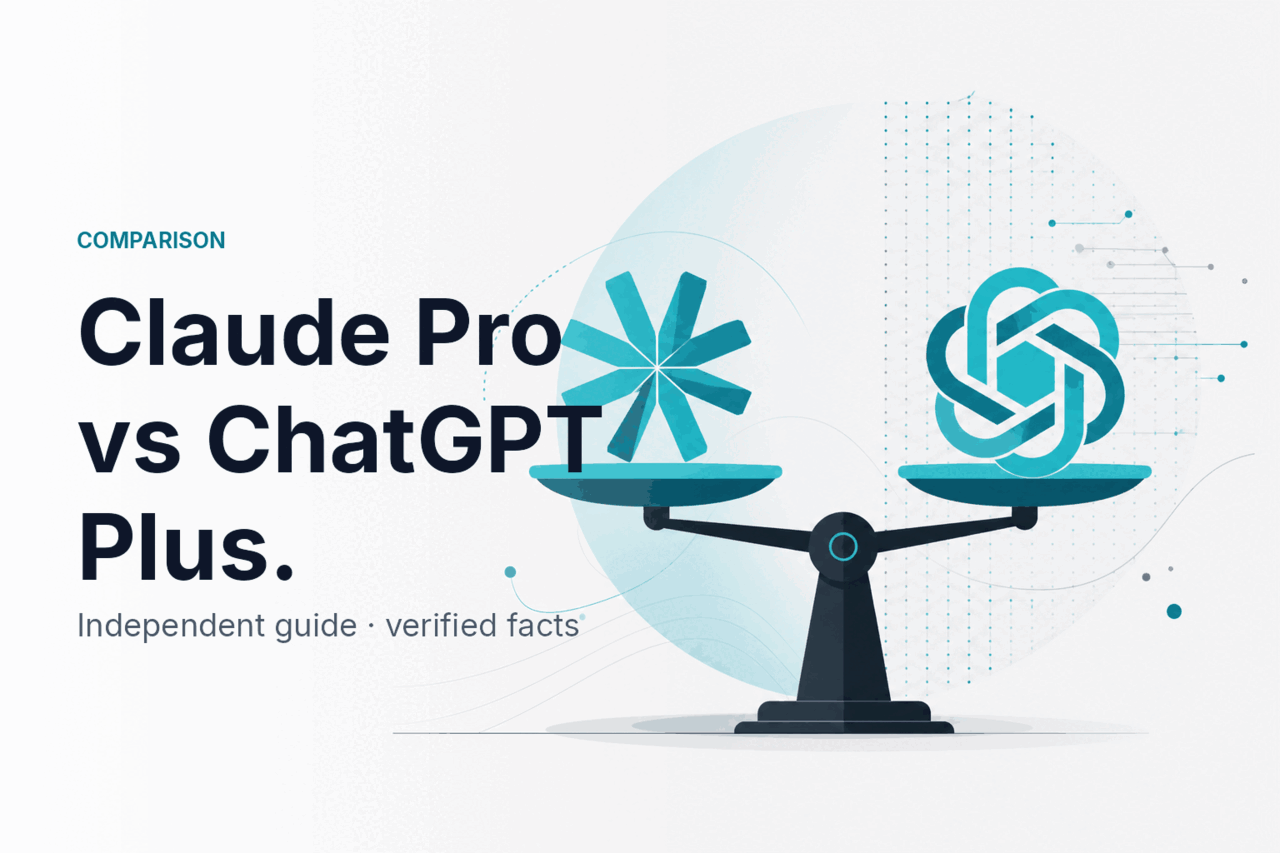
Claude Pro vs ChatGPT Plus: choose Claude Pro if your paid AI subscription needs long-document work, careful writing, code review, and Anthropic’s Claude models; choose ChatGPT Plus if you value a broader general-purpose app ecosystem, and use our independent Claude guide for Claude-specific context.
- The bottom line
- Head to head
- Where Claude is the better pick
- Where the other tool is better
- How to choose
- FAQ
- Sources
The bottom line
Claude Pro is usually the better paid plan for people who read, write, analyse, and refactor large amounts of text or code. ChatGPT Plus is often the better fit for users who want one broad consumer AI app with a large surrounding ecosystem. If you are choosing for work, start with the task, not the brand.
c-ai.chat is independent. Anthropic makes Claude, and claude.ai is the official product. For Claude plan details, check the official Claude pricing page. For developer-side model and API details, use Anthropic’s model overview and API pricing documentation.
Free
$0
Best for occasional Claude use and light testing.
Pro
$20/month
Also available at $17/month on annual billing. This is the individual plan most people compare with ChatGPT Plus.
Max
From $100/month
For heavier individual usage.
Team
From $25/seat
Team Standard is $25/seat monthly or $20/seat annual. Team Premium is $125/seat monthly or $100/seat annual.
Enterprise
$20/seat base
Enterprise adds API rates on top of the base seat price.
Head to head

The comparison depends on your daily work. A paid AI subscription is not just a model list. It is a bundle of usage limits, interface design, tools, integrations, file handling, safety behaviour, and ecosystem fit.
| Dimension | Claude Pro | ChatGPT Plus | Practical takeaway |
|---|---|---|---|
| Pricing | $20/month or $17/month annual, according to official Claude pricing. | Paid individual subscription. Check ChatGPT checkout for the current price in your region. | Claude Pro pricing is clear on the official Claude pricing page. Do not choose on price alone if your usage pattern differs. |
| Models | Anthropic’s lineup includes Claude Opus 4.7, Claude Sonnet 4.6, and Claude Haiku 4.5. Product access can vary by plan and rollout. | ChatGPT Plus gives access to OpenAI’s paid consumer model set, which can change by product rollout and region. | Claude is easier to evaluate if your priority is Anthropic’s model family. See our Claude models guide. |
| Context window | Claude Opus 4.7 and Claude Sonnet 4.6 support 1,000,000 tokens of context in the documented model lineup. Product limits can differ from API limits. | ChatGPT Plus can handle files and long chats, but practical limits vary by product state and tool path. | Claude has a clear advantage for users who routinely work with long documents, codebases, transcripts, or policy packs. |
| Coding | Claude is strong for code explanation, refactoring, test generation, and reviewing larger snippets. | ChatGPT Plus is strong for interactive coding help, prototyping, and tool-assisted developer workflows. | Choose Claude if code review and repository reasoning matter. Choose ChatGPT Plus if your existing developer workflow is already built around ChatGPT. |
| Writing | Claude is often preferred for structured, natural, restrained writing. It is good at maintaining tone across long drafts. | ChatGPT Plus is flexible for general writing, brainstorming, and varied formats. | Claude is usually the better fit for briefs, memos, policy drafts, analysis, and editing long documents. |
| Safety and refusals | Claude has a cautious safety posture. That can mean careful answers and more refusals on sensitive requests. | ChatGPT Plus also applies safety policies, but the refusal style and boundaries can feel different. | If you work in regulated or reputation-sensitive contexts, Claude’s cautious tone can help. If you need looser brainstorming, test both. |
| Ecosystem | Claude’s app experience focuses on document work, Projects, writing, coding, and model quality. Feature availability can vary by plan. | ChatGPT Plus has a broader consumer ecosystem and high user familiarity. | Claude wins on focused document and reasoning workflows. ChatGPT Plus wins when ecosystem breadth is the main value. |
For Claude-specific subscription details, see our Claude pricing guide. For product capabilities beyond pricing, our Claude features guide explains Projects, files, coding workflows, and app features in more detail.
Where Claude is the better pick
Claude Pro is strongest when the work has weight: long inputs, careful reasoning, precise wording, and a need to keep context across a project. It is less about quick novelty and more about dependable output on serious tasks.
Long-document analysis
Claude is a strong choice for contracts, research papers, board packs, call transcripts, internal policies, and dense PDFs. The benefit is not only accepting long input. It is the ability to track definitions, exceptions, dependencies, and contradictions across a large text.
A typical Claude workflow: upload a long policy document, ask for obligations by department, request a risk table, then ask Claude to draft a plain-English executive summary. ChatGPT Plus can also work with documents, but Claude is often the more natural fit when the document itself is the centre of the task.
Careful professional writing
Claude is good at rewriting without making text feel overproduced. It can tighten a memo, preserve a founder’s voice, turn notes into a structured brief, or make a sensitive email more direct without making it sound robotic.
This matters for client updates, investor notes, policy documents, launch plans, internal announcements, and editorial drafts. Claude usually follows style constraints well when you give it examples and clear rules.
Code review and refactoring
Claude’s model family is strong for explaining unfamiliar code, spotting edge cases, proposing tests, and refactoring in a controlled way. It is useful when you want a second reviewer, not just a snippet generator.
For example, paste a function, explain the intended behaviour, and ask Claude to identify hidden assumptions before changing anything. That makes it helpful for maintainers, technical founders, students, and developers working across languages they do not use every day.
Project knowledge and repeated work
Claude Projects make sense when you have recurring context: brand rules, research notes, product specs, customer interviews, or internal documentation. Instead of repeating the same background each time, you can keep related materials together and ask Claude to work within that context.
This is one of the clearest reasons to consider a paid Claude plan over occasional free use. If your work is repeated production inside a domain, Projects can save time and reduce inconsistency. Check the official pricing page for current plan access and limits.
Research synthesis
Claude can help turn source material into a structured comparison, decision memo, interview guide, or reading plan. It does not replace verification.
For high-stakes work, check source documents directly. Claude can miss context, compress nuance too far, or treat a weak source as more settled than it is. Use Claude to organise the work, then verify claims before publishing or acting on them.
Worked example
When Claude Pro clearly earns its place
Claude is strongest when the value comes from reading carefully across a large body of material.
Where the other tool is better
Claude Pro is not the automatic answer. ChatGPT Plus can be the better paid subscription when the surrounding product matters more than Claude’s strengths in writing, long context, and structured reasoning.
You already depend on ChatGPT workflows
If you already have saved prompts, shared workflows, team habits, or personal routines inside ChatGPT, switching may cost more time than it saves. The best AI subscription is often the one you will use consistently.
This is especially true for students, solo operators, and small teams who have built everyday habits around ChatGPT. If those habits work, Claude Pro needs a clear job to replace or supplement them.
You want the broadest consumer AI ecosystem
ChatGPT Plus is often stronger for people who want one broad app for many casual tasks: quick brainstorming, general Q&A, experiments, media-adjacent workflows, and community-shared patterns. Claude can do many general tasks well, but its strongest case is more focused.
If you value ecosystem breadth over document depth, ChatGPT Plus may feel more useful day to day. That can be a valid reason to choose it, even if Claude performs better on some writing and analysis tasks.
You prefer ChatGPT’s response style
Output style is subjective. Some users prefer Claude’s careful and restrained tone. Others prefer ChatGPT’s more expansive style, especially for brainstorming, ideation, and quick consumer tasks.
Do not decide from benchmarks alone. Take five real tasks from your work and run them in both tools. Compare the first answer, the follow-up behaviour, and how much editing you still need.
Your organisation has standardised on ChatGPT
Tool choice is not always individual. If your company already approves ChatGPT, trains staff on it, and manages data policies around it, that can outweigh Claude Pro’s advantages for one user.
For team or enterprise use, look beyond individual subscriptions. Claude Team Standard is $25/seat monthly or $20/seat annual. Team Premium is $125/seat monthly or $100/seat annual. Enterprise has a $20/seat base plus API rates. The right comparison may be Claude Team or Enterprise against an organisation-wide alternative, not Claude Pro against ChatGPT Plus.
How to choose
Use a task-based decision tree. Start with the work you do weekly, then choose the plan that removes the most friction. Do not choose based on a single demo or one-off benchmark.
Pick Claude Pro when
- You analyse long documents, transcripts, policies, research, or contracts.
- You need polished professional writing with a controlled tone.
- You review, refactor, or explain code.
- You use recurring project context.
- You value a cautious assistant for sensitive or reputation-heavy work.
Pick ChatGPT Plus when
- You already rely on ChatGPT workflows and do not want to rebuild them.
- You prefer a broader consumer app ecosystem.
- Your tasks are mostly short, casual, and varied.
- Your team or school already standardises on ChatGPT.
- You prefer ChatGPT’s default response style after testing both.
If you are still unsure, run a small trial with your own work. Choose three documents, two coding tasks, two writing tasks, and one research task. Ask both tools the same prompts. Score them on accuracy, usefulness, editing time, and how well they follow constraints.
List your weekly AI tasks
Separate long-document work, writing, coding, research, brainstorming, and quick Q&A. The mix matters more than the brand.
Test with real inputs
Use documents, snippets, and briefs you would actually use at work. Avoid toy prompts.
Measure editing time
The better answer is not always the longest answer. Track how much work remains after the model responds.
Check limits and privacy needs
For Claude, review official plan details at claude.com/pricing and service status at status.claude.com.
For individual users, Claude Pro is the right default if your work resembles analysis, writing, coding, and document handling. For casual general use, ChatGPT Plus may be the more familiar choice. For businesses, compare the admin, security, and data controls in Claude Team or Enterprise rather than stopping at individual plans.
If you plan to build with Claude rather than use the chat app, see our Claude API guide. API billing is separate from Claude Pro.
FAQ
These questions come up often when people compare Claude Pro vs ChatGPT Plus. The right answer depends on your actual workload.
For more common questions, see our Claude FAQ.
Independent guide. Not affiliated with Anthropic. For the official Claude product, visit claude.ai.
Last updated: 2026-05-12
This article is part of the Claude comparisons hub on c-ai.chat.