Claude app plans
- Free: $0
- Pro: $20/month or $17/month with annual billing
- Max: from $100/month
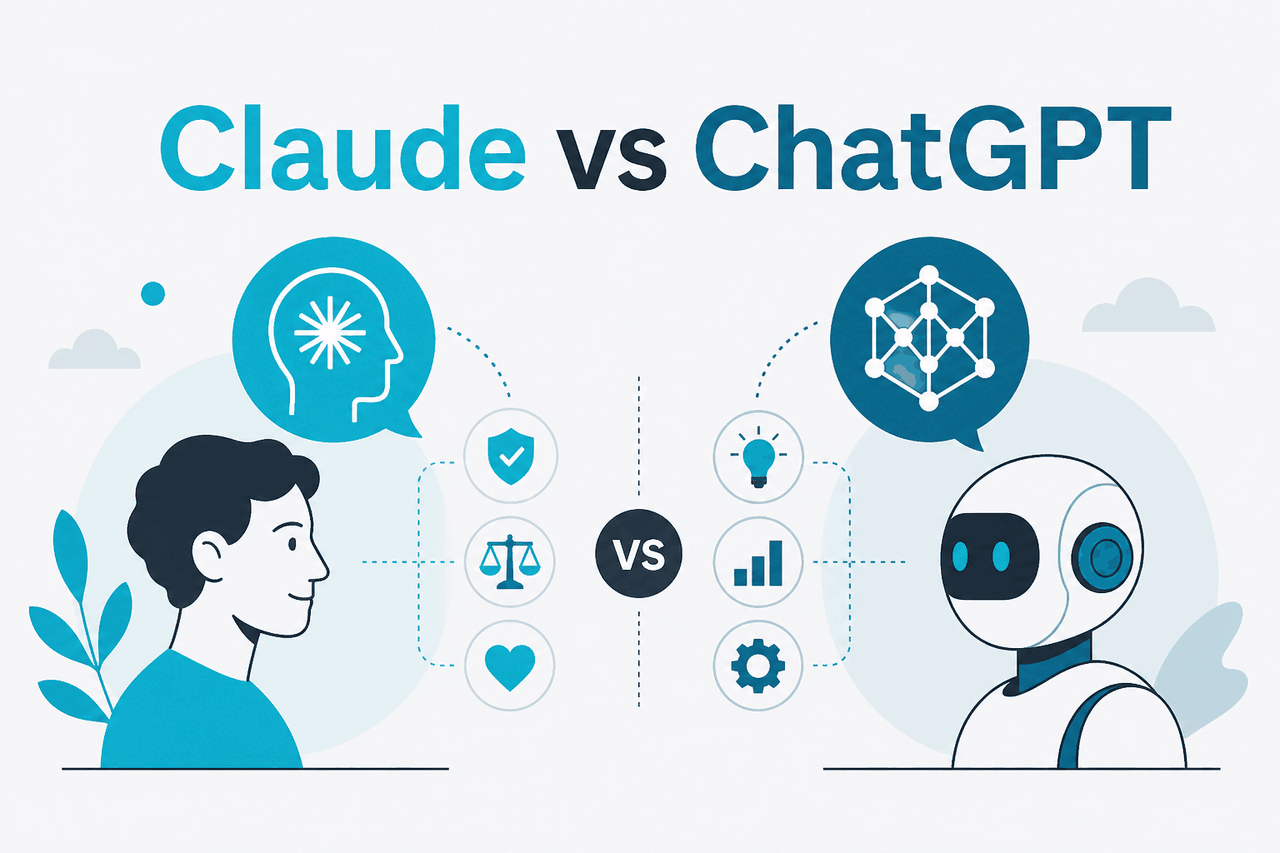
Claude vs ChatGPT: choose Claude for long-document reasoning, careful writing, code review, and professional workflows with strict instructions; choose ChatGPT for broader consumer convenience, casual multimodal tasks, and mainstream familiarity.
c-ai.chat is an independent Claude AI guide, not Anthropic; Anthropic makes Claude, and claude.ai is the official Claude product.
This page compares Claude with ChatGPT, Gemini, Grok, and open-weight alternatives so you can choose the right tool for the job.
Contents
Claude is the sensible default when your prompt is long and the answer must respect constraints. ChatGPT is the easier default for many short, casual tasks. Gemini matters when Google-native workflow is decisive. Grok matters when X context is part of the task. Open-weight models matter when control is worth the operational work.
For Claude-specific facts, check the official Claude plans page, Anthropic’s model overview, and our Claude pricing guide.
Key facts
| Question | Claude | ChatGPT | Practical answer |
|---|---|---|---|
| Best everyday fit | Professional writing, long documents, structured analysis, code review, and careful instruction following. | Broad personal assistance, quick ideation, mixed media tasks, and mainstream familiarity. | Use Claude for high-context work. Use ChatGPT when convenience and breadth matter more. |
| Writing and editing | Often strong at preserving tone, structure, and constraints across a long draft. | Strong for short drafts, creative alternatives, and casual rewriting. | For memos, policies, and client-facing drafts, test Claude first. |
| Long-context work | Opus 4.7 and Sonnet 4.6 support 1M-token context. Sonnet 4.6 supports 128K max output. | Long-file limits vary by plan and product surface. | Benchmark with your largest real document, not a synthetic prompt. |
| Coding | Strong for code review, refactoring plans, debugging explanations, and repository-style workflows. | Strong for examples, syntax help, and quick technical questions. | Use a real issue from your repository as the test. |
| Files and knowledge work | Works well when the answer depends on provided documents, transcripts, requirements, and project context. | Works well for lighter file analysis and general assistant tasks. | If the file is the task, Claude is a strong candidate. |
| Multimodal consumer use | Useful for many document and app workflows, with features varying by plan and surface. | Often the easier pick for broad consumer media workflows. | Pick ChatGPT if interface breadth matters more than long-form text quality. |
| Claude API pricing | Opus 4.7 is $5/M input and $25/M output. Sonnet 4.6 is $3/M input and $15/M output. Haiku 4.5 is $1/M input and $5/M output. | Separate pricing. Check the official product before budgeting. | Compare cost per workload, not subscription price alone. |
| Claude cost controls | Prompt caching gives 90% off cached input. Batch API gives 50% off input and output. | Separate cost controls and product terms. | Repeated long prompts can make caching more important than headline price. |
| Business use | Claude has Team and Enterprise plan surfaces, trust documentation, admin controls, and status visibility. | ChatGPT has separate business and enterprise offerings. | Compare data controls, retention, audit needs, and admin workflow. |
Claude tends to win when the work is dense and consequential: legal or policy text, long transcripts, refactoring plans, customer-support knowledge tasks, and structured drafts. Developers should also compare model tiers in our Claude models guide and implementation details in our Claude API docs guide.
ChatGPT tends to win when familiarity reduces friction. Many users already know its interface and common prompt patterns. That helps with personal tasks, quick brainstorming, lightweight media workflows, and short outputs that do not need strict review.
| Question | Claude | Gemini | Practical answer |
|---|---|---|---|
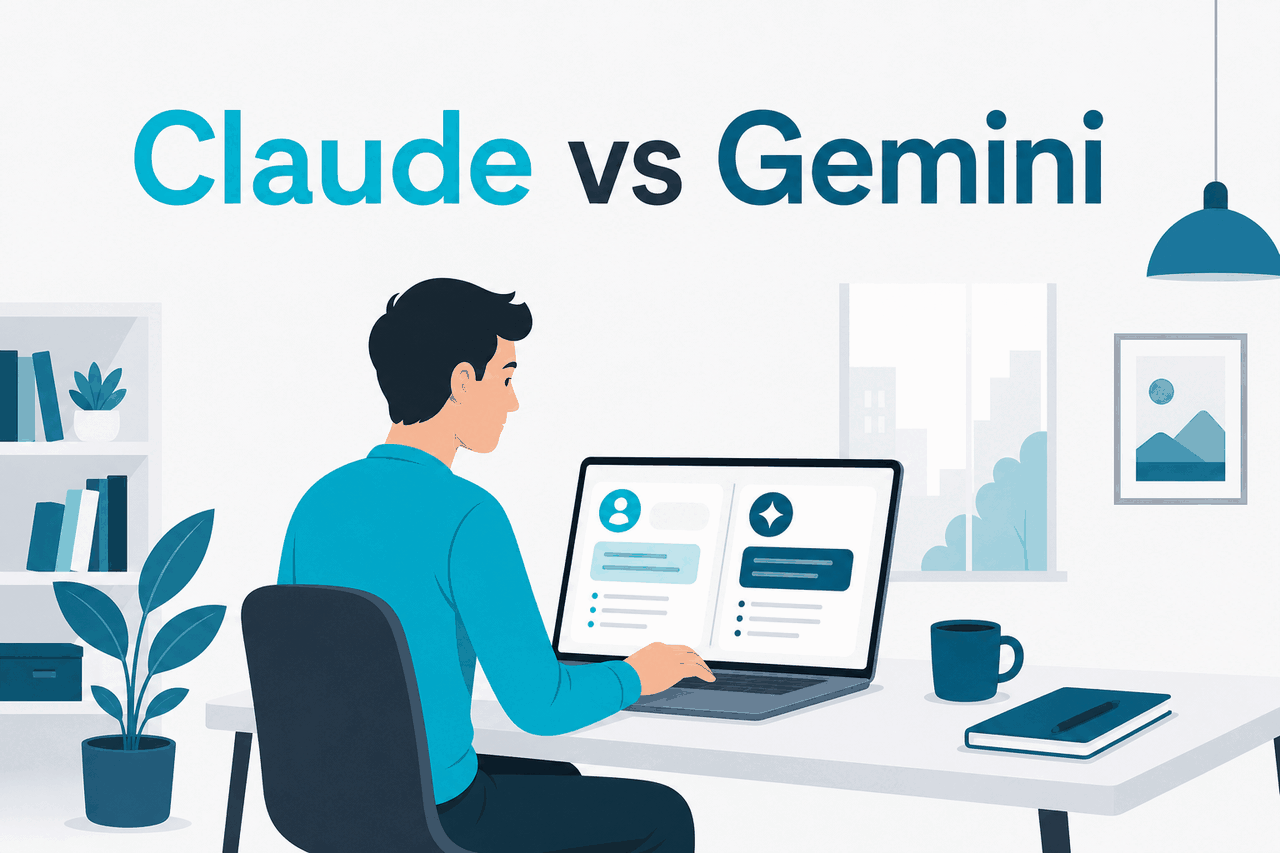
| Who is it for? | Teams that want careful writing, reasoning, coding support, and a model not tied to one productivity suite. | Teams already centered on Google apps, Google accounts, Android, Search, or Google Cloud. | Gemini’s main advantage is ecosystem fit. Claude’s advantage is text-heavy professional work. |
| Google Workspace fit | Useful for drafts, analysis, and document review, but not Google’s native assistant. | Natural fit when the buyer wants a Google-first assistant. | If the work starts and ends inside Google tools, test Gemini carefully. |
| Writing quality | Often good for structured, restrained, professional prose and long-form editing. | Useful for drafts and assistance inside Google-centered workflows. | Compare final drafts, not first impressions. |
| Long-context work | Claude’s large-context model options make it a strong candidate for document packs. | Also associated with large-context workflows, especially inside Google’s ecosystem. | Test with messy real files. Context size alone does not decide quality. |
| Research and facts | Feature access depends on plan, product surface, and tools available in the session. | Compelling when the task is tied to Google search-adjacent workflows. | Verify important claims against primary documents in either product. |
| Coding | Strong for code reasoning, architectural review, and repository-style work. | Worth testing for Google Cloud and Android-centered development. | Use repo-level tasks, not only syntax questions. |
| Administration | Offers Free, Pro, Max, Team, and Enterprise plan surfaces with different controls and usage limits. | May fit existing Google identity, procurement, and admin patterns. | The better model can still lose if admin fit is poor. |
Gemini’s clearest case is ecosystem fit. If your organization already runs on Gmail, Docs, Sheets, Drive, Google Cloud, Android, and Google identity, Gemini may be easier to roll out. Adoption matters. People use assistants more often when the tool sits where work already happens.
Claude’s case is behavior under constraint. It is a strong candidate for a long memo, a codebase review, a policy comparison, or a structured document that must keep a consistent tone. Check our Claude features guide, then test Gemini and Claude on the same work sample.
| Question | Claude | Grok | Practical answer |
|---|---|---|---|
| Who is it for? | Professionals who want careful writing, long-context reasoning, code review, and a restrained assistant style. | Users who want an assistant closely associated with X and public conversation on that platform. | Claude is the professional-work pick. Grok is the X-context pick. |
| Current conversation | Useful when paired with the right product features, tools, or provided documents. | Attractive when X-centered discussion, social context, or public narrative is the task. | For current events, verify against primary reporting and official documents. |
| Tone | Usually more controlled, formal, and policy-aware. | Often positioned as more informal and personality-forward. | Use Claude for board, legal, policy, and client work. |
| Documents | Strong candidate for long documents, contracts, transcripts, specifications, and structured drafts. | Less obvious as the default for careful document production. | If the task ends in a serious document, test Claude first. |
| Coding | Good fit for code review, planning, and repository-style workflows. | May be useful for general programming help, depending on access and model behavior. | Use a repository task as the benchmark. |
| Business confidence | Anthropic publishes trust resources, plan details, API documentation, and a public status page. | Evaluate enterprise documentation separately. | Governance matters as much as model quality. |
Grok’s reason to be in the comparison set is X. If your work depends on fast-moving public conversation, creator commentary, political narrative, or brand sentiment on X, Grok may deserve a test. Judge it on accuracy, source quality, tone control, and whether it can produce a useful deliverable without adding noise.
Claude is easier to recommend when the output has to look like serious work: vendor analysis, customer letters, legal summaries, internal policies, code review notes, and executive briefings. Buyers can also check the Anthropic Trust Center and Claude status page.
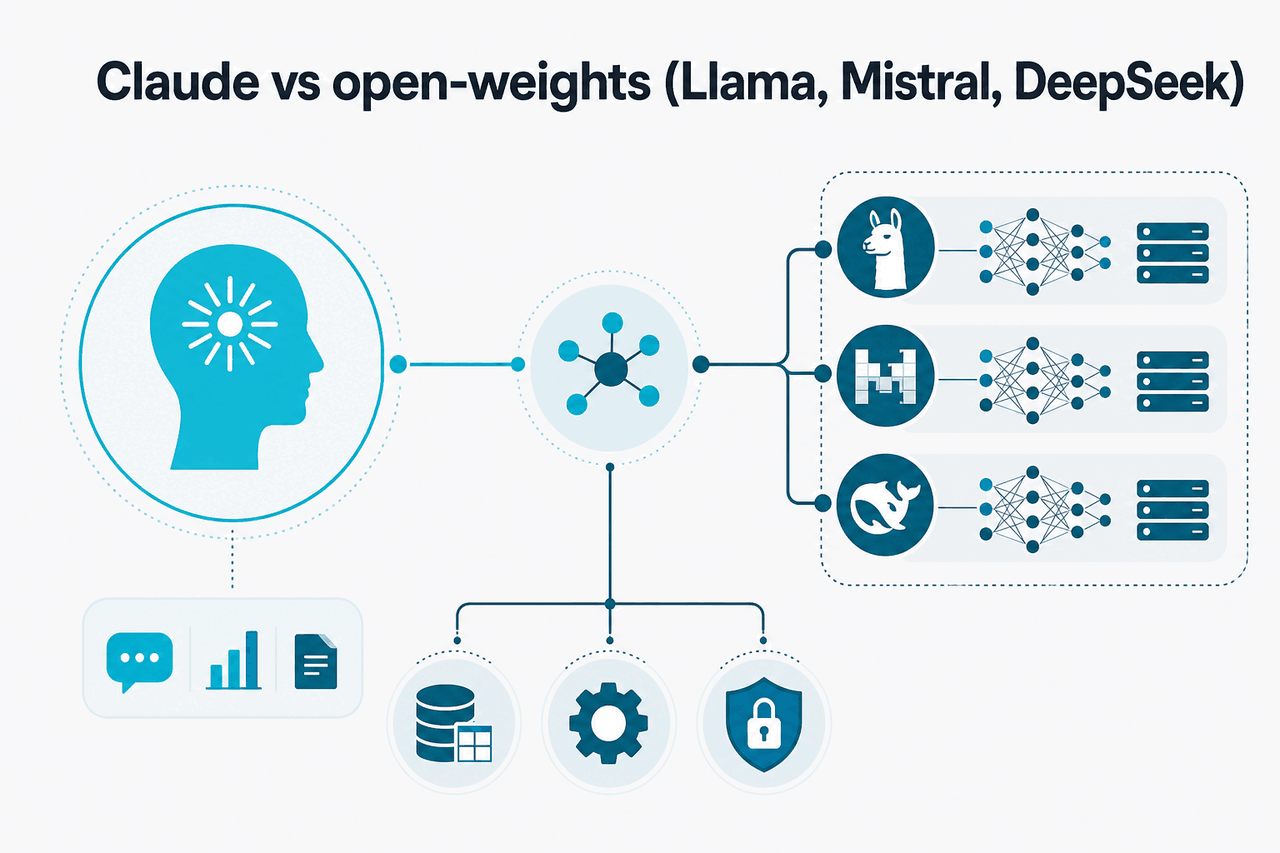
Claude is a closed, hosted model family. You do not download the weights or run them on your own hardware. In exchange, you get managed access, documented model options, hosted scaling, and Anthropic’s safety and trust posture. That suits teams that want to build with a model rather than operate model infrastructure.
Open-weight models such as Llama, Mistral, and DeepSeek shift the trade-off. The more accurate label is open-weight, not automatically open-source, because licenses and usage rights differ. These models can be the right choice when you need local deployment, custom fine-tuning, offline operation, weight-level control, or direct infrastructure control.
They also add work: GPU planning, quantization, serving, monitoring, security patches, evaluation, routing, and license review. Open-weight models are not automatically cheaper once engineering time and infrastructure are counted. If you are building with Claude instead, start with our Claude resources and Anthropic’s official API pricing page.
Choose by constraint, not by brand preference. A founder writing investor updates has different needs from a developer reviewing a repository, a marketer rewriting campaign copy, a student studying from lecture notes, or an enterprise buyer checking audit controls.
Example benchmark
Give every assistant the same files and this prompt:
Prompt: “Read the attached policy, mark contradictions, rewrite section 3 in the company’s tone, list risks, and return valid JSON with summary, edits, and open_questions fields.”
Score the first answer before you clarify. Then score the revised answer after one follow-up.
Write down the real output you need: a contract summary, product spec, Python refactor, sales email, spreadsheet explanation, or research brief.
Include constraints, edge cases, style rules, and files. Claude often shows value when the prompt is long and the model must read carefully.
Use simple labels such as pass, minor edit, and unsafe fail. Fluency should not beat accuracy.
Pick Gemini if Google-native workflow is decisive. Pick ChatGPT if broad consumer convenience is decisive. Pick Grok if X context is decisive. Pick Claude when document quality and coding discipline matter most.
For Claude API work, estimate input tokens, output tokens, repeated prompts, and batchable jobs. Prompt caching can cut cached input cost by 90%, and Batch API can cut input and output cost by 50%.
For business use, check admin controls, identity, retention, audit needs, regional requirements, and support paths.
Many teams should use more than one model. Claude can be the default for long-form and code work while another assistant handles media-heavy, Google-native, X-centered, or self-hosted workloads.
Neither Claude nor ChatGPT is universally better. Claude wins when you care about long context, disciplined prose, code review, and professional output under constraints. ChatGPT wins convenience for many casual workflows. Gemini wins when Google fit is the main requirement. Grok wins when X context is the job. Open-weight models win when control and self-hosting are requirements.
Run your own evaluation with a real file, a real code task, and a real policy constraint. If a model cannot follow your highest-risk instruction set reliably, do not use it there.
Claude is better for many long-document, structured writing, code review, and careful reasoning tasks. ChatGPT is better for many broad consumer workflows where speed, familiarity, and mixed media convenience matter more. Test both with your real prompts.
Claude is a strong coding assistant, especially for code review, refactoring plans, debugging explanations, and repository-style work. ChatGPT is also useful for syntax help, examples, and broad programming questions. Judge both on a real issue from your repository.
It depends on whether you mean app subscriptions or API usage. Claude API rates are Opus 4.7 at $5/M input and $25/M output, Sonnet 4.6 at $3/M input and $15/M output, and Haiku 4.5 at $1/M input and $5/M output. Claude app plans are Free at $0, Pro at $20/month or $17/month with annual billing, Max from $100/month, Team Standard at $25/seat/month or $20/seat/month with annual billing, Team Premium at $125/seat/month or $100/seat/month with annual billing, and Enterprise at $20/seat base + API rates.
Claude can use live research or web-connected features only when the relevant plan, product surface, or configured tool provides them. API developers can connect tools that they control. If current facts matter, confirm the tool is active and verify key claims against primary documents.
Anthropic puts visible emphasis on safety, policy, and trust documentation. That does not mean Claude is always correct or always the safest choice for every use case. Claude can still make mistakes, misunderstand instructions, or produce output that needs human review. For regulated work, compare provider documentation, retention settings, admin controls, audit needs, and your own risk policy.
A Google Workspace team should test Gemini first if native Google integration is the main requirement. The same team should still test Claude for long documents, careful drafting, policy review, code review, and analysis that is not dependent on a Google-native workflow. A mixed setup may be the best fit.
Use Claude API when you want a managed model with documented pricing, model options, large-context capability, and less infrastructure work. Use an open-weight model when you need local deployment, custom fine-tuning, offline operation, weight-level control, or a hosting setup that you fully manage.
Grok may be a better candidate when the task depends on X-centered conversation or social context. That does not make it the better model for professional writing, code review, or document analysis. For current events, ask for sources, check primary documents, and separate social sentiment from confirmed facts.
Independent guide. Not affiliated with Anthropic. For the official Claude product, visit claude.ai.
Hand-picked from the cluster — the pages we recommend first.