
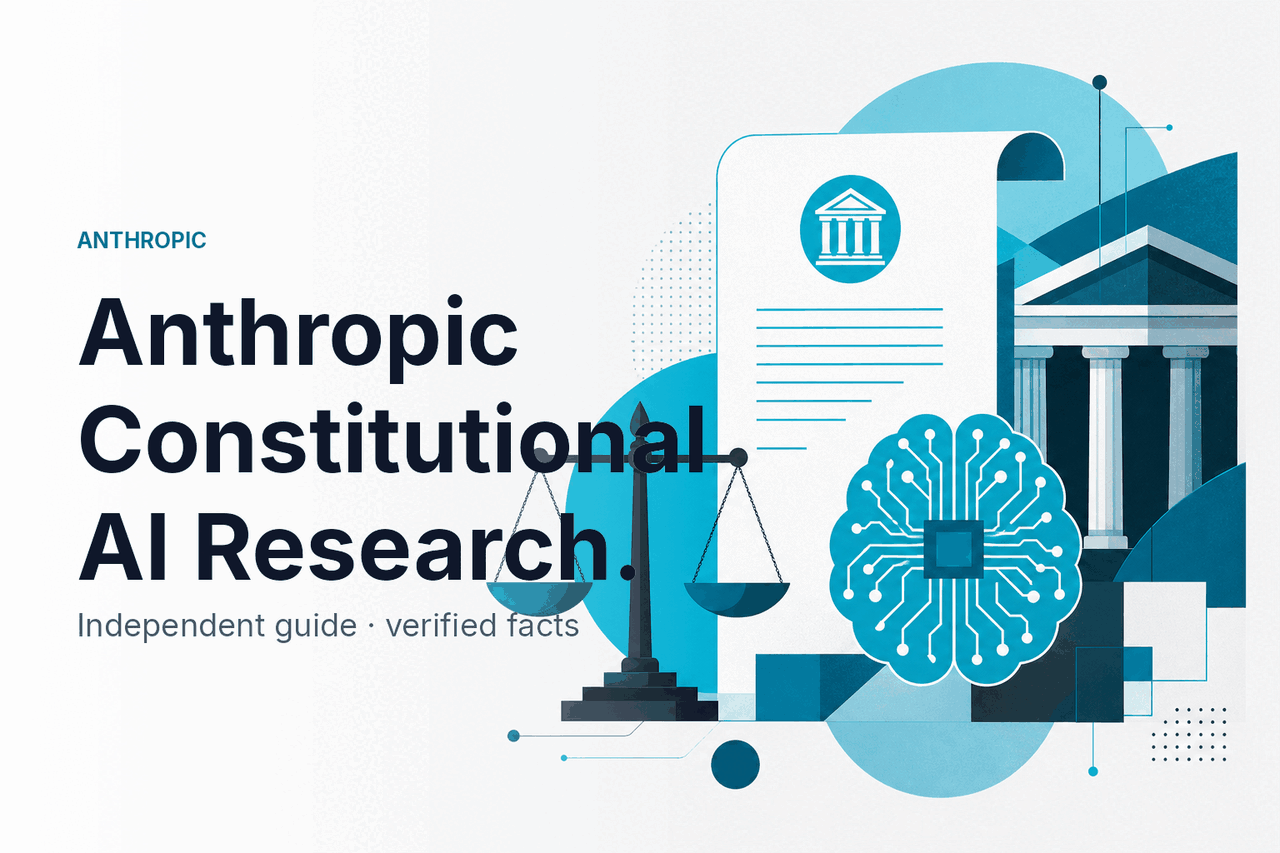
Constitutional AI research is Anthropic’s method for training and aligning AI systems with a written set of principles, using self-critique and model-generated feedback instead of relying only on human labelers; this page explains what that means, why Anthropic built it, and how it connects to Claude as covered across our Anthropic guide.
- The short answer
- What Anthropic actually is
- People and leadership
- Products and revenue
- Other questions readers ask
- The honest take
The short answer
Anthropic’s constitutional AI research is a safety and alignment approach where a model is trained to follow a written “constitution” of rules and values, then revise and improve its own outputs against those principles. Anthropic presented the method publicly in its research and later applied related ideas to Claude, which is why the topic sits at the center of many questions about what Claude AI is and how Anthropic differs from other AI labs.
- Founded in 2021
- Founders include Dario Amodei and Daniela Amodei
- HQ in San Francisco
- Funding backed by major strategic and venture investors
The key idea is simple: instead of teaching an AI assistant only by collecting large amounts of human preference data, Anthropic also gives the model a set of explicit principles to critique and refine its own answers. In practice, that means the system can learn to be more helpful, honest, and less harmful by checking its responses against those rules during training. Anthropic describes the wider company mission, research direction, and product work on anthropic.com.
What Anthropic actually is
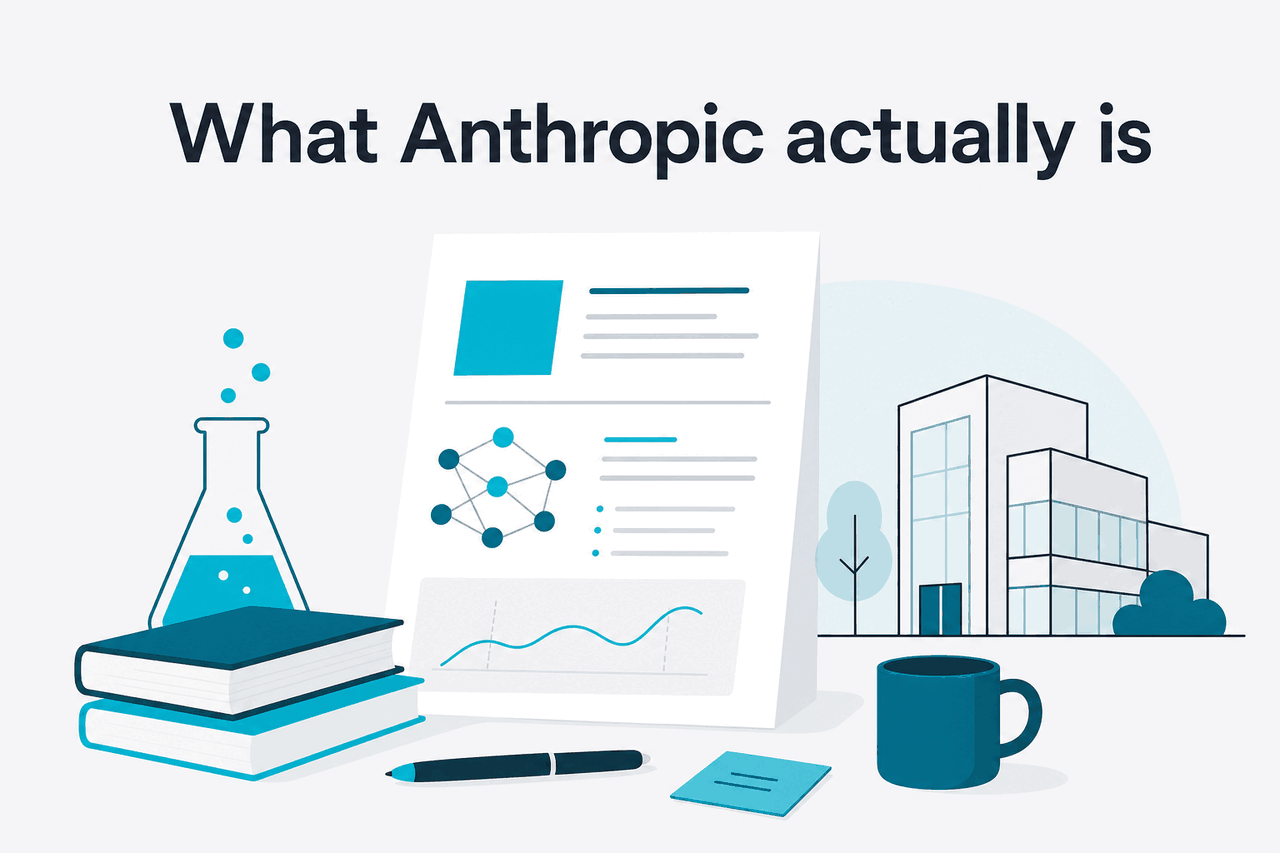
Anthropic is an AI company focused on building large language models, AI assistants, developer tools, and safety research. The company is best known for Claude, its main assistant product, but its public identity has always been tied closely to AI alignment and reliability research rather than consumer software alone. On its official site and newsroom, Anthropic presents itself as a public-benefit corporation working on frontier AI systems with an emphasis on safety, interpretability, and responsible deployment.
That background matters when people search for constitutional AI research. The phrase is not a side project or a random paper title. It reflects one of the ideas most associated with Anthropic’s early research agenda: using a written constitution to guide model behavior, then scaling that method into practical training workflows. Anthropic’s news and research updates on anthropic.com/news show how the company has moved from publishing alignment work to shipping Claude across web, mobile, desktop, and API products. If you want the product view rather than the company view, the official assistant lives at claude.ai.
Anthropic is not just “the company behind Claude.” It is also one of the main organisations that pushed constitutional AI into mainstream discussion about model alignment.
For readers trying to place this topic, it helps to separate three layers. First, Anthropic is the company. Second, Claude is the product family. Third, constitutional AI is a research and training approach associated with how Anthropic thinks about alignment. Our independent Claude guide covers the product ecosystem, while this page focuses on the research idea and the company context around it.
People and leadership
Anthropic’s public profile is closely tied to a small group of founders and executives who are visible in research, strategy, and product discussions. For most readers, four names matter most.
- Dario Amodei — Co-founder and CEO. He is the best-known public voice on Anthropic’s research direction, scaling strategy, and AI safety position. He has written and spoken extensively about frontier model risks, interpretability, and responsible deployment.
- Daniela Amodei — Co-founder and President. She has played a central role in company operations, policy-facing work, and the translation of research priorities into an operating business.
- Jack Clark — Co-founder and policy-focused leader widely known from AI policy and industry analysis. He has been one of Anthropic’s most visible communicators on governance, research framing, and the broader AI landscape.
- Tom Brown — Co-founder and research leader associated with large model development and the technical work behind Anthropic’s systems.
These short bios matter because constitutional AI research did not emerge in isolation. It came from a leadership group that framed alignment as a first-order design problem, not a compliance layer added after model training. That is one reason Anthropic is often discussed differently from companies whose public brand is driven mainly by app features or consumer growth.
Why leadership matters here
- Founders are publicly associated with alignment research
- Company messaging consistently links safety to product design
- Research ideas like constitutional AI shaped the Claude brand
What not to overstate
- Constitutional AI is not the only method Anthropic uses
- Public bios do not explain every internal training detail
- Leadership visibility does not replace technical documentation
If you are tracking ongoing company announcements, our Claude and Anthropic news section is the best place to follow updates without relying only on scattered headlines.
Products and revenue
Anthropic sells both end-user software and developer infrastructure. That mix is important because constitutional AI research is not just an academic brand asset; it supports a commercial stack that includes consumer subscriptions, workplace plans, and API usage.
- Claude consumer app — The main assistant experience on web, iOS, Android, and desktop through claude.ai and related official apps.
- Claude API — Paid model access for developers and businesses through platform.claude.com.
- Claude Code — Anthropic’s coding-focused workflow and tooling for users who want Claude integrated more directly into software work.
- Cowork — Collaboration-oriented features included in paid Claude plans for users who want more structured assistance inside ongoing tasks.
- Skills — Reusable capabilities and workflow features that extend Claude in more task-specific ways.
On the consumer side, Anthropic offers Free, Pro, Max, Team, and Enterprise options on claude.com/pricing. On the developer side, model access is priced per million tokens. Current public pricing lists Claude Opus 4.7 at $5/M input and $25/M output, Claude Sonnet 4.6 at $3/M input and $15/M output, and Claude Haiku 4.5 at $1/M input and $5/M output. Anthropic also documents cost controls such as prompt caching and Batch API discounts in the official pricing docs.
| Product area | Who it serves | How Anthropic charges | Why it matters for constitutional AI |
|---|---|---|---|
| Claude Free / Pro / Max | Individuals and power users | Subscription | Turns alignment research into a user-facing assistant experience |
| Team / Enterprise | Businesses and organisations | Per seat, with enterprise arrangements | Makes safety and control features part of workplace adoption |
| Claude API | Developers and product teams | Per million input/output tokens | Commercialises model capabilities directly |
| Claude Code / Cowork / Skills | Advanced users and teams | Included in paid plans or bundled by plan level | Shows how research ideas become practical workflow tools |
90% off
cached input tokens with prompt caching
Anthropic is private, so exact revenue is not reported in the same way as a public company’s filings. Still, the scale is clearly beyond the research-lab stage: it has major enterprise customers, paid developer usage, and a full commercial pricing structure. When you see constitutional AI discussed, it is best understood as part of a research-to-product pipeline, not a paper disconnected from revenue.
If your question is more practical than historical, our Claude FAQ covers common user issues, while the official platform documentation at platform.claude.com covers current model and API details.
Other questions readers ask
Searchers looking for constitutional AI research usually want one of a few adjacent answers. Here are the short versions.
A practical way to read this topic is: constitutional AI explains part of Anthropic’s philosophy, Claude shows how that philosophy reached users, and the company’s pricing and platform pages show how it became a business. Those are related, but they are not interchangeable.
The honest take
Anthropic’s constitutional AI research matters because it gave a clear, memorable name to one approach for aligning assistant behavior with explicit principles. That does not mean every Claude response can be reduced to a single paper or training trick, and it does not mean Anthropic has solved AI safety. But if you want to understand why Anthropic is discussed differently from many other AI companies, constitutional AI is one of the first concepts worth learning.
The plain answer is that Anthropic is a commercial AI company with a strong research identity, and constitutional AI is one of the ideas that helped define that identity. If you want the product itself, go to the official Claude site. If you want context, comparisons, and plain-English explanations, keep exploring c-ai.chat’s independent coverage.
Independent guide. Not affiliated with Anthropic. For the official Claude product, visit claude.ai.
Last updated: 2026-05-12