
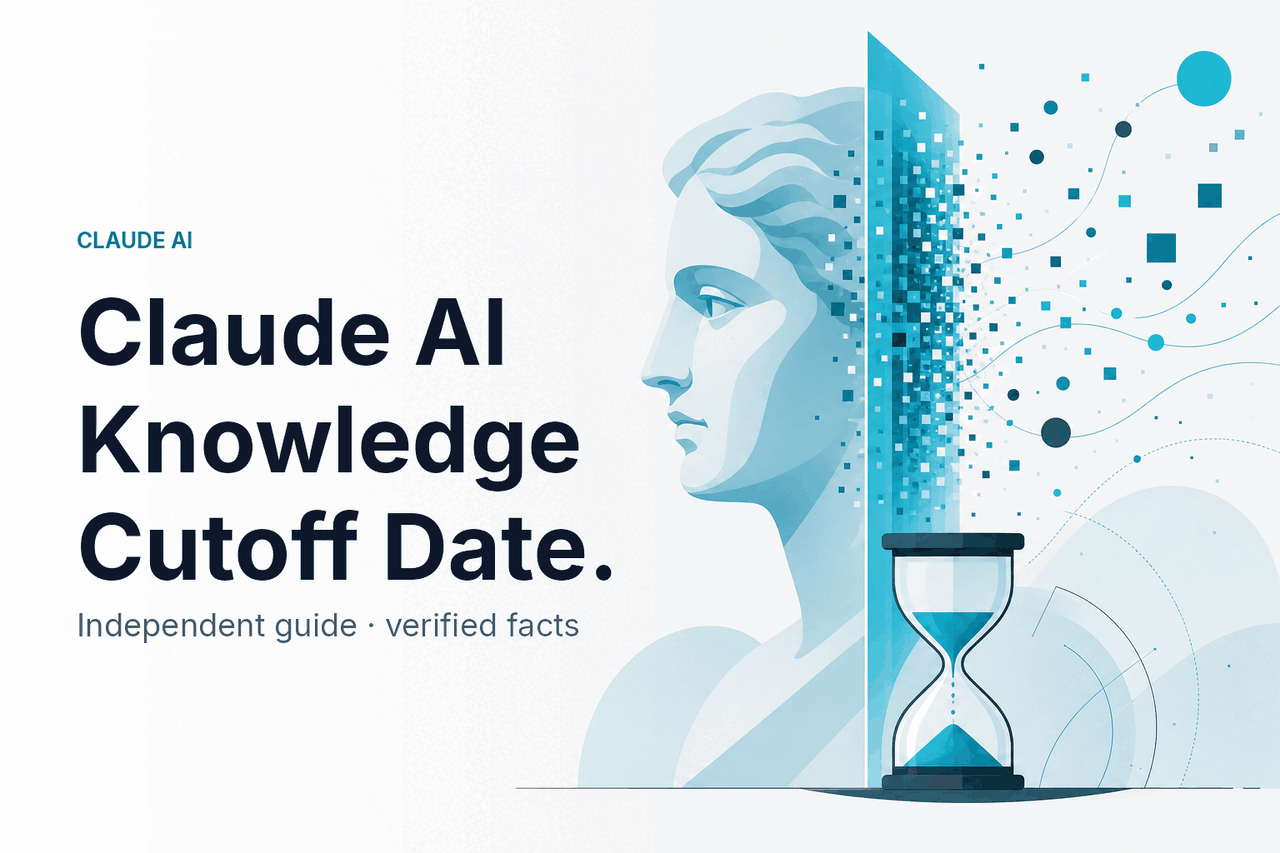
Claude knowledge cutoff is the point after which Claude’s built-in training knowledge may not include newer facts, but the exact cutoff can vary by model and Anthropic does not always present it as a single fixed date on public model pages. This independent guide explains what that means, how to check Claude’s current capabilities, and when the cutoff matters in real use; if you want a broader overview first, see what Claude AI is.
- The short answer
- The full story
- What this means in practice
- Other questions readers ask
- The honest take
The short answer

Claude knowledge cutoff usually means the latest point in time covered by a model’s built-in knowledge before live web retrieval or uploaded documents are needed, and the safest answer is that you should not assume Claude knows current events unless the specific product feature you are using can fetch fresh information.
- Not always a single public date for every Claude model
- Model knowledge is different from live web access
- Projects and file uploads can add newer context
- Check official model docs before relying on recency
That distinction matters because people often search for “claude knowledge cutoff” when they really want to know one of three things: whether Claude can answer questions about recent news, whether it will know a newly released tool or law, or whether a dated answer means the model is wrong. In practice, those are slightly different issues.
The full story
Anthropic publishes official information about Claude models, pricing, and platform behaviour on Platform Claude model overview, platform pricing docs, and Claude plan pages. Those pages clearly describe model families, context windows, and pricing, but they do not always give searchers a neat, permanent “knowledge cutoff date” label in the way some people expect. That is why the query is common and the answer is often muddled.
A Claude model has built-in knowledge from training, but that is only one source of information. Depending on the product and plan, Claude may also work from your prompt, uploaded files, project context, connected tools, or retrieval features. So when someone asks for the Claude knowledge cutoff, the right follow-up question is: are you asking about the base model’s training knowledge, or are you asking whether Claude can access newer information while answering?
This is also why the answer can differ between using Claude on claude.ai and using Claude through the API on platform.claude.com. The model itself may have a fixed training horizon, but the application around it can supply more recent context. If you are comparing product options, our Claude features guide and Anthropic overview help place that in context.
Another common source of confusion is that users may see Claude answer recent questions correctly even without knowing whether the model itself was trained on that information. That can happen if the answer comes from material you provided, from connected tools, or from retrieval inside the product experience. It does not automatically prove the underlying model has a later training cutoff.
The practical rule: treat Claude’s built-in knowledge as historical up to an unspecified point unless Anthropic documents otherwise for the model and product you are using.
For developers, the official model overview is the best place to verify the current model lineup and deployment options. Anthropic currently lists active families including Claude Opus 4.7, Claude Sonnet 4.6, and Claude Haiku 4.5, with API pricing on a per-million-token basis and long-context support documented on the official platform pages. Those details matter because newer models may be better at using provided context, even when the underlying knowledge cutoff question remains separate from raw model quality.
What this means in practice

If you use Claude for writing, coding, analysis, or study help, the knowledge cutoff only matters when the task depends on very recent facts. For evergreen work such as drafting emails, summarising documents, explaining established concepts, or reviewing code you provide, the cutoff is usually not the main issue. The bigger factor is whether you give Claude the exact source material it should work from.
If your task depends on fresh information, do not rely on memory alone. Give Claude the current document, article text, policy, dataset, or notes you want it to use. That approach is often more reliable than assuming any chatbot “knows” the latest change. If you are still deciding whether Claude fits your workflow, the homepage c-ai.chat guide and our Claude FAQ cover the basics without vendor spin.
Pick when
- You can provide the latest document or source text
- You need strong reasoning over long context
- Your work is mostly evergreen rather than news-driven
- You want a model that can use large supplied context well
Skip when
- You need guaranteed real-time awareness without supplying sources
- Your workflow depends on live facts every time
- You are treating chatbot memory as an authoritative current database
- You cannot verify time-sensitive answers independently
For many users, the takeaway is simple: Claude is often strongest when you use it as a reasoning engine over current material you provide, not as a standalone source for breaking developments. That is a limitation, but also a workable pattern. In many professional workflows, uploading the current file is better than relying on any model’s built-in timeline.
Other questions readers ask
Those questions all point to the same pattern: “knowledge cutoff” is useful shorthand, but it is not the whole story. The better question is whether Claude has access to the information you need for this task right now.
The honest take
The honest answer on claude knowledge cutoff is that you should treat it as a real limitation, but not always a deal-breaker. Claude does not become useless because its built-in knowledge stops at some point in time. It becomes less reliable for unsourced, recent-facts questions. For writing, analysis, coding, and document work with current inputs supplied, that is often manageable.
If your work depends on fresh information, use Claude with current documents, retrieval, or official source text. If your work is mostly evergreen, the exact cutoff date may matter far less than model quality, context handling, and the workflow around it. For the official product, try Claude directly below.
Independent guide. Not affiliated with Anthropic. For the official Claude product, visit claude.ai.
Last updated: 2026-05-12