
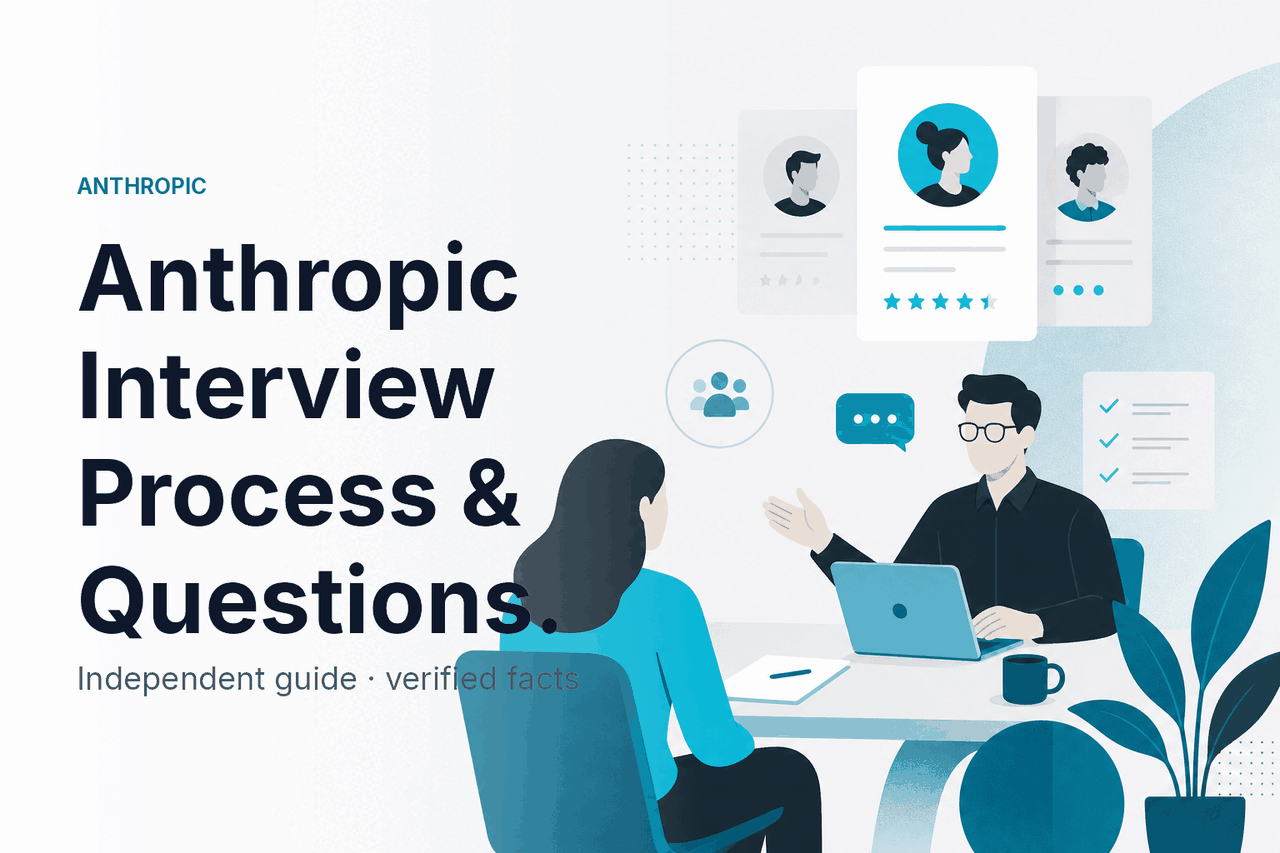
The Anthropic interview process usually includes a recruiter screen, role-specific technical or work-sample rounds, collaboration interviews, and final team conversations; c-ai.chat is an independent Claude guide, not Anthropic, and our main Claude AI guide explains the wider ecosystem behind the company.
Use this page as a practical company briefing. It explains what Anthropic is, who leads it, what it sells, and how that context can help candidates prepare without relying on rumours or generic AI talking points.
- The short answer
- What Anthropic actually is
- People and leadership
- Products, pricing, and revenue context
- How to prepare for Anthropic interviews
- The honest take
- FAQ
- Sources
The short answer
Anthropic makes Claude, and its interviews tend to test the same themes the company discusses publicly: strong craft, careful reasoning, user trust, AI safety, and practical judgment under uncertainty.
- Company: Anthropic, the maker of Claude.
- Product: Claude is available through the official app, developer API, and business plans.
- Founders: Dario Amodei, Daniela Amodei, and colleagues, including former OpenAI employees.
- Headquarters: San Francisco, with distributed teams.
- Major backers: Publicly disclosed investors include Amazon and Google.
If you are preparing for an Anthropic interview, do not only rehearse generic AI questions. Learn the company’s public safety position. Use Claude yourself. Understand the difference between Anthropic, Claude models, the Claude app, and the API. Be ready to explain trade-offs.
The official hiring source is Anthropic’s careers site. This guide is independent. We do not represent Anthropic, and we cannot confirm a specific recruiter’s process for a specific role.
| Interview area | What it may test | How to prepare |
|---|---|---|
| Recruiter screen | Role fit, motivation, basic experience | Know why Anthropic, why Claude, and why this team |
| Technical or work-sample round | Practical skill in the job function | Practise realistic tasks, not trivia |
| Research or product discussion | Judgment, trade-offs, clarity | State assumptions, risks, and evidence clearly |
| Values and collaboration interview | How you work with others | Use specific examples from past projects |
| Final conversations | Team match and operating style | Ask direct questions about scope, feedback, and expectations |
What Anthropic actually is
Anthropic is an AI research and product company best known for Claude, a family of large language models available through the official Claude product, supported apps, and developer APIs. The company describes its mission as building reliable, interpretable, and steerable AI systems.
For candidates, that mission matters because many interview answers should connect the work to safety, reliability, deployment quality, user trust, and long-term risk. A strong candidate can discuss capability and limits in the same answer.
Anthropic’s public updates on anthropic.com/news cover model launches, safety research, enterprise partnerships, policy work, and product releases. For independent background, compare those updates with our guides to Claude features, models, and API basics.
You do not need to agree with every public position to interview well. You should understand the vocabulary and discuss practical implications. For example: when should a model refuse a request, when should a product slow down a launch, and what evidence would justify more access?
People and leadership
Dario Amodei is Anthropic’s chief executive and one of its co-founders. His public profile is closely tied to AI safety, scaling research, and policy discussions around advanced AI systems. For interview preparation, the point is not biography. It is how Anthropic’s leadership talks about risk, capability, and deployment discipline.
Daniela Amodei is Anthropic’s president and a co-founder. She is publicly associated with the company’s operational growth, hiring, partnerships, and go-to-market work. Candidates in operations, finance, people, sales, policy, product, and support roles should understand that Anthropic is both a research lab and a commercial organisation.
Other visible leaders include Jared Kaplan, a co-founder and chief science officer, and Mike Krieger, chief product officer. Kaplan is associated with research direction and model development. Krieger is associated with Claude’s product experience and user-facing development.
What to study before interviews
- Anthropic’s mission and safety framing
- Claude’s product surfaces and model lineup
- The role’s team, customers, and constraints
- Examples of trade-offs you have made in past work
What not to rely on
- Memorised founder facts with no job connection
- Generic claims that AI will change everything
- Claims about unreleased Claude features
- Assuming every role has the same interview loop
Translate leadership themes into the job. A research candidate might discuss evaluation design. A product manager might discuss launch criteria and user trust. A marketer might discuss how to explain Claude without overstating it. A sales candidate might discuss enterprise adoption, security review, and procurement friction.
Products, pricing, and revenue context
Anthropic sells access to Claude across consumer, developer, and business channels. That mix matters in interviews because the company hires for research, infrastructure, product, design, security, sales, support, policy, finance, and operations.
- Claude app: The official product at claude.ai gives users a direct way to work with Claude.
- Claude API: Developers use platform.claude.com to build Claude into applications, agents, internal tools, and customer-facing software.
- Claude Code: Anthropic’s coding product helps developers work with codebases from the terminal and related development environments.
- Business plans: Team and Enterprise plans support workplace use, administration, and organisational deployment.
For plan details, use Anthropic’s official pricing pages first, then compare with our independent Claude pricing guide. Published plan prices are:
Free
$0
For individuals starting with Claude.
Pro
$20/month
$17/month with annual billing.
Max
From $100/month
For heavier individual use.
Team Standard
$25/seat/month
$20/seat/month with annual billing.
Team Premium
$125/seat/month
$100/seat/month with annual billing.
Enterprise
$20/seat base
Plus API rates.
For API roles, know the model lineup and the basic economics. Anthropic publishes current API prices in its official pricing documentation.
| Model | Input price | Output price | Context and output facts |
|---|---|---|---|
| Claude Opus 4.7 | $5 per million tokens | $25 per million tokens | 1M context |
| Claude Sonnet 4.6 | $3 per million tokens | $15 per million tokens | 1M context; 128K max output |
| Claude Haiku 4.5 | $1 per million tokens | $5 per million tokens | Fast, lower-cost model in the lineup |
Prompt caching gives a 90% discount on cached input. Batch API usage gives a 50% discount in both directions. These details matter for engineering, product, finance, and sales roles because they shape customer architecture and cost discussions.
Anthropic is privately held, so it does not provide the same public revenue detail as a listed company. Public materials still show the business model clearly: consumer subscriptions, team and enterprise plans, API usage, and strategic partnerships. The useful candidate takeaway is simple: Anthropic’s business depends on frontier model capability and reliable delivery to real users.
How to prepare for Anthropic interviews
Prepare for the role first, then add Anthropic context. The company does not appear to use one public interview script for every candidate. The loop can vary by function, level, location, and team.
Preparation priority
- If you have one day: Read the job description, use Claude, review Anthropic’s mission, and prepare two strong work examples.
- If you have one week: Add role-specific practice, review Claude pricing and models, and prepare questions about team scope.
- If you have more time: Study Anthropic’s research and product announcements, then practise explaining trade-offs in plain English.
Map the role to Anthropic’s business
Write down how the role supports Claude, the API, enterprise customers, safety, infrastructure, or operations.
Prepare two technical stories
Choose examples where you solved a hard problem, changed your mind, or handled constraints. Use concrete details.
Prepare two collaboration stories
Show how you worked with people who had different incentives, expertise, or standards.
Test your Claude knowledge
Use the official product and docs. Know the difference between Claude the app, Claude models, the API, and Anthropic the company.
Example answer shape: “In that project, we could optimise for speed or reliability. I chose reliability because the user impact of a wrong answer was high. I tested the decision with these metrics, found this failure mode, and changed the rollout plan.”
For official technical context, review the developer documentation and our independent Claude API docs guide. For user-facing context, review our Claude features guide. For common beginner questions, use the Claude FAQ.
The honest take
The Anthropic interview process is best understood as a selective tech-company process with extra attention to AI safety, practical judgment, and clear reasoning. Expect normal hiring components: recruiter calls, technical or functional interviews, work samples, team conversations, and closing steps where relevant.
The strongest preparation is specific. Know what Anthropic makes. Use Claude yourself. Read official materials. Prepare examples that show how you think. If you can connect your role to the company’s product, customers, and safety posture without exaggeration, you will be better prepared than candidates who only memorise interview questions.
FAQ
What questions does Anthropic ask in interviews?
Expect role-specific questions rather than one fixed script. Engineering candidates may receive coding, systems, ML, infrastructure, or debugging tasks. Product, policy, operations, and go-to-market candidates are more likely to receive case discussions, work samples, and examples of judgment under ambiguity.
How should I prepare for an Anthropic technical interview?
Prepare for the craft of the role first. For software roles, practise clear coding, testing, architecture, and debugging. For research roles, practise explaining experiments, evaluation design, failure modes, and what evidence would change your mind.
Does Anthropic care about AI safety in non-research interviews?
Yes, but the depth depends on the role. A finance or sales candidate will not be judged like a safety researcher. Still, you should be able to discuss responsible deployment, customer trust, and limits on what Claude should be used for.
Is Anthropic harder to get into than a normal tech company?
It can be highly selective because the company works on advanced AI and receives strong candidate interest. Difficulty depends on the role. A clear work sample, strong fundamentals, and specific motivation usually matter more than broad AI claims.
Should I use Claude before interviewing at Anthropic?
Yes. Use the official product if you can. Notice what it does well, where it struggles, how it handles files or long context, and how it differs from other AI assistants you have used.
Where can I check official information before applying?
Use Anthropic’s careers page, the official Claude product at claude.ai, the developer docs, and Anthropic’s trust resources at trust.anthropic.com.
Independent guide. Not affiliated with Anthropic. For the official Claude product, visit claude.ai.
Last updated: 2026-05-12
This article is part of the Anthropic hub on c-ai.chat.