
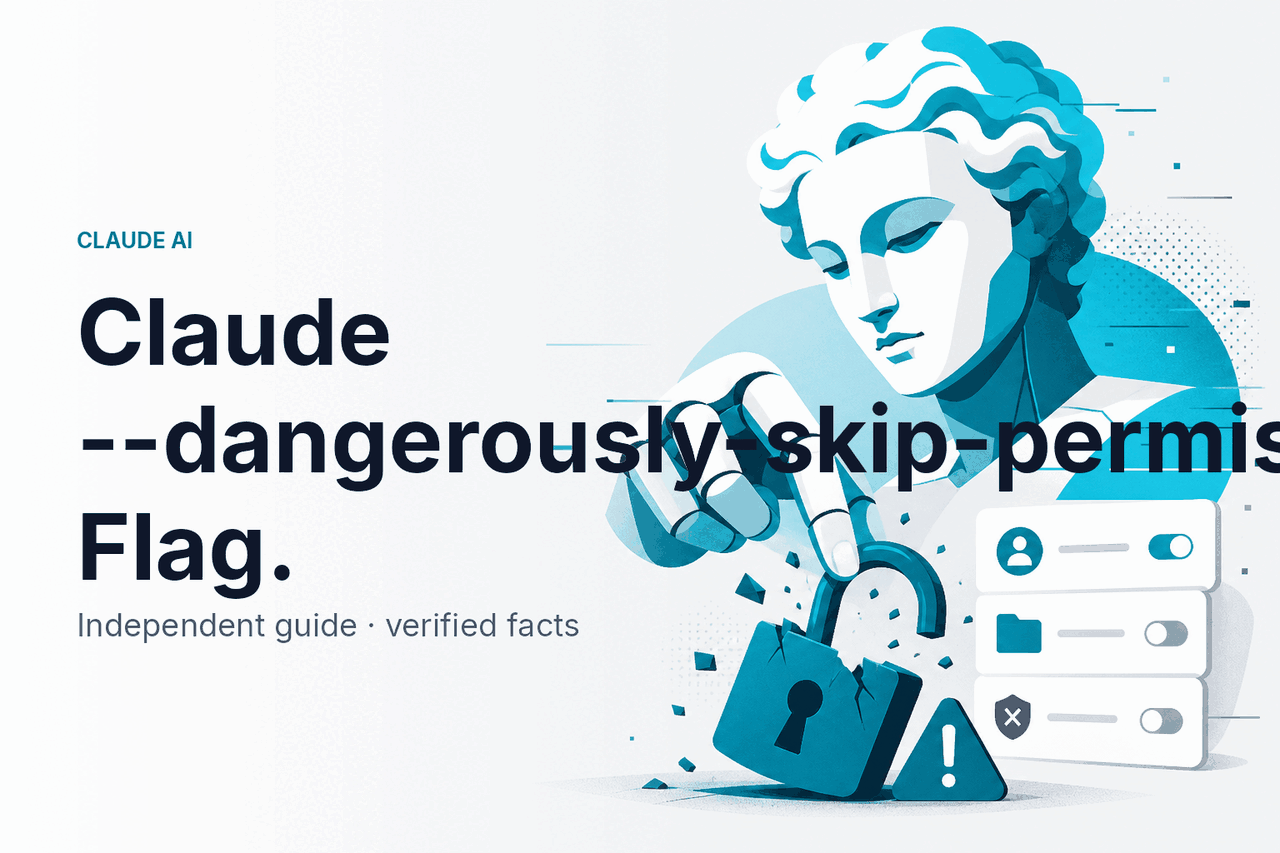
claude dangerously skip permissions usually means the --dangerously-skip-permissions flag in Claude Code, which lets the terminal agent run tool actions without stopping for approval each time.
Use it only in a controlled workspace. Start with our Claude API and developer docs guide if you need the broader developer context. This flag is for isolated coding sessions where speed matters more than interactive permission prompts. It is not a safe default for your main machine, production repositories, or folders with sensitive files.
- The short answer
- How it works
- What you would actually do with it
- Vs. the alternatives
- FAQ: other questions readers ask
- The honest take
- Sources
The short answer

--dangerously-skip-permissions is a Claude Code command-line flag that reduces or bypasses permission prompts for tool use. Claude can then act more continuously inside a local coding session.
The flag is for developers who understand the repository, runtime environment, and possible side effects of shell commands, file writes, package installs, test runs, and network calls.
The name is blunt for a reason. If you let an AI coding agent run tools without asking, it may edit files, delete generated artifacts, install packages, run scripts, or trigger network calls. The exact risk depends on what the local environment allows.
The safer default is to review tool requests before they run. Use the skip flag only when the workspace is safe to modify and easy to restore.
Claude Code is part of Anthropic’s Claude developer ecosystem. Anthropic publishes official product and developer information at anthropic.com, claude.ai, and docs.claude.com. c-ai.chat is independent and not affiliated with Anthropic.
How it works

Claude Code works as a command-line coding agent. You open a project directory, start Claude, describe the task, and Claude uses tools to inspect and modify the project.
Those actions can include reading files, editing files, searching the repository, running tests, and executing shell commands. In the normal workflow, Claude asks for approval before sensitive actions. That approval prompt is the control point.
--dangerously-skip-permissions changes that rhythm. Instead of pausing for each permitted action, Claude can continue through a task with less interruption. This helps with repeatable work such as test-fix loops, mechanical refactors, or documentation cleanup in a disposable checkout.
The flag does not make Claude more capable. It changes execution control, not model quality. If you want to compare model choices, see our Claude models guide. If you want usage and billing context, use our Claude pricing guide.
Temporary Git branch
Good for local edits, test runs, and small refactors. Review the full diff before merging.
Container or dev VM
Better for tasks that may install packages or run scripts. Keep credentials and personal files out of scope.
Restricted CI runner
Useful only when credentials, deployment permissions, and network access are tightly limited.
Start from a clean workspace
Create a fresh branch. Confirm
git statusis clean. Avoid directories with secrets, personal files, or unrelated projects.Decide whether the task is safe
Use the flag for bounded code tasks. Avoid it for deployments, credentials, destructive migrations, or shared infrastructure.
Run Claude Code with the flag
Start the session with
claude --dangerously-skip-permissionsfrom the project directory you want Claude to work in.Give a narrow instruction
Ask for one job at a time, such as “fix failing unit tests in this package” or “rename this helper and update references.”
Review outside the agent
Inspect the diff, run your own tests, and revert anything unexpected before committing or merging.
A simple rule: if the cost of a wrong command is high, do not use the flag.
What you would actually do with it
The flag works best when the task is bounded, reversible, and easy to verify. It works poorly when the task is vague, security-sensitive, or connected to systems you cannot safely reset.
A safe example is a temporary branch in a test project. You can ask Claude Code to run the test suite, fix failures, and keep iterating until the tests pass. Version control gives you a review point.
git checkout -b claude/fix-tests
claude --dangerously-skip-permissions
Inside the session, use a narrow prompt:
Run the unit tests for the billing package. Fix only the failures caused by the recent tax calculation change. Do not modify public API names.Worked example
Use it for a bounded test-fix loop
This is a good fit because the task has a clear pass/fail signal and the changes are reversible.
A second use case is mechanical refactoring. For example, you may need to rename a private helper across a package, update imports, and fix formatting. The flag helps because Claude does not need to stop at each file edit.
claude --dangerously-skip-permissions

Rename the internal helper parseUserRecord to parseAccountRecord across src/accounts only. Update tests in tests/accounts. Do not touch migrations, docs, or public route handlers.
A third use case is documentation cleanup in a repository copy. Claude can update stale references, run link checks, and standardise headings. Review the result because automated edits can change meaning.
claude --dangerously-skip-permissions

Update Markdown files under docs/api to match the current function names in src/public-api.ts. Keep examples unchanged unless they refer to removed parameters.
A fourth use case is local prototype generation. You can ask Claude to scaffold a small feature branch, add tests, and run a dev build. This is useful when you expect to discard most of the result and keep only the useful pieces.
claude --dangerously-skip-permissions

Create a prototype of a CSV import preview screen using the existing table components. Put all changes behind a feature flag named csvImportPreview. Add a basic test for invalid rows.
Do not use the flag to deploy, rotate credentials, modify cloud infrastructure, run database migrations against shared environments, clean your home directory, or work in a repository that contains secrets. For a broader product view, see our guide to Claude features.
Use it when
- The repository is on a disposable branch.
- The task has a clear verification step.
- The environment is sandboxed or containerised.
- You can inspect and revert the full diff.
Avoid it when
- The workspace contains secrets or personal files.
- The command could affect production systems.
- The task involves credentials, billing, or access control.
- You cannot easily undo the result.
Vs. the alternatives
The main alternative is not another model. It is a different permission model. Claude Code with normal permissions keeps a human approval step. Claude Code with --dangerously-skip-permissions removes more of that friction.
Editor assistants such as Cursor, GitHub Copilot, and Sourcegraph Cody usually sit closer to the IDE. Claude Code is terminal-first. That makes shell feedback loops feel direct, but it also raises the stakes when permission prompts are skipped.
| Tool or workflow | Typical interface | Strength | Trade-off | Closest use case |
|---|---|---|---|---|
Claude Code with --dangerously-skip-permissions | Terminal | Works through multi-step repo tasks with fewer pauses | Higher risk if the environment is not isolated | Test-fix loops, mechanical refactors, local prototypes |
| Claude Code with normal permissions | Terminal | Keeps human approval in the loop | Slower for repetitive actions | Everyday development on important repositories |
| Editor coding assistants | Editor | Strong inline editing and file-level review | Less suited to unattended terminal loops | Interactive coding, explanations, small edits |
| Manual shell scripts | Terminal | Predictable when reviewed and tested | No AI reasoning unless paired with an assistant | Repeatable migrations, formatting, generated-code cleanup |
| Claude API automation | Custom app or service | You design tools, logs, approval gates, and storage | Requires engineering work | Internal automation, product features, controlled agent systems |
For most developers, Claude Code without the skip flag is the safer default. You still get repository context and tool use, but you keep the approval checkpoint.
If you are building a product or internal automation service, the API route may give you more control than a local CLI session. See our Claude resources hub for related guides.
FAQ: other questions readers ask
The honest take
claude --dangerously-skip-permissions is useful, but it is not a default setting for normal development. It makes sense when you have a contained workspace, a narrow task, version control, and a clear review step.
It is a poor choice when the environment contains secrets, production access, or files you cannot easily restore.
The flag is a speed-versus-control trade-off. If approval prompts slow down a safe, repetitive local task, it can help. If the prompts protect you from commands you have not reviewed, leave them on.
Independent guide. Not affiliated with Anthropic. For the official Claude product, visit claude.ai.
Last updated: 2026-05-12