
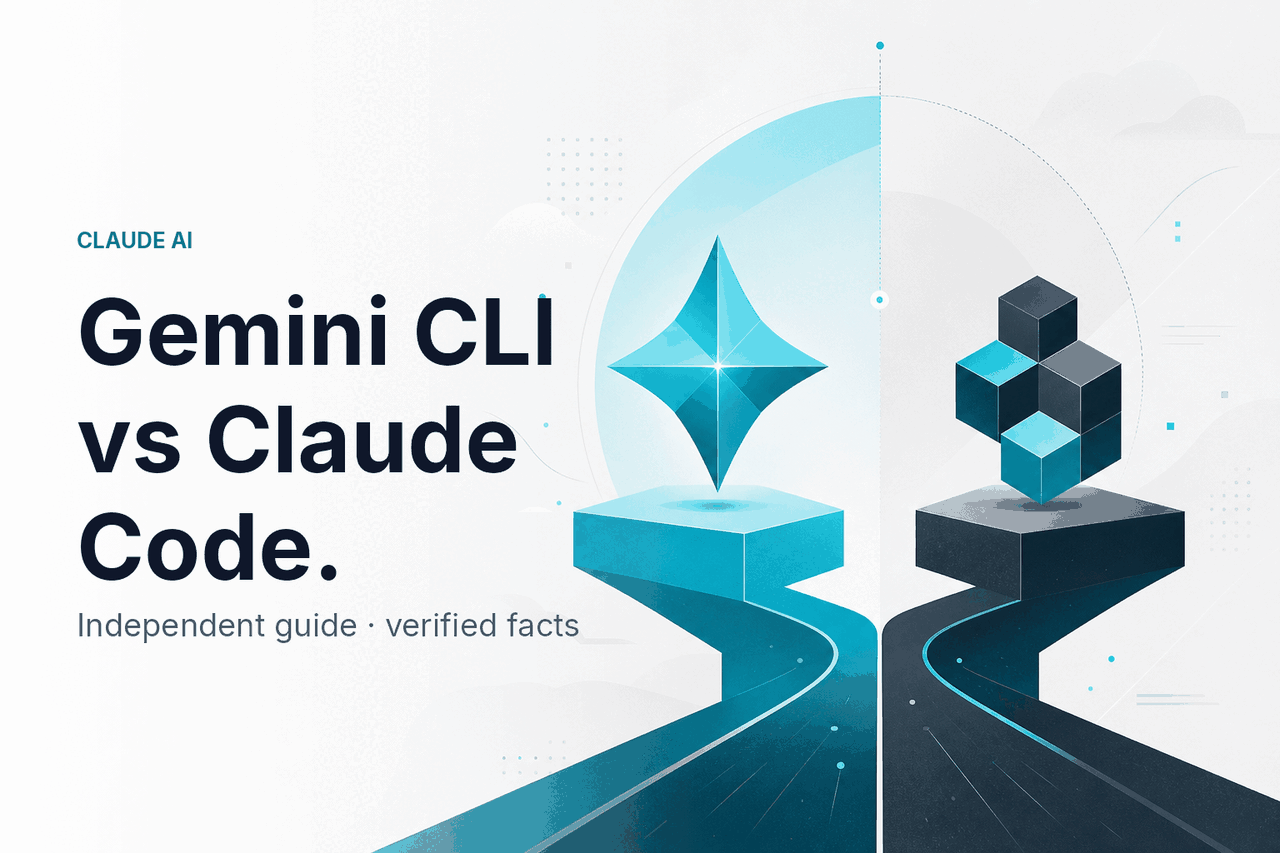
For Gemini CLI vs Claude Code, choose Gemini CLI if your workflow is already Gemini-first; choose Claude Code if you want Anthropic’s Claude-native terminal coding agent, plan-based Claude access, and official Anthropic support alongside our Claude API guide.
c-ai.chat is independent from Anthropic. Anthropic makes Claude, and claude.ai is the official Claude product.
- The short answer
- How it works
- What you would actually do with it
- How it compares with alternatives
- FAQ
- The honest take
- Sources
The short answer
Gemini CLI and Claude Code are both terminal coding assistants. The main difference is not the terminal. It is the model family, account system, permissions, pricing path, and how well each tool fits your team’s workflow.
The practical decision is simple. If your team already uses Claude for writing, reasoning, code review, or internal tools, Claude Code fits that stack. If your team has standardised on Gemini and wants a CLI layer around that model family, Gemini CLI is the cleaner starting point.
Do not treat either tool as a replacement for code review. Both can produce wrong patches, miss project conventions, or run commands you did not intend. Use version control. Review diffs. Keep secrets out of prompts.
For plan details, see our Claude pricing guide. For model selection, see our Claude models guide. For product capabilities, see our Claude features guide.
How it works
A terminal coding assistant runs inside your project directory. You ask for a change in natural language. The assistant reads relevant files, builds a plan, proposes edits, and may ask for permission before writing files or running commands. The permission model depends on the tool and your local configuration.
Claude Code uses Anthropic’s Claude models and sits inside the Claude product ecosystem. Anthropic lists plan details at claude.com/pricing, and model documentation is available through platform.claude.com.
Gemini CLI follows the same broad pattern but uses Google’s Gemini model family. Both tools can help with code. The real question is which model you trust on your repository, which account and billing setup you already use, and how well the tool handles your tests, conventions, and security rules.
Open the project in a clean branch
Create a branch before giving either tool write access. Generated edits stay isolated and easy to discard.
Ask for a narrow task
Use one request, such as
Find why the login test fails and propose a minimal fix. Avoid broad prompts likeimprove the app.Review the plan before edits
Good CLI workflows show which files the assistant wants to inspect or change. Stop it if the scope expands.
Run tests locally
Ask the assistant to run the relevant test command, then verify the result yourself.
Commit only reviewed diffs
Use
git diffand your normal review process. Treat the assistant like a fast junior contributor.
The strongest use case is not “write my whole app.” It is reducing friction around known tasks: tracing a bug, changing a repeated pattern, writing test scaffolding, explaining unfamiliar modules, or turning an issue into a candidate patch.
What you would actually do with it
The easiest way to compare Gemini CLI and Claude Code is to test realistic terminal tasks. The command name changes. The review discipline does not.
1. Investigate a failing test. Start with the smallest failing unit, not the whole suite. Name the test, expected behaviour, and limit on changes.
claude "The test auth/session.test.ts fails on token expiry. Inspect the relevant files, explain the likely cause, and suggest the smallest safe fix. Do not edit files yet."gemini "The test auth/session.test.ts fails on token expiry. Inspect the relevant files, explain the likely cause, and suggest the smallest safe fix. Do not edit files yet."This is a good first task because the assistant has a clear target and an observable success condition. It can read the test, compare it with implementation code, and propose a fix you can verify.
Worked example
Reduce a bug report into a patch
Terminal agents are useful when they connect repository search, file edits, and test feedback in one loop.
2. Refactor a repeated pattern. CLI agents can handle mechanical changes if you define the pattern tightly. For example, migrate one helper function to a new import path inside one package.
claude "Replace uses of legacyFormatDate with formatDate from src/lib/date-format.ts in the billing package only. Preserve behaviour. Show the diff before running tests."The risk is overreach. A model may “clean up” nearby code or make style changes that hide the real migration. Tell it what not to change. Review the diff file by file.
3. Add test coverage around an existing function. This is often safer than asking for new production logic. The assistant can inspect current tests, copy project style, and propose cases you may have missed.
gemini "Add focused tests for calculateInvoiceTotal. Cover discounts, tax rounding, and empty line items. Match the existing test style. Do not change production code unless a test exposes a bug."Claude Code may be preferable if you already use Claude for specification writing or code review. Gemini CLI may be preferable if your team already uses Gemini for internal developer tasks.
4. Explain an unfamiliar repository. Both tools can act as onboarding assistants. Ask for a map, not a rewrite.
claude "Give me a concise map of this repository: main entry points, data flow, test commands, and files I should read first. Do not edit anything."This helps students, new hires, and founders taking over inherited code. Still verify the answer. A model may infer architecture from file names rather than execution paths.
5. Prepare a pull request description. After you finish a change, a CLI assistant can turn the diff into a PR summary, test notes, and reviewer checklist.
claude "Review the current git diff and draft a pull request description with: summary, implementation notes, tests run, and risks. Do not include claims that are not visible in the diff."This task is lower risk because it produces text, not application logic. It also forces the assistant to ground its answer in the actual diff.
How it compares with alternatives
Gemini CLI and Claude Code are not the only developer AI tools. Choose based on whether you want a terminal agent, editor autocomplete, or a larger AI-assisted coding environment.
| Tool | Best fit | Strength | Trade-off |
|---|---|---|---|
| Gemini CLI | Developers who want a Gemini-based terminal assistant | Command-line workflow around the Gemini model family | Value depends on your Gemini account, quotas, and repository fit |
| Claude Code | Claude users who want Anthropic’s official coding agent in the terminal | Fits Claude plans and Claude model behaviour; useful for repo analysis and patch workflows | Still requires review; heavy use may require a higher Claude plan |
| Cursor | Developers who want AI inside a code editor | Editor-native context, chat, and code changes | Less terminal-first; adds another editor layer |
| GitHub Copilot | Teams standardised on GitHub and IDE autocomplete | Strong inline suggestions and broad IDE support | Agent workflows differ from terminal-based tools |
| Sourcegraph Cody | Teams that care about code search and large codebase context | Useful for understanding code across repositories | May be more than needed for one small project |
If you mostly want autocomplete while you type, start with an editor tool. If you want to assign a task from the terminal, inspect a diff, run tests, and iterate, compare Gemini CLI and Claude Code directly.
Free
$0
Entry-level Claude access with plan limits.
Pro
$20/month or $17/month annual
Individual paid Claude access.
Max
From $100/month
Higher-usage individual access.
Team Standard
$25/seat or $20/seat annual
Team access with standard seat pricing.
Team Premium
$125/seat or $100/seat annual
Higher-tier team access.
Enterprise
$20/seat base + API rates
Enterprise access with usage priced at API rates.
For direct API work, Anthropic lists Claude Opus 4.7 at $5/M input and $25/M output tokens, with a 1M context window. Claude Sonnet 4.6 is $3/M input and $15/M output tokens, with a 1M context window and 128K max output. Claude Haiku 4.5 is $1/M input and $5/M output tokens. Prompt caching gives 90% off cached input. The Batch API gives 50% off both directions.
Pick Claude Code when
- You already use Claude for writing, review, or product work.
- You want a terminal agent tied to Anthropic’s official Claude ecosystem.
- You need strong natural-language reasoning over code and project instructions.
- Your team is also evaluating Claude plans, Claude features, or API usage.
Skip Claude Code when
- Your team is already committed to Gemini-first tooling.
- You only need inline autocomplete inside an IDE.
- You cannot review generated diffs before merge.
- Your security rules prohibit sending code to external AI services.
Security and governance matter more than branding. Before adopting either tool, check what code it can read, whether it can run shell commands, how approvals work, and whether your organisation allows repository data to be processed by that provider. For Claude-specific trust material, Anthropic publishes information at trust.anthropic.com.
FAQ
These are the related questions people ask after comparing Gemini CLI and Claude Code.
The honest take
The Gemini CLI vs Claude Code decision is not about which assistant types code faster. Both can help. The real question is which ecosystem you trust, which model gives better answers on your codebase, and which workflow your team can govern.
If you already use Claude for complex writing, analysis, or development support, Claude Code is the more natural choice. If your stack is built around Gemini, start with Gemini CLI.
Test both on the same narrow tasks: one failing test, one refactor, one documentation pass, and one PR summary. Compare the diffs, not the demos. The better tool is the one that produces smaller, more reviewable changes and fits your security rules.
Independent guide. Not affiliated with Anthropic. For the official Claude product, visit claude.ai.
Last updated: 2026-05-12
This article is part of the Claude Code hub on c-ai.chat.