
Claude Code vs Cursor comes down to workflow: Claude Code is better for agentic, repo-level coding work, while Cursor is better for editor-first coding with inline edits, autocomplete, and chat. c-ai.chat is an independent guide to Claude, not Anthropic; for broader context, start with our Claude features guide.

The short answer
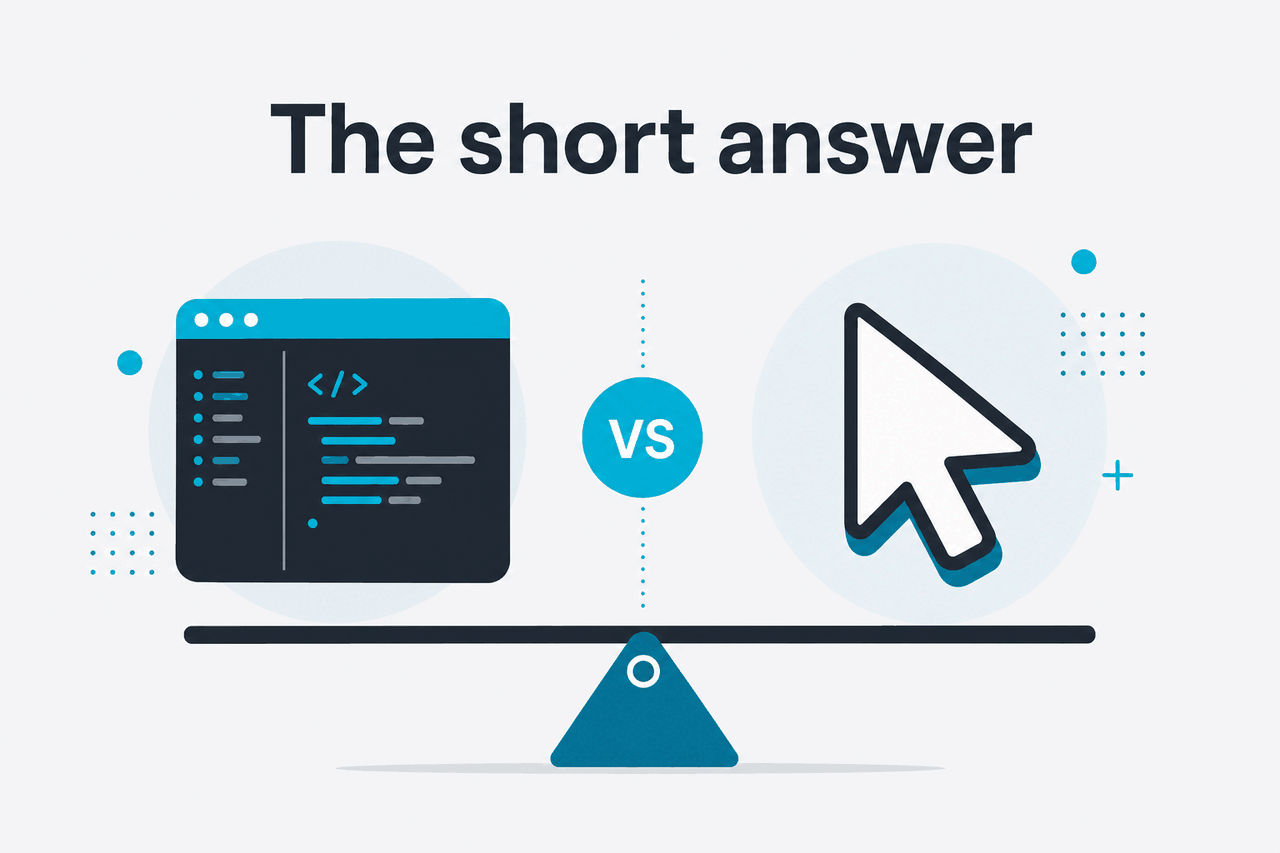
Choose Claude Code if you want Claude to inspect a repository, plan changes, edit files, and help run development tasks. Choose Cursor if you want an AI code editor with chat, inline edits, and completions built into the coding surface.
The split is practical. Claude Code feels closer to assigning a development task to an assistant. Cursor feels closer to writing code in an editor with AI available at each step. Both can help with bug fixes, refactors, tests, explanations, and scaffolding. They differ most in where the work happens and how much action you want the assistant to take.
| Category | Claude Code | Cursor |
|---|---|---|
| Primary form | Agentic coding tool from Anthropic | AI-first code editor |
| Best fit | Repo-level tasks, terminal workflows, multi-step changes | Editor-first coding, inline edits, autocomplete, chat in the IDE |
| Claude relationship | Official Anthropic product experience tied to Claude | Third-party editor that may support Claude models depending on configuration |
| Workflow style | Assign a task, review the plan and diffs, approve actions | Write and edit code directly while using AI suggestions |
| Main trade-off | More agentic, but commands and diffs need close supervision | More familiar editor flow, but less like delegating a full task |
The details

Claude Code is part of Anthropic’s Claude developer ecosystem. It is designed for software engineering work where Claude can understand a codebase, propose changes, edit files, and support development workflows. Anthropic publishes official information about Claude developer docs, the Claude model lineup, and API pricing.
Cursor is different. It is not made by Anthropic and is not the official Claude product at claude.ai. Cursor is an editor built around AI-assisted coding. Developers compare it with Claude Code because both affect daily programming work, but they are not the same category. One is a coding agent from the maker of Claude. The other is an editor that brings AI into the normal write-test-refactor loop.
Where Claude Code is stronger
Claude Code is strongest when you want a task-oriented assistant. Good tasks include “find why this test fails,” “add a new API endpoint using the existing pattern,” “refactor this module without changing behavior,” or “explain how authentication flows through this repo.” These tasks require context, planning, edits across files, and often command-line checks.
The value is not only code generation. Claude Code can keep a thread of work moving across a project. That suits developers who already use the terminal, version control, tests, and diff review. It also suits teams that want explicit supervision before commands run or files change.
Where Cursor is stronger
Cursor is strongest when you want AI inside the editor all day. Inline changes, quick explanations, autocomplete, and chat beside the code can be faster for small edits. If you are writing one function, adjusting a component, or moving between nearby files, an editor-first workflow can feel more natural than asking an agent to take over.
Cursor can also be easier for developers who want AI help without changing their working style. You still open files, place the cursor, select code, and accept or reject suggestions. That makes it familiar for people who already prefer a graphical editor.
Pick Claude Code when
- The task spans several files or folders.
- You want the assistant to inspect the repo before editing.
- You prefer terminal workflows and reviewable diffs.
- You want a closer fit with Anthropic’s Claude ecosystem.
Pick Cursor when
- You want AI built into the editor itself.
- You rely on inline edits and autocomplete.
- You want quick help while manually steering the code.
- You prefer an IDE-style workflow over a terminal-agent workflow.
Pricing is not a simple one-line comparison
Claude pricing depends on how you access Claude. Consumer and team plans are separate from API usage. If your coding workflow uses the API directly, cost depends on tokens used, not only on the tool you choose. See our Claude pricing guide and Claude API guide for more detail.
Free
$0
Basic Claude access with usage limits.
Pro
$20/mo or $17/mo annual
Individual plan for heavier personal use.
Max
From $100/mo
Higher-usage individual plan.
Team Standard
$25/seat or $20/seat annual
Team plan for shared workspaces.
Team Premium
$125/seat or $100/seat annual
Higher-tier team plan.
Enterprise
$20/seat base + API rates
Enterprise access with usage-based API billing.
For API work, Claude Opus 4.7 costs $5/M input tokens and $25/M output tokens, with a 1M token context window. Claude Sonnet 4.6 costs $3/M input tokens and $15/M output tokens, with a 1M token context window and 128K max output. Claude Haiku 4.5 costs $1/M input tokens and $5/M output tokens. Prompt caching gives 90% off cached input. The Batch API gives 50% off both input and output.
Model choice affects coding workflows. Opus is the flagship option. Sonnet is the balanced default for many tasks. Haiku is the fastest and cheapest option. For a broader comparison, see our Claude models guide.
Worked example
How the same task can feel different
The better workflow depends on whether you want to assign the task or stay close to each edit.
Security and governance matter more than the feature list
AI coding tools can see sensitive context if you give them repository access. That may include source code, environment examples, logs, internal APIs, customer data in test fixtures, or proprietary architecture. Before choosing a tool, check company policy, data retention terms, access controls, and review process. Anthropic publishes trust information at trust.anthropic.com and service status at status.claude.com.
For teams, the question is not only “which tool writes better code?” It is also “which tool fits our review process?” A strong setup includes small pull requests, test coverage, secrets scanning, dependency checks, and human review. AI can speed up code work, but it can also make confident mistakes. Treat generated changes like changes from a junior developer who can type very fast.
How to test Claude Code against Cursor fairly
Do not compare them with one toy prompt. Use three to five real tasks from your backlog. Include a small bug fix, a test-writing task, a refactor, a documentation update, and an unfamiliar-codebase explanation. Time each task, record rejected suggestions, and inspect the final diff.
Choose real tasks
Use issues from your own repo, not generic benchmark prompts. Include at least one task that touches multiple files.
Use the same constraints
Give both tools the same goal, acceptance criteria, and test instructions.
Review the diff
Check correctness, unnecessary edits, style drift, security concerns, and test quality.
Measure developer effort
Track elapsed time and the amount of supervision the tool required.
If you are still mapping the Claude ecosystem, our Claude resources hub collects related guides. For account and product basics, see the Claude FAQ.
What this means
The Claude Code vs Cursor decision is less about which tool is universally better and more about which interface matches your development loop. If your work is task-driven, repository-wide, and terminal-heavy, Claude Code is usually the cleaner fit. If your work is edit-driven, visual, and tightly tied to the code editor, Cursor may feel faster.
For individual developers, the best answer may be to use both at different moments. Claude Code can handle “go investigate and propose a change” work. Cursor can help while you are actively writing, selecting, and revising code. For teams, standardise only after a trial with real repositories, security review, and clear rules for AI-generated code.
FAQ: other questions readers ask
Is Claude Code better than Cursor?
Claude Code is better for agentic, multi-step coding tasks where you want Claude to inspect a repo, plan changes, and work through files. Cursor is better for editor-native AI help such as inline edits, autocomplete, and chat while you manually steer the work. Better depends on workflow, not only model quality.
Can Cursor use Claude?
Cursor is a third-party editor, so Claude availability depends on Cursor’s own product settings and supported model options. Check Cursor’s current configuration before assuming a specific Claude model is available. If you need official Claude access, use claude.ai or Anthropic’s API platform.
Is Claude Code only for professional developers?
No. It is most useful when you are comfortable with repositories, terminals, diffs, and tests. Beginners can still use it to explain code or make small changes, but they should review outputs carefully. It is not a replacement for understanding what a change does.
Should I use Claude Code or Claude chat for coding?
Use Claude chat for explanations, design discussion, small snippets, and learning. Use Claude Code when the task needs access to project files and a workflow around edits. Chat is often enough for isolated questions. Claude Code is better when the answer needs to become a working patch.
Does Claude Code replace code review?
No. AI-generated changes still need human review, tests, and security checks. Claude Code can speed up implementation and investigation, but it can make incorrect assumptions or produce code that passes a narrow test while missing the real requirement.
Which is better for large codebases?
Claude Code is often a better fit when a task requires repository-level context, several file changes, or command-line validation. Cursor can still help in large codebases, especially when you are making focused edits in files you already understand.
The honest take
If you want one plain answer: choose Claude Code for agentic coding work and Cursor for editor-first coding. Claude Code is the stronger match when the assistant needs to understand a repository and carry out a task across files. Cursor is the stronger match when you want AI help embedded in the act of writing code.
The safest adoption decision is to test both on your own code. Use real tasks, review every diff, and include security and privacy requirements in the decision. Model quality matters, but workflow fit matters just as much.
Independent guide. Not affiliated with Anthropic. For the official Claude product, visit claude.ai.
Last updated: 2026-05-12
This article is part of the Claude Code hub on c-ai.chat.