
For a claude code github search, start with Anthropic’s official Claude Code docs, then judge GitHub repos by ownership, maintenance, permissions, and security before running them on your codebase; c-ai.chat is an independent guide, and our Claude API docs guide explains the related developer tooling.

- Quick answer
- Which Claude Code GitHub repos are worth checking?
- How to evaluate a Claude Code repo
- How Claude Code fits into GitHub workflows
- Pricing and model facts to check
- FAQ
- Sources
Quick answer
The best Claude Code GitHub repos are official, actively maintained, narrowly scoped, and safe to test in a sandbox. Use Anthropic’s Claude Code documentation as the source of truth. Use GitHub repos for examples, workflow patterns, SDK samples, and internal automation you control.
- Start official: confirm setup and supported usage in Anthropic’s docs.
- Check ownership: prefer repos with clear maintainers and visible activity.
- Review permissions: inspect GitHub token scopes, secrets, shell access, and branch access.
- Test locally: do not run unknown automation against private production code.
A useful “top repos” list should cover four buckets: official Anthropic materials, Claude Code workflow examples, SDK or API examples, and internal repos owned by your team. Public community repos can help, but they need extra review because they may request file access, shell access, or GitHub token permissions.
Which Claude Code GitHub repos are worth checking?

Repo quality matters more than star count. A small repo with clear permissions and active maintenance is often safer than a popular repo with vague scripts.
| Repo type | Best use | Risk to check |
|---|---|---|
| Official Anthropic-owned repos or examples | Setup patterns, supported usage, issue context | Confirm the owner and maintenance status |
| Claude Code workflow examples | Pull request review, issue triage, test automation | GitHub token permissions, secrets, and branch access |
| SDK and API sample repos | Custom tools around Claude models | Outdated model names, unsafe key handling, missing rate-limit handling |
| MCP server repos | Connecting Claude Code to tools, files, databases, or internal systems | Overbroad tool permissions and untrusted network calls |
| Your internal Claude Code repo | Team prompts, slash commands, review rules, onboarding | Accidental exposure of private architecture or secrets |
Use this rule
Choose a repo only if you can explain who maintains it, what it can access, what commands it runs, and how to roll it back.
If any of those answers are unclear, test it in a throwaway repository or skip it.
How to evaluate a Claude Code repo
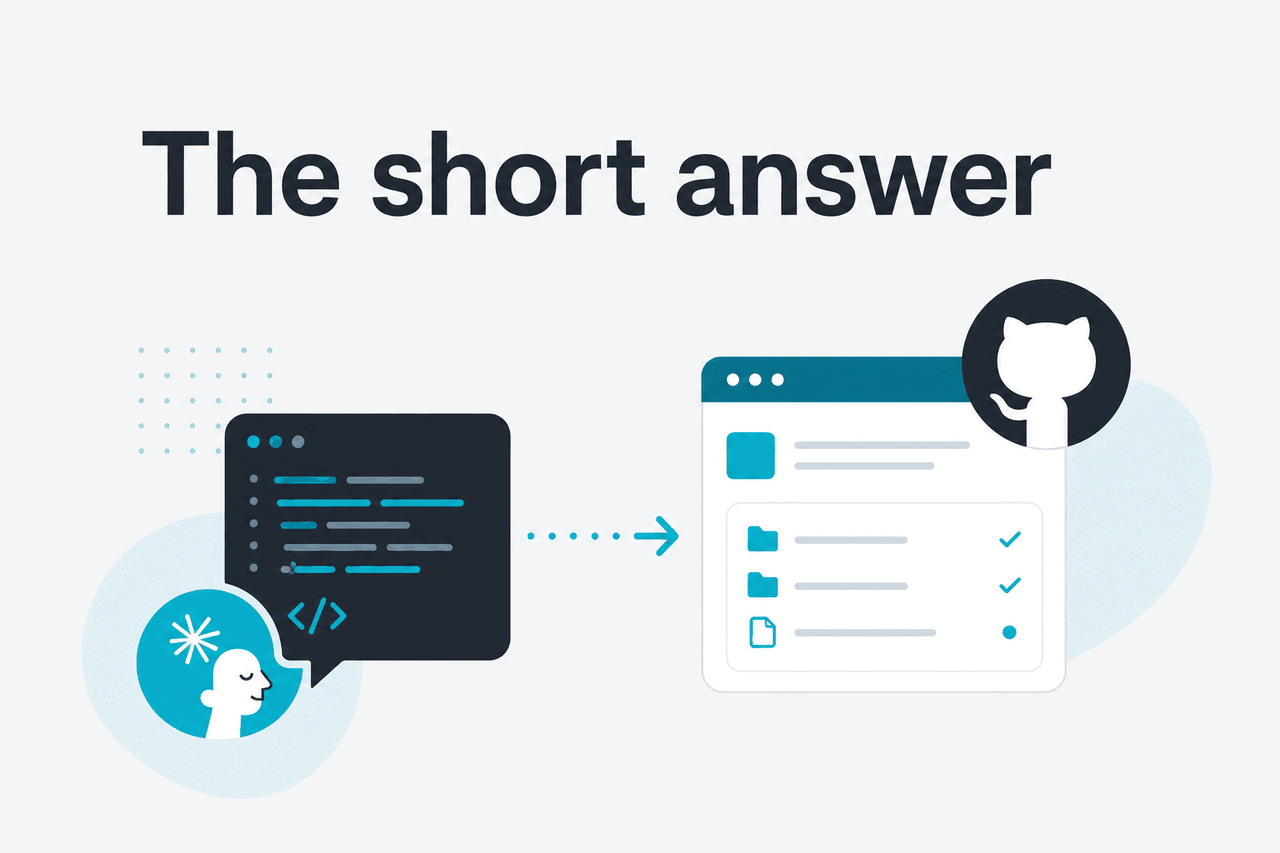
Claude Code is Anthropic’s agentic coding tool for working with software projects. That makes repo review more important than it is for a normal documentation sample. Coding agents may interact with files, commands, version control, CI systems, and credentials.
Look beyond the README. Check workflow files, install commands, package lockfiles, open issues, release notes, licenses, and any scripts that touch your repository. Be cautious with any repo that asks for repository write access, organization-level secrets, or broad shell permissions without a clear reason.
Worked example
A quick safety pass before using a Claude Code GitHub repo
A repo that fails the permissions or secrets check should not touch a private production codebase.
Pick when
- The repo has clear ownership and a narrow purpose.
- Permissions are documented and limited.
- You can test it in a non-production repository.
- Your team already uses code review and branch protection.
Skip when
- The repo asks for broad write access without a reason.
- The setup hides scripts behind vague install commands.
- The README promises full automation without failure guidance.
- You cannot tell who is responsible for maintenance.
How Claude Code fits into GitHub workflows
GitHub enters Claude Code workflows in two ways. Developers use GitHub to find examples, actions, templates, and setup files. Teams use GitHub as the place where Claude-assisted work becomes issues, branches, commits, pull requests, and reviews.
For an individual developer, the main benefit is speed. Claude Code can help inspect a project, explain unfamiliar files, draft changes, and write tests. For a team, the main question is governance. Decide who can run the tool, what it can access, whether it can create branches or pull requests, and how humans review its output.
Our Claude features guide covers broader product capabilities. Our Claude models guide explains model choices. For common account and product questions, see the Claude FAQ.
Start with official docs
Confirm setup, authentication, and supported workflows in Anthropic’s documentation before copying any GitHub example.
Clone into a sandbox
Use a throwaway repository or test organization first. Do not grant production secrets during evaluation.
Inspect automation files
Review workflow permissions, shell commands, package scripts, and any file paths the repo reads or writes.
Limit credentials
Use scoped tokens and environment variables. Rotate credentials if a test repo handled sensitive access.
Document the pattern
When a workflow passes review, copy the pattern into an internal repo with your team’s rules and owners.
Pricing and model facts to check
Pricing depends on whether you use Claude through the official app, a team plan, or API calls inside a GitHub workflow. Do not assume a GitHub automation repo has the same limits as a chat session. Check Anthropic’s official Claude pricing page and our independent Claude pricing guide before rollout.
Free
$0
Basic access for individual use.
Pro
$20/mo or $17/mo annual
Paid individual plan.
Max
From $100/mo
Higher-usage individual plan.
Team Standard
$25/seat or $20/seat annual
Team plan for shared workspaces.
Team Premium
$125/seat or $100/seat annual
Higher-tier team plan.
Enterprise
$20/seat base + API rates
Enterprise access with API usage billed separately.
If a GitHub repo calls the API directly, model and token costs matter. Opus 4.7 is $5 input and $25 output per million tokens with a 1M token context window. Sonnet 4.6 is $3 input and $15 output per million tokens with a 1M token context window and 128K max output. Haiku 4.5 is $1 input and $5 output per million tokens.
Prompt caching gives 90% off cached input. The Batch API gives 50% off both directions. Those discounts can matter for repeated CI checks, large review jobs, and scheduled repository analysis.
FAQ
Is Claude Code open source?
The Claude models and the hosted Claude product are not open source. Some examples, integrations, or community projects may be public on GitHub. Each repo has its own license, maintainer, and security profile.
Is there an official Claude Code GitHub repo?
Use Anthropic’s Claude Code docs as the authority. If you find a repo that claims to be official, verify the owner and compare the setup with Anthropic’s documentation before using it.
Can Claude Code work with GitHub pull requests?
Claude Code can help draft, inspect, and explain code changes in workflows connected to a repository. GitHub permissions still come from your account, token, local checkout, or CI runner. Keep humans in the review loop for production code.
What should I search for on GitHub?
Search for Claude Code setup examples, GitHub Actions workflows, MCP servers, SDK samples, and project-specific prompt patterns. Then filter by owner, maintenance, license, and permissions.
Does Claude Code replace GitHub Copilot?
Not exactly. Claude Code is commonly used as an agentic coding assistant that can reason across a project and operate through a terminal or workflow. GitHub Copilot is closely integrated into GitHub and editor completion workflows. Compare them by task: inline completion, codebase exploration, test writing, pull request review, and automation.
Where do I check outages or trust information?
Use Claude status for service availability and Anthropic Trust for security and compliance materials.
Independent guide. Not affiliated with Anthropic. For the official Claude product, visit claude.ai.
Last updated: 2026-05-12
This article is part of the Claude Code hub on c-ai.chat.