
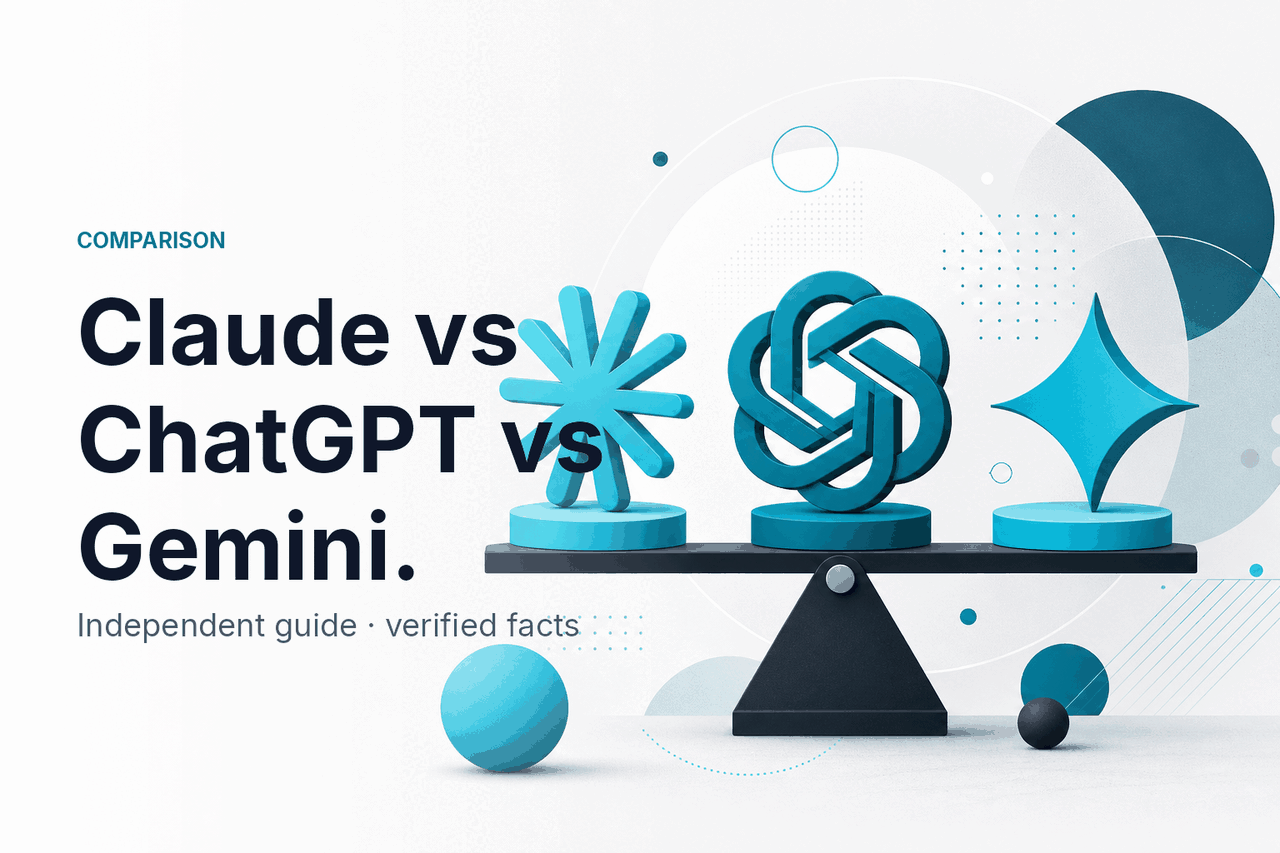
Claude vs ChatGPT vs Gemini comes down to workload: Claude is strongest for long documents, careful writing, and structured coding help; ChatGPT is usually the broadest general-purpose assistant; Gemini is the easiest fit for people already working inside Google’s ecosystem.
c-ai.chat is an independent guide to Claude AI by Anthropic. We are not Anthropic or claude.ai. For the broader Claude hub, start with our Claude guide, or use the sections below to compare the tools by task.
- The bottom line
- Head to head
- Where Claude is the better pick
- Where the other tool is better
- How to choose
- FAQ
- Sources
The bottom line
Claude wins on long-context analysis, careful writing, and transparent reasoning. ChatGPT wins on the broadest consumer ecosystem. Gemini wins when your workflow already depends on Google apps.
Best default
Choose Claude for long documents, polished writing, research synthesis, and coding review.
- Claude is the safest first test for long documents and professional writing.
- ChatGPT is often the broadest all-purpose assistant for casual and mixed tasks.
- Gemini fits best when Google Workspace is the centre of your work.
- Claude API has clear model pricing, prompt caching, and Batch API discounts.
If you only want one answer, choose Claude for document work, coding review, research synthesis, and writing that needs a calm, accurate tone. Choose ChatGPT if you want a widely used mainstream assistant with a broad feature ecosystem. Choose Gemini if your main need is AI inside Gmail, Docs, Sheets, Drive, and other Google surfaces.
Claude is not better at every task. It can be more cautious with refusals. Some users prefer ChatGPT or Gemini for image workflows, voice features, or native app integrations. The strongest choice depends on your weekly work, not one benchmark score.
Head to head

The table below compares the practical differences that matter for most buyers and daily users. Claude details come from Anthropic’s official pricing and model documentation, including Claude plans, API pricing, and the Claude models overview.
| Dimension | Claude | ChatGPT | Gemini |
|---|---|---|---|
| Best fit | Long documents, structured writing, coding review, research synthesis, and careful professional tasks. | General-purpose assistant use, broad consumer features, multimodal workflows, and widely shared habits. | Google-first workflows, especially when the user already works in Gmail, Docs, Sheets, Drive, and Android. |
| Plans | Free is $0. Pro is $20/month or $17/month annual. Max starts from $100/month. Team Standard is $25/seat or $20/seat annual. Team Premium is $125/seat or $100/seat annual. Enterprise is a $20/seat base plus API rates. | Free and paid tiers are available. Exact limits, models, and packaging vary by plan, product surface, and region. | Free and paid tiers are available through Google AI and workspace products. Exact limits and packaging vary by account type, product surface, and region. |
| Models | Opus 4.7 is the flagship model. Sonnet 4.6 is the best balance for most professional work. Haiku 4.5 is the fastest and lowest-cost option. See our Claude models guide. | Uses OpenAI’s model family across ChatGPT and API products. Model access depends on plan and product surface. | Uses Google’s Gemini model family across consumer, developer, and workspace products. Model access depends on plan and product surface. |
| Context and output | Opus 4.7 supports a 1,000,000 token context. Sonnet 4.6 also supports a 1,000,000 token context and a 128K maximum output. Long context is a major reason to choose Claude for large document sets. | Strong long-context options exist, but limits depend on the model and plan. Verify current limits inside the product. | Strong long-context options exist, especially in Google’s AI ecosystem. Limits depend on the model, plan, and product surface. |
| API pricing | Opus 4.7 costs $5 per million input tokens and $25 per million output tokens. Sonnet 4.6 costs $3/$15. Haiku 4.5 costs $1/$5. Prompt caching gives 90% off cached input. Batch API gives 50% off both directions. | API pricing depends on the selected model and product. Check the official pricing page before estimating production cost. | API pricing depends on the selected Gemini model and Google product surface. Check the official pricing page before estimating production cost. |
| Coding ability | Strong for code explanation, refactoring, test generation, debugging plans, and repository-level reasoning when enough context is provided. | Strong for coding help, quick prototypes, multimodal debugging, and broad developer workflows. | Strong when coding workflows involve Google Cloud, Android, notebooks, or Google developer tooling. |
| Writing ability | Excellent for clean drafts, editing, rewriting, tone control, and long-form structure. Claude often sounds less promotional by default. | Strong for ideation, varied formats, social content, fast drafting, and creative variation. | Strong for workplace writing inside Google apps and fast rewriting where source material already sits in Drive or Docs. |
| Safety and refusals | Claude is designed with Anthropic’s safety approach and may be more cautious on sensitive, risky, or ambiguous prompts. See Anthropic and Anthropic Trust. | Usually flexible for mainstream consumer tasks, but still applies safety rules and policy limits. | Usually strongest when working inside Google-managed environments, with safety controls tied to Google’s product stack. |
| Ecosystem | Claude is available through claude.ai, apps, Projects, Research access, Claude Code, Claude API, and team plans. See our Claude features guide. | Broad consumer ecosystem with many users, apps, templates, and workflows built around ChatGPT. | Deep Google ecosystem alignment, especially for users and organisations already standardised on Google products. |
For Claude buyers, plan choice matters as much as model choice. Free is enough for light testing. Pro fits individuals who use Claude regularly. Max fits high-volume users who keep hitting usage limits. Team and Enterprise add administrative controls, shared workspace features, and governance. See our Claude pricing guide for a Claude-only plan breakdown.
Where Claude is the better pick
Claude’s strongest use cases are specific. It is best when the work has lots of context, needs careful wording, or benefits from visible assumptions and trade-offs.
Long-document analysis
1,000,000 tokens
For legal, research, policy, finance, and operations teams
- Analyse large document sets in one conversation.
- Ask follow-up questions without re-uploading every detail.
- Extract risks, contradictions, and action items.
Professional writing
Clean tone
For marketers, founders, students, analysts, and operators
- Rewrite rough drafts without inflated language.
- Maintain structure across long pieces.
- Adapt tone for executives, customers, or technical readers.
Coding review
Practical help
For developers reviewing code, tests, and architecture
- Explain unfamiliar code paths.
- Suggest tests and edge cases.
- Plan refactors with trade-offs.
1. Long-document analysis with large context. Claude is a strong choice when you want to compare contracts, summarise research papers, inspect policy documents, or ask questions across a long knowledge base. Opus 4.7 supports a 1,000,000 token context. That is the main reason many professionals test Claude first for document-heavy work.
2. Writing that must sound precise. Claude is often better when a memo, proposal, email, report, or article needs a measured tone. It tends to follow editorial constraints well. If you ask for short sentences, no hype, and a specific audience, it usually stays close to the brief.
3. Structured reasoning across messy inputs. Claude performs well when the prompt includes competing facts, stakeholder notes, meeting transcripts, and partial requirements. A useful pattern is to ask Claude to separate facts, assumptions, risks, and next actions. That makes the answer easier to audit.
4. Code explanation and refactoring support. Claude is useful for reading code, explaining unfamiliar repositories, drafting tests, and outlining refactor plans. It is not a replacement for code review or production testing. It can still miss runtime behaviour, dependency issues, or security edge cases. Treat it as a reviewer, not an authority.
5. API cost control for repeated prompts. Claude’s API pricing is clear by model and token direction. Opus 4.7 costs $5 per million input tokens and $25 per million output tokens. Sonnet 4.6 costs $3 per million input tokens and $15 per million output tokens. Haiku 4.5 costs $1 per million input tokens and $5 per million output tokens. Prompt caching gives 90% off cached input tokens. Batch API gives 50% off both directions.
90% off
cached input tokens with prompt caching
Example prompt
Use Claude when the work needs structure: “Review these three policy documents. Create a table with conflicts, missing definitions, operational risks, and recommended edits. Separate confirmed facts from assumptions. Keep the language suitable for a legal and operations audience.”
Claude is also a good fit for users who want fewer distractions. The product experience is usually centred on the conversation and the task. That helps when you are writing, reviewing, or analysing instead of browsing a large tool marketplace.
Where the other tool is better
Claude is not the best answer for every searcher. ChatGPT and Gemini each have areas where they can be the better practical choice.
1. Choose ChatGPT for the broadest general assistant ecosystem. If your main goal is to use the AI product that more colleagues, tutorials, templates, and third-party workflows already assume, ChatGPT often has the advantage. This matters in teams where people share prompts and habits across departments.
2. Choose ChatGPT for casual multimodal use. Many users prefer ChatGPT when they want one mainstream assistant for quick image discussion, voice-style interactions, brainstorming, lightweight coding, and everyday questions. Claude can handle many mixed tasks, but ChatGPT is often the more familiar consumer default.
3. Choose Gemini for Google Workspace alignment. Gemini is the easier recommendation when your documents, email, calendar, spreadsheets, and meetings already live in Google’s environment. Native integration can matter more than small model differences.
4. Choose Gemini for Google Cloud or Android-centred work. Developers and organisations already committed to Google Cloud, Android, or Google’s data stack may prefer Gemini because it sits closer to that ecosystem. The model is only one part of the decision. Identity, admin controls, data location, procurement, and existing vendor contracts can matter more.
5. Avoid Claude if you need the most permissive assistant. Claude’s safety posture can be an advantage in professional environments, but it may frustrate users who want fewer refusals or looser interpretations of ambiguous prompts. If your workflow regularly hits policy boundaries, test the same prompts across all three tools before committing.
How to choose
Use this decision process before you compare benchmark charts. Benchmarks can help, but they rarely reflect your files, prompts, team policies, or tolerance for errors.
Pick Claude when
- You analyse long PDFs, contracts, reports, transcripts, or research notes.
- You care about polished writing with less hype and tighter structure.
- You want strong coding explanations, refactor plans, and test suggestions.
- You need clear API pricing with Sonnet 4.6, Opus 4.7, and Haiku 4.5 options.
- You value a cautious assistant for professional or regulated work.
Pick ChatGPT or Gemini when
- You want the most familiar general-purpose assistant across a wide audience.
- Your team already uses ChatGPT prompts, templates, and workflows.
- Your work is centred on Google Workspace, Google Cloud, Android, or Drive.
- You want the broadest consumer AI feature set in one product surface.
- You need to match the tool your organisation already procures and governs.
A simple test is better than arguing from brand preference. Create five prompts from your real work. Include one long document task, one coding or spreadsheet task, one writing task, one research task, and one task with sensitive or ambiguous instructions. Run the same prompts in Claude, ChatGPT, and Gemini. Score each answer on accuracy, completeness, tone, usefulness, and time saved.
Start with your main workload
If your work is mostly documents and writing, test Claude first. If it is broad daily assistance, test ChatGPT first. If it is Google Workspace, test Gemini first.
Use the same prompt in all three tools
Do not compare a careful Claude prompt with a rushed ChatGPT or Gemini prompt. Keep inputs equal so the result is fair.
Score the answer, not the personality
Check whether the answer is correct, usable, well structured, and easy to verify. A confident tone is not proof of accuracy.
Check limits and plan fit
If Claude is the best answer-quality match, compare Free, Pro, Max, Team, and Enterprise on our Claude plan guide.
For many individuals, the cleanest path is to use Claude Pro for serious writing, research, document review, and coding help, while keeping free access to the other tools for occasional comparison. For teams, use a structured pilot. Ask who can upload what, which logs are retained, how admin controls work, and whether the vendor fits existing security review.
If you are choosing Claude specifically, match the model to the job. Use Haiku 4.5 for fast and low-cost tasks. Use Sonnet 4.6 as the default for most professional work. Use Opus 4.7 when the task is complex enough to justify the flagship model. Our model comparison explains the trade-off in more detail.
FAQ
These are quick answers to related searches people often make when comparing Claude, ChatGPT, and Gemini.
Last updated: 2026-05-12
This article is part of the Claude comparisons hub on c-ai.chat.