
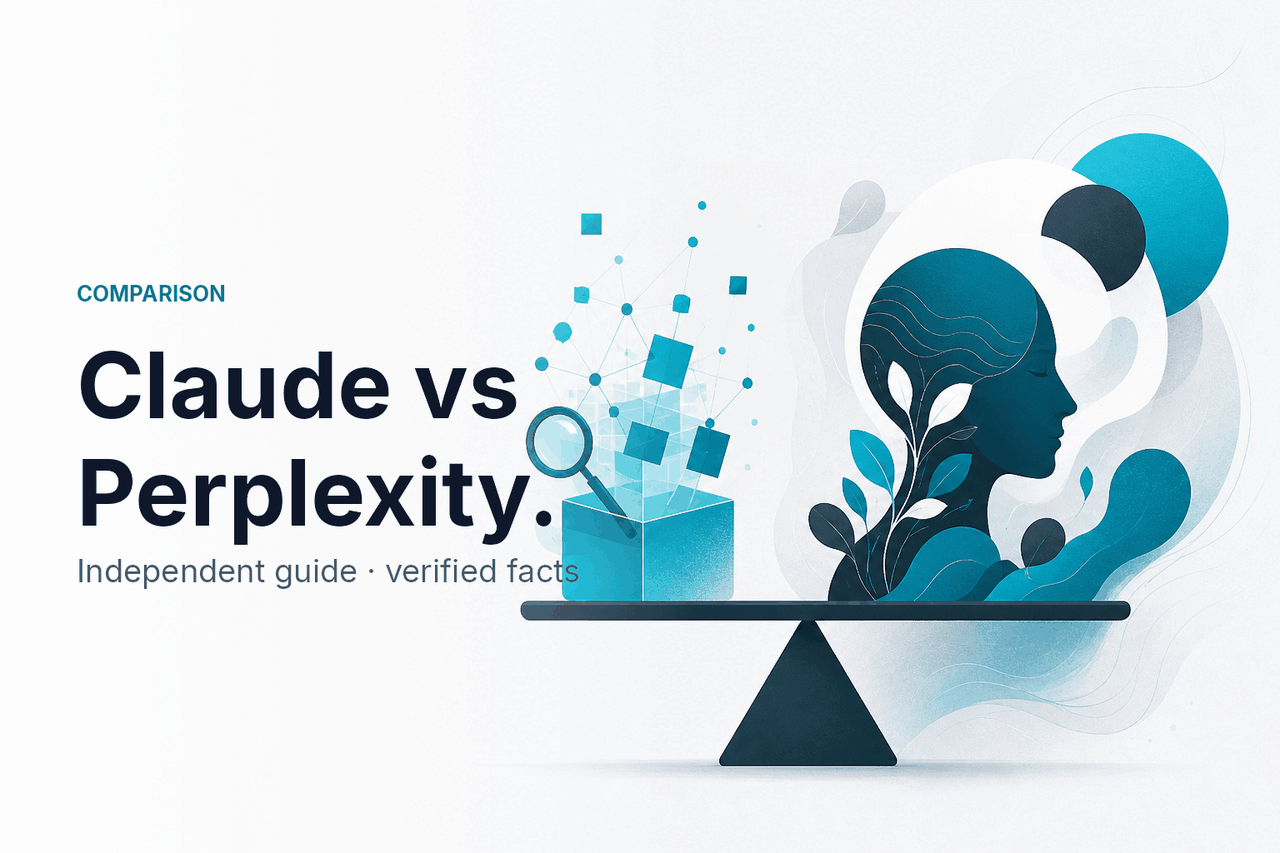
For Perplexity vs Claude, choose Claude for long-form reasoning, coding, document analysis, and controlled writing; choose Perplexity when your main task is web research with visible source links. c-ai.chat is independent, not Anthropic, and this comparison sits in our Claude resources hub for readers choosing between AI tools.
- The bottom line
- Head to head
- Where Claude is the better pick
- Where the other tool is better
- How to choose
- Other questions readers ask
- Sources
The bottom line
Claude is the stronger workbench. Perplexity is the stronger research front end. Use Claude when you bring the source material. Use Perplexity when you need to find sources first.
- Claude is stronger for long documents, code work, structured writing, file analysis, and repeatable workflows.
- Perplexity is stronger when the task starts with finding current public web sources.
- Claude pricing includes Free, Pro, Max, Team, Enterprise, and API usage.
- Best workflow: use Perplexity to find sources, then use Claude to analyse, draft, refactor, or decide.
The split is product shape. Claude, made by Anthropic, is a general AI assistant and developer platform. It is built for tasks, files, code, prompts, projects, and workflows. Perplexity is closer to an answer engine. It is useful when the first step is searching the web and inspecting source links.
If you are comparing them for work, do not ask which one is smarter in the abstract. Ask what the input is. If the input is your documents, code, notes, transcripts, policies, spreadsheets, or product requirements, Claude is usually the better primary tool. If the input is the public web, Perplexity is usually the faster starting point.
Head to head

The main differences are workflow, context, pricing, and source handling. Claude’s official product is claude.ai. Anthropic documents model details and API pricing in its official developer resources.
| Dimension | Claude | Perplexity | Practical verdict |
|---|---|---|---|
| Core product | General AI assistant and developer platform for writing, analysis, coding, files, projects, and API work. | Search-first AI answer engine focused on retrieving and presenting web-backed answers. | Claude is the workbench. Perplexity is the research lens. |
| Pricing | Free is $0. Pro is $20/month, or $17/month paid annually. Max starts from $100/month. Team Standard is $25/seat/month, or $20/seat/month paid annually. Team Premium is $125/seat/month, or $100/seat/month paid annually. Enterprise is $20/seat base plus API rates. | Check Perplexity’s own product for current plan details. This guide quotes only Claude prices from the approved Claude facts. | Claude is easier to model for teams, API usage, and repeatable workflows. |
| Models | Claude Opus 4.7 is the flagship model at $5/M input tokens and $25/M output tokens. Sonnet 4.6 is the balanced model at $3/M and $15/M. Haiku 4.5 is the fast, cheaper model at $1/M and $5/M. See our Claude models guide. | Perplexity presents model choices through its own search-and-answer product experience. | Claude gives you a clearer model-selection decision. Perplexity abstracts more of the retrieval workflow. |
| Context window | Opus 4.7 supports a 1,000,000-token context. Sonnet 4.6 also supports a 1,000,000-token context and a 128,000-token maximum output. | Perplexity is less about loading a large private corpus into one prompt and more about retrieving web information for a query. | Claude is stronger for long private documents, codebases, logs, and multi-file analysis. |
| Coding | Strong for code explanation, refactoring, test generation, architecture review, debugging, and structured implementation plans. | Useful for finding documentation, examples, release notes, and public issue context before coding. | Claude is better for doing code work. Perplexity is useful before the work starts. |
| Writing | Strong for tone control, long-form drafting, editing, summarising, business writing, and document transformation. | Good for quick source-backed answer drafts and research summaries. | Claude is better for final drafts and editorial control. Perplexity is better for fast sourced orientation. |
| Safety and governance | Anthropic publishes safety, trust, and policy material through official channels such as Anthropic Trust. Claude can refuse unsafe or disallowed requests. | Perplexity also applies product safety rules, but its user experience is centred on retrieval and citations. | Claude is often easier to assess for governed team workflows. Both tools can limit or refuse answers. |
| Ecosystem | Web product, API, Projects, model selection, prompt caching, Batch API, team administration, and enterprise controls. | Search-oriented discovery, citation-led answers, and browser-style research workflows. | Claude fits production and team workflows. Perplexity fits research discovery. |
Claude’s API economics matter if you build software. Opus 4.7 costs $5/M input tokens and $25/M output tokens. Sonnet 4.6 costs $3/M input tokens and $15/M output tokens. Haiku 4.5 costs $1/M input tokens and $5/M output tokens. Prompt caching gives 90% off cached input tokens. The Batch API gives 50% off both directions. For a fuller breakdown, see our Claude pricing guide and Claude API docs guide.
90% off
cached input tokens with prompt caching
Free
$0
Good for light personal use and testing Claude before paying.
Pro
$20/month
Also available at $17/month paid annually.
Max
From $100/month
For heavier individual use.
Team Standard
$25/seat/month
Also available at $20/seat/month paid annually.
Team Premium
$125/seat/month
Also available at $100/seat/month paid annually.
Enterprise
$20/seat base
Usage is billed at API rates.
That cost model makes Claude easier to plan for repeatable internal workflows. If your app sends the same system prompt, policy document, rubric, schema, or tool instructions many times, caching can reduce input cost. Perplexity is usually evaluated more as a search product than as a token pipeline.
Where Claude is the better pick
Claude is the better pick when the task requires sustained reasoning over material you already have. It is especially useful when the output must follow a format, tone, policy, or software constraint.
Analyse long private documents
Use Claude to compare contracts, policies, research notes, transcripts, logs, or internal documentation. The 1,000,000-token context on Opus 4.7 is a major advantage when the source material is not just a web search result.
Write and edit with tight tone control
Claude can rewrite the same facts for different audiences. For example, it can turn a technical incident report into an executive memo, customer email, internal FAQ, and support macro.
Work through code
Claude is useful for explaining unfamiliar code, generating tests, reviewing pull requests, debugging stack traces, and planning refactors.
Build repeatable AI workflows
Claude’s API, prompt caching, model choices, and Batch API make it easier to design repeatable workflows for support triage, document classification, report generation, data extraction, and internal tools.
Use team and enterprise controls
Claude’s team and enterprise options are more relevant when an organisation needs administration, governed usage, and predictable rollout planning.
Claude also fits people who spend more time producing than searching. A founder writing investor updates, a lawyer reviewing clauses, a marketer editing campaign copy, a developer refactoring a service, or a student organising lecture notes will usually get more direct value from Claude than from a search-led tool.
Projects are another practical advantage. A Project can hold instructions and context for a recurring workflow, so you do not have to restate the same rules every time. For a broader feature overview, see our Claude features guide.
Claude’s biggest strength is not that it always knows more. It is that it can do more with the material you provide. When you upload a document, paste a long brief, provide a rubric, or define an output schema, Claude is usually better suited to turning that input into usable work.
Where the other tool is better
Perplexity is often the better tool when the job begins with the open web. Claude is not always the right first tab.
Perplexity is better when
- You need a quick answer grounded in public web sources.
- You want source links visible as part of the answer experience.
- You are comparing recent public claims, pages, or announcements.
- You are starting research and do not yet know which sources matter.
Claude is better when
- You already have the source material and need analysis.
- You need code, drafts, structured outputs, or business documents.
- You need repeatable instructions, Projects, API usage, or team controls.
- You are working with private files rather than public search results.
Use Perplexity for market scans, competitor pages, definitions, news-style orientation, and source discovery. If your question is about the latest public statements on a topic, a search-first tool is the natural place to begin. It reduces tab-switching and gives you a source trail to inspect.
Perplexity is also helpful when you do not know the right query yet. Search engines require you to choose keywords. A conversational answer engine can help you identify names, concepts, companies, and documents before you decide what to investigate next.
Citations also change user behaviour. When links sit beside an answer, readers are more likely to inspect the evidence. Claude can work with sources when you provide them, but Perplexity makes source discovery part of the default product habit.
The trade-off is that source-led answers are not the same as finished work. A cited paragraph may still miss context, overstate a source, or combine results in a way that needs review. For high-stakes tasks, treat Perplexity output as a research brief, not the final deliverable.
How to choose
Choose based on the first verb in your task. If the verb is find, search, compare sources, or check current public information, start with Perplexity. If the verb is write, analyse, code, transform, plan, classify, review, or automate, start with Claude.
Pick Claude when
- You need long-document analysis or a large context window.
- You write reports, memos, emails, briefs, documentation, or policy drafts.
- You code and want help with tests, refactors, debugging, or architecture.
- You need API access, prompt caching, batch processing, or model selection.
- You need team administration, enterprise controls, or predictable workflows.
Pick Perplexity when
- You need to discover public sources quickly.
- You want a search-style answer with visible citations.
- You are doing early-stage research and do not yet have documents to analyse.
- You need a fast overview of a topic before moving into drafting or execution.
- You care more about source discovery than file-based or code-based work.
For many users, the right setup is both. Start with Perplexity when you need sources. Save the useful pages, quotes, and claims. Then bring that material into Claude and ask for structured analysis, a rewrite, a risk review, an implementation plan, or a decision memo.
Worked example
Research-to-output workflow
This split keeps source discovery separate from reasoning, writing, and delivery.
If you want one paid AI tool for everyday professional work, Claude is the safer default. The reason is breadth. It can handle writing, coding, long files, brainstorming, structured outputs, and developer workflows from one interface. If you want one tool mainly for research and cited web answers, Perplexity is the more direct fit.
Teams should also consider governance. Claude Team Standard is $25/seat/month, or $20/seat/month paid annually. Team Premium is $125/seat/month, or $100/seat/month paid annually. Enterprise is $20/seat base plus API rates. For official plan details, use Claude pricing, not a third-party screenshot or outdated plan table.
Other questions readers ask
These quick answers cover common follow-up questions about Claude and Perplexity. For broader Claude help, see our Claude FAQ.
For a wider map of Claude’s place in the AI assistant market, start from the c-ai.chat homepage or review the author and editorial approach on About the author.
Last updated: 2026-05-12
This article is part of the Claude comparisons hub on c-ai.chat.