
Claude 4 is Anthropic’s current Claude model generation, with Claude Opus 4.7 as the flagship option; this independent c-ai.chat guide explains where it fits in the Claude models lineup, when it is worth the cost, and when Sonnet or Haiku is the better choice.

- Which model is this?
- What it’s best at
- Where it falls short
- When to pick this model
- FAQ
- The honest take
- Sources
Which model is this?
Claude 4 is a generation label, not one model. The flagship model in the generation is Claude Opus 4.7.
Opus is the high-end family. Sonnet is the balanced default. Haiku is the fast, lower-cost option. When people search for “Claude 4,” they often mean the generation as a whole. In practice, they need to choose between Opus 4.7, Sonnet 4.6, and Haiku 4.5.
Opus 4.7
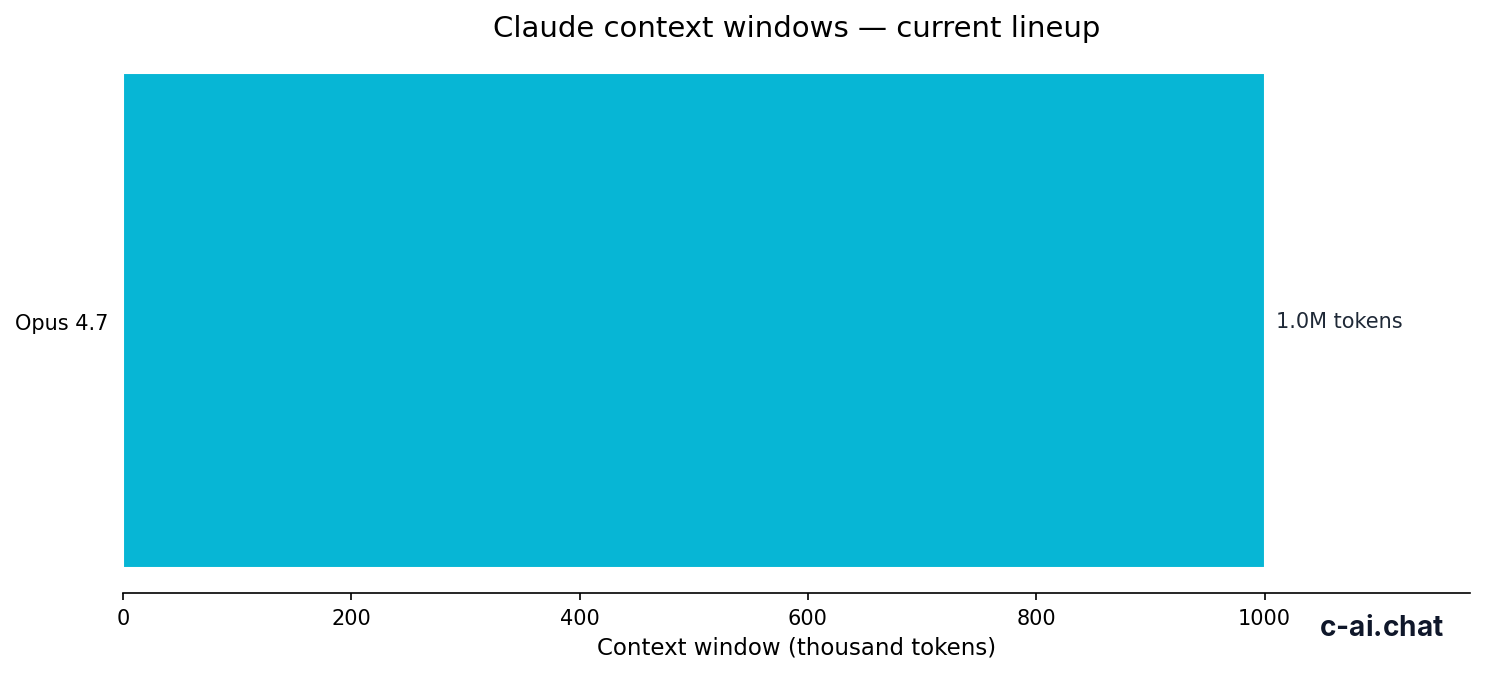
Flagship Claude 4 model · $5/M input tokens · $25/M output tokens · 1,000,000-token context
Anthropic makes Claude and runs the official product at claude.ai. Anthropic publishes developer details in the official Claude model overview. c-ai.chat is independent. We explain the lineup, pricing, trade-offs, and use cases, but we do not speak for Anthropic.
For most users, the right question is not whether Claude 4 is newer. It is which Claude 4 model to use. Opus 4.7 is the premium choice. Sonnet 4.6 is the sensible starting point for most work. Haiku 4.5 is the efficiency pick when speed and cost matter more than peak reasoning.
| Model | Best role | Input price | Output price | Context | Max output |
|---|---|---|---|---|---|
| Claude Opus 4.7 | Flagship reasoning, complex analysis, difficult coding tasks | $5/M tokens | $25/M tokens | 1,000,000 tokens | See official model table |
| Claude Sonnet 4.6 | Recommended default for most work | $3/M tokens | $15/M tokens | 1,000,000 tokens | 128,000 tokens |
| Claude Haiku 4.5 | Fast, lower-cost tasks at scale | $1/M tokens | $5/M tokens | 200,000 tokens | See official model table |
What it’s best at

Claude Opus 4.7 is best for work that requires careful reasoning across many constraints. It is strongest when the answer must be accurate, structured, and sensitive to details in the source material.
Use it for complex coding, long-document analysis, multi-step research synthesis, technical writing, contract review, and planning tasks where one missed detail can change the result.
The trade-off is cost. Opus 4.7 costs more than Sonnet 4.6 and Haiku 4.5. It should not be your default for every prompt. A practical workflow is to use Sonnet 4.6 for daily work, Haiku 4.5 for high-volume simple tasks, and Opus 4.7 for the final pass or the hard cases. If you are building with the API, see our Claude API guide before designing model routing.
- Hard coding tasks: debugging across files, architecture review, migration planning, test design, and code explanation.
- Long-context review: large policy packs, research collections, discovery materials, technical specs, and product documentation.
- High-stakes writing: executive memos, legal-style summaries, investor materials, and documents that need careful structure.
- Reasoned comparison: weighing trade-offs across several options instead of producing a generic recommendation.
- Agentic workflows: planning steps, checking intermediate results, and revising the plan when new information appears.
Worked example
A practical model-routing pattern
This keeps quality high without paying flagship rates for every step.
Claude 4 also sits inside the broader Claude product set. Depending on your plan and product surface, Claude can support Projects, Research, Office integrations, Claude Code, and other workflow features. For the wider map, see our Claude features overview.
For developers, Anthropic’s official pricing pages explain model rates, prompt caching, batch processing, and long-context costs. API pricing is listed in the Claude pricing docs. Consumer plan pricing is listed at claude.com/pricing.
90% off
cached input tokens with prompt caching
Prompt caching helps when you reuse a large system prompt, policy document, codebase summary, or reference pack. It does not reduce output-token cost. Batch API processing can reduce cost by 50% in both directions when the job can run asynchronously.
Where it falls short
Claude Opus 4.7 is not the right model for every job. Its main drawback is cost. At $5/M input tokens and $25/M output tokens, it can be too expensive for routine summarization, classification, extraction, and short drafting.
It can also be slower than a lighter model in high-throughput systems. A stronger model still needs clear instructions, relevant source material, evaluation, and human review for important work.
- Routine classification: use Haiku 4.5 when the task is simple, repetitive, and easy to verify.
- Everyday drafting: use Sonnet 4.6 for emails, outlines, summaries, and general business writing unless the stakes justify Opus.
- Large-scale extraction: do not pay flagship output rates to pull structured fields from predictable documents.
- Latency-sensitive apps: choose the fastest model that meets your quality threshold.
- Unsupported assumptions: Claude can reason over the material you provide, but it should not be treated as a source of truth without citations or validation.
- Product availability: consumer plan access, usage limits, and feature availability can vary. Use official product and plan pages for current limits.
Do not use Opus 4.7 as a substitute for process. A better model can improve reasoning, but it will not fix unclear goals, missing data, weak evaluation, or a workflow with no review step.
Reliability also depends on the service surface you use. For live incidents or degraded service, check Claude status. For security, compliance, and trust documentation, Anthropic publishes information at trust.anthropic.com.
When to pick this model
Pick Claude Opus 4.7 when quality matters more than marginal token cost. Skip it when a cheaper Claude model can produce an answer that is good enough.
Pick when
- The task has many constraints and a wrong answer is costly.
- You need careful reasoning across long documents or codebases.
- You are doing final review after a cheaper model produced a first pass.
- You need strong planning, critique, or edge-case analysis.
- The budget supports $5/M input tokens and $25/M output tokens.
Skip when
- The task is simple classification, tagging, or extraction.
- You are generating large volumes of low-stakes output.
- Latency matters more than peak reasoning quality.
- Sonnet 4.6 meets your quality bar at $3/M input tokens and $15/M output tokens.
- Haiku 4.5 can solve the task at $1/M input tokens and $5/M output tokens.
The decision rule is simple: start with Sonnet 4.6, move down to Haiku 4.5 for cheap repetitive work, and move up to Opus 4.7 when reasoning quality changes the outcome.
If you use Claude through the consumer app, your plan affects access and usage limits. For a fuller breakdown, see our Claude pricing guide.
Free
$0
Basic access with daily usage limits.
Pro
$20/month
$17/month when billed annually. Built for individual users who need more capacity.
Max
From $100/month
Higher-capacity access for power users.
Team Standard
$25/seat/month
$20/seat/month when billed annually.
Team Premium
$125/seat/month
$100/seat/month when billed annually.
Enterprise
$20/seat base
Usage is charged at API rates under enterprise terms.
For teams, model choice should be part of a governance plan. Decide who can use flagship models, what data can be sent to Claude, how outputs are reviewed, and how spend is tracked. In regulated environments, admin controls, SSO, audit logs, role-based access, and data residency may matter more than the model name.
FAQ
These are the related questions people usually ask after searching for Claude 4. For broader questions, see our Claude FAQ.
The honest take
Claude 4 is the generation to evaluate if you want Anthropic’s current Claude capabilities. Within it, Claude Opus 4.7 is the strongest option for demanding reasoning, long-context analysis, difficult coding, and high-stakes review.
It is not the automatic default. Its pricing makes it a specialist tool for the work that deserves it. Most users should start with Sonnet 4.6, use Haiku 4.5 for fast low-cost tasks, and reserve Opus 4.7 for the hard parts.
Independent guide. Not affiliated with Anthropic. Official product: claude.ai.
Last updated: 2026-05-15