
Claude benchmarks depend on the exact model you mean: Claude Opus 4.7 is the current flagship, Sonnet 4.6 is the practical default for most users, and Haiku 4.5 is the low-cost speed option. This is an independent guide from c-ai.chat, not Anthropic, and this page explains how to identify the model, where it performs well, where it does not, and when the benchmark numbers actually matter.

If you need broader context first, see our guides to Claude models, Claude pricing, the Claude API, and core Claude features.
- Which model is this?
- What it’s best at
- Where it falls short
- When to pick this model
- Other questions readers ask
- The honest take
Which model is this?

For most searches around claude benchmarks, the model people usually mean is Claude Sonnet 4.6: the Sonnet family, version 4.6, released as Anthropic’s recommended default model for general use. It sits between Opus and Haiku in the lineup, with lower cost than Opus 4.7 and stronger broad capability than Haiku 4.5.
- Input $3/M tokens
- Output $15/M tokens
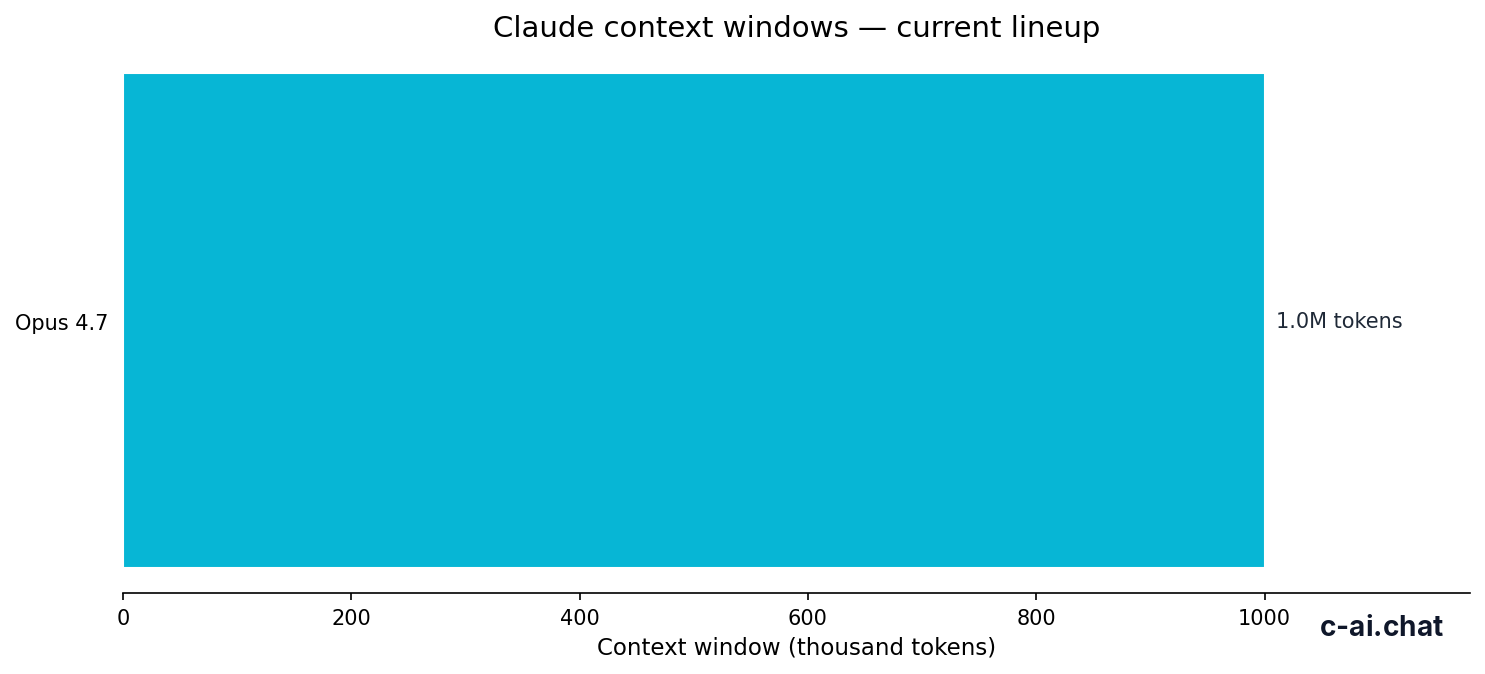
- Context 1,000,000 tokens
- Max output 128K tokens
That matters because benchmark comparisons are often blurred together. A headline may say “Claude” without naming the exact version, pricing tier, or context limit. On Anthropic’s current lineup page, the active public families are Opus 4.7, Sonnet 4.6, and Haiku 4.5, each aimed at a different speed-capability-cost trade-off. If you want the full lineup and positioning, our models overview is the best starting point.
| Model | Position in lineup | Input price | Output price | Context window | Best fit |
|---|---|---|---|---|---|
| Claude Opus 4.7 | Flagship | $5/M | $25/M | 1,000,000 tokens | Hard reasoning, highest-stakes work |
| Claude Sonnet 4.6 | Recommended default | $3/M | $15/M | 1,000,000 tokens | Balanced quality, speed, and cost |
| Claude Haiku 4.5 | Fastest and cheapest | $1/M | $5/M | Smaller-cost general workloads | Latency-sensitive and budget-sensitive tasks |
What it’s best at
Claude Sonnet 4.6 is best at being reliably strong across many common benchmark categories without the higher Opus price. That includes coding help, structured writing, document analysis, summarisation, instruction following, and long-context work where you need a model that stays coherent over large inputs. If your benchmark question is really “which Claude should I start with?”, Sonnet 4.6 is usually the right answer.
Against siblings, Sonnet 4.6 is the middle ground that wins on practicality. Opus 4.7 is the better pick when benchmark gains on complex reasoning or difficult multi-step tasks justify paying $5/M input and $25/M output. Haiku 4.5 is the better pick when speed and price dominate, but it will usually give up some accuracy, nuance, and consistency on harder workloads. Sonnet 4.6 is often where benchmark performance and real operating cost meet cleanly.
- Coding and debugging: Strong enough for many production assistants, internal tools, and repo-level workflows without jumping straight to Opus pricing.
- Long-document analysis: The 1,000,000-token context window makes it useful for large policy sets, research packets, transcripts, and multi-file reviews.
- Business writing: Better than lower-tier models at tone control, extraction, rewriting, and structured outputs that need fewer retries.
- Agentic workflows: A solid default for API-based systems that need a balance of quality and cost across repeated calls.
- Mixed workloads: If your benchmark use case spans writing, reasoning, and analysis in the same product, Sonnet 4.6 is easier to standardise on than Opus 4.7 or Haiku 4.5.
90% off
cached input tokens with prompt caching
That cost detail matters for benchmark interpretation. Some teams judge a model only by raw quality scores, but real usage cost changes the recommendation. With prompt caching, repeated large system prompts or reference material can be much cheaper. Anthropic also offers Batch API pricing at 50% off both input and output, which can shift a benchmark winner from “too expensive” to “viable” for offline jobs. For implementation details, see our Claude API guide and pricing breakdown.
Where it falls short
Sonnet 4.6 falls short when you need the absolute strongest model in the lineup or the absolute cheapest one. It is not the top-end choice for the hardest reasoning tasks where Opus 4.7 can justify its higher cost, and it is not the budget pick for high-volume, latency-sensitive workflows where Haiku 4.5 is more economical. Benchmark wins in one category also do not guarantee fewer hallucinations, perfect factual recall, or better performance on your own domain prompts.
- Hard reasoning edge cases: If a benchmark is focused on difficult multi-step reasoning, Opus 4.7 is the safer bet.
- Ultra-low-cost volume: If you are processing huge request volumes, Haiku 4.5’s $1/M input and $5/M output pricing is much easier to scale.
- Latency-first applications: Chat widgets, real-time classification, and lightweight extraction may not need Sonnet’s extra capability.
- Benchmark overfitting: A model can look strong on public leaderboards but still underperform on your documents, codebase, or style rules.
- Very long outputs at scale: Even with a 128K max output, long generations can become expensive quickly at $15/M output tokens.
When to pick this model
Pick Sonnet 4.6 when you want the strongest general-purpose Claude model before cost starts climbing into flagship territory. The pricing trade-off is simple: it costs more than Haiku 4.5 but materially less than Opus 4.7, which is why it is the default recommendation for many benchmark-driven evaluations.
Pick when
- You want the best quality-per-dollar balance in the current Claude lineup.
- Your tasks mix reasoning, writing, coding, and document analysis.
- You need 1,000,000-token context without paying Opus 4.7 rates.
- You care about benchmark strength, but also about production cost.
- You are building on the API and want one sensible default model.
Skip when
- You need the highest-performing Claude available for difficult tasks; choose Opus 4.7.
- You need the cheapest high-volume throughput; choose Haiku 4.5.
- Your workload is simple classification, routing, or short extraction where Sonnet is more than you need.
- Your budget is sensitive to output token costs; Sonnet output is $15/M versus $5/M on Haiku 4.5.
If you are comparing benchmarks through the app rather than the API, plan choice also affects the experience. The Claude pricing page is useful here: Free is $0/month with daily usage limits, Pro is $20/month or $17/month annual for individuals, Max starts at $100/month for higher usage, Team Standard is $25/seat/month or $20/seat/month annual, Team Premium is $125/seat/month or $100/seat/month annual, and Enterprise starts from a $20/seat base plus usage at API rates. Those plan limits can shape perceived benchmark performance because they affect access, traffic priority, and available capacity.
Other questions readers ask
The honest take
If you searched for claude benchmarks because you want one clear recommendation, start with Claude Sonnet 4.6. It is the model that makes the most sense for most people: strong enough to score well across many practical tasks, cheaper than Opus 4.7, and much more capable than a pure budget-first choice in many real workflows.
If your benchmark is pushing the limits of reasoning, use Opus 4.7. If your benchmark is really a cost-per-task exercise, use Haiku 4.5. But if you want the model that most often balances score, speed, long-context utility, and price, Sonnet 4.6 is the honest default. For the official product, you can test it directly on claude.ai, and for a wider comparison of the lineup, see our Claude models guide.
Independent guide. Not affiliated with Anthropic. For the official Claude product, visit claude.ai.
Last updated: 2026-05-15