
Claude AI costs $0 on Free, $20/month for Pro, from $100/month for Max, $25/seat/month for Team Standard, and API usage is billed per million tokens. This independent c-ai.chat guide explains the official Claude pricing options, what each plan includes, and when upgrading makes sense.

- The bottom line
- What’s actually included
- Is it worth it for you?
- Cheaper / better alternatives
- The honest take
- FAQ
- Sources
The bottom line
Most individual users pay either $0/month or $20/month. Free works for occasional use. Pro is the main paid plan for daily writing, analysis, coding, and document work. Max starts at $100/month for heavier users. Team Standard starts at $25/seat/month. Enterprise uses a $20/seat base plus usage at API rates under a custom contract.
$0–$20/month
covers most individual Claude users
The official Claude product is available at claude.ai. Anthropic publishes current plan details at claude.com/pricing. c-ai.chat is independent and is not Anthropic.
There are two ways to pay for Claude:
- Claude app subscriptions for people using Claude through the web, desktop, iOS, or Android apps.
- Claude API pricing for developers and businesses building Claude into products, tools, or workflows.
For most readers asking how much Claude AI costs, app pricing is the answer. For developers, the important numbers are token prices, model choice, caching, and batch discounts. See our Claude API documentation guide if you are estimating production usage.
What’s actually included
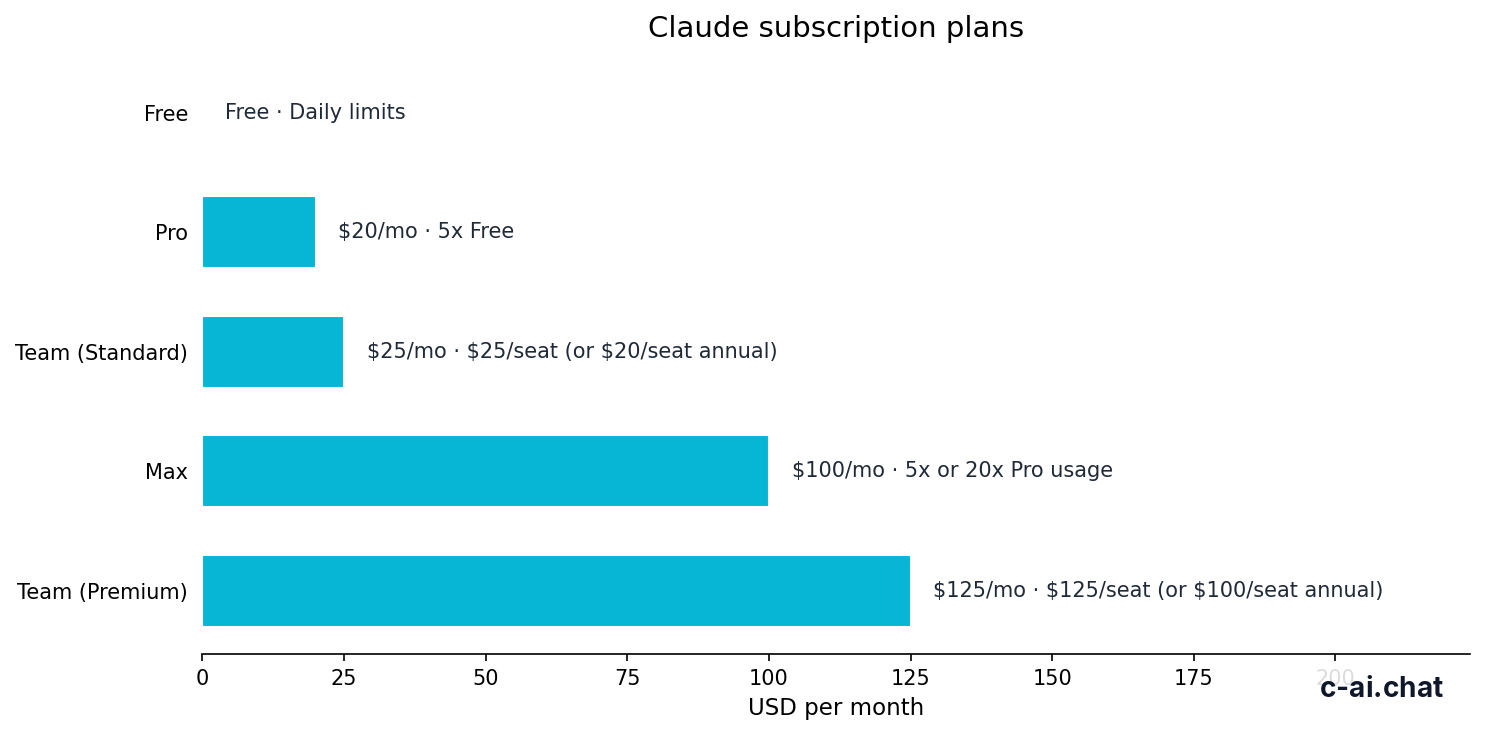
Claude plans differ by usage limits, collaboration controls, model access, admin features, and whether you need the app or metered API access. The table below uses the official plan structure and prices.
Free
$0/month
For occasional users and first-time testing
- Web, iOS, Android, and desktop access
- Daily usage limits
- No card required to start
Pro
$20/month
For individuals using Claude for regular work
- Claude Code
- Projects
- Research access
- Additional model access
- Office integrations for Excel, PowerPoint, and Word beta
- $17/month equivalent with annual billing
Max
From $100/month
For power users who hit Pro limits
- Higher usage than Pro
- Higher output limits
- Priority traffic
- Useful for long sessions and frequent high-volume work
Team Standard
$25/seat/month
For small teams that need shared controls
- $20/seat/month equivalent with annual billing
- Team workspace
- Admin controls
- Centralised billing
Team Premium
$125/seat/month
For teams needing more capacity and controls
- $100/seat/month equivalent with annual billing
- Higher-capacity team tier
- Priority traffic
- Expanded admin controls
Enterprise
$20/seat base + API rates
For organisations with governance and deployment needs
- Custom contract
- Enterprise administration
- Security and compliance options
- Usage billed at API rates
For individuals, the practical choice is usually Free, Pro, or Max. Free is enough for light use. Pro is the normal paid plan for people who rely on Claude during the week. Max is for users who already know Pro limits are blocking useful work.
For organisations, Team and Enterprise matter because they add management features. Central billing, admin controls, and shared workspaces help companies manage access and cost. See our overview of Claude’s broader features if you are comparing the app with developer access.
Claude API model pricing
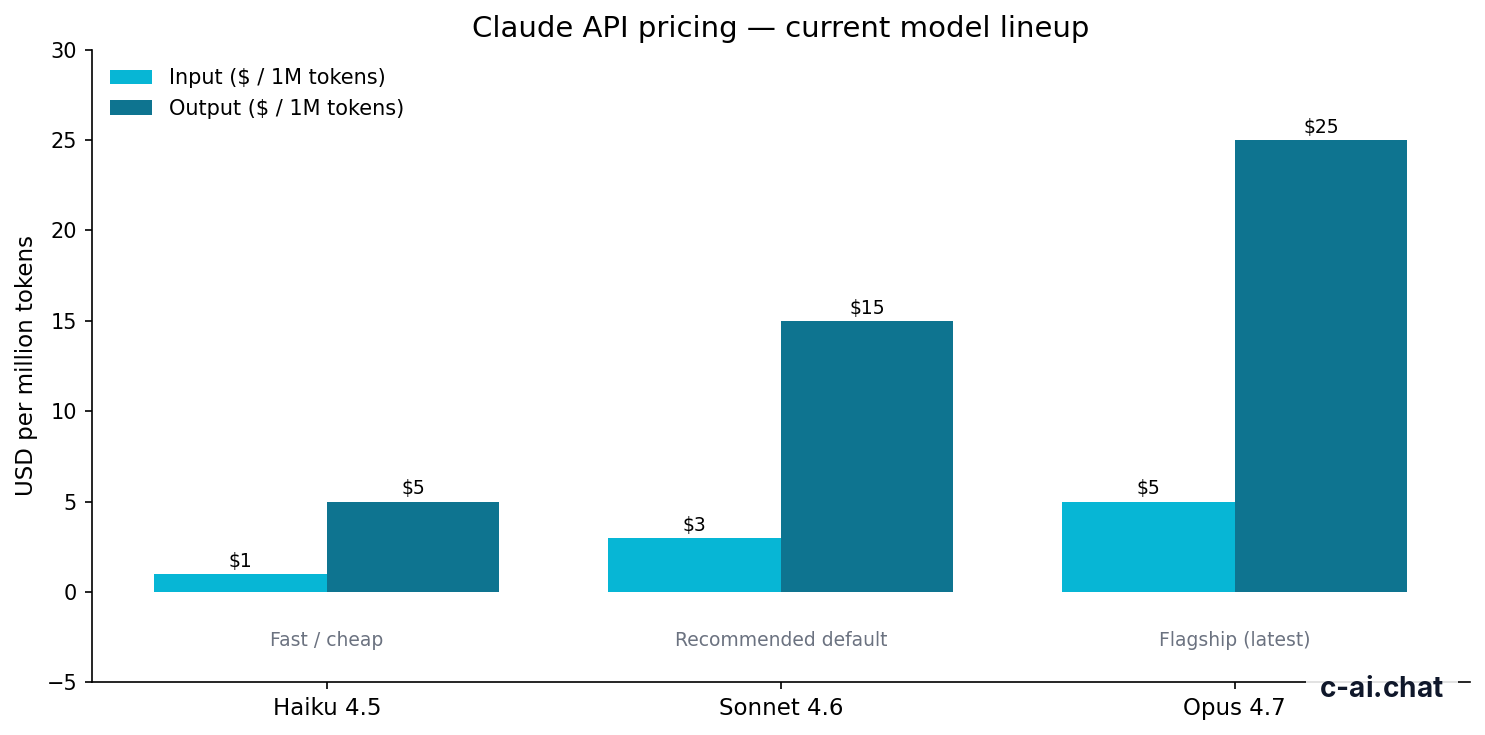
Developers pay by tokens. A token is a chunk of text. Input tokens are what you send to Claude. Output tokens are what Claude generates. Longer prompts, large documents, and long answers cost more than short chat turns.
| Model | Best fit | Input price | Output price | Context and output |
|---|---|---|---|---|
| Claude Opus 4.7 | Highest-capability tasks | $5/M tokens | $25/M tokens | 1M context |
| Claude Sonnet 4.6 | Default balance of cost and capability | $3/M tokens | $15/M tokens | 1M context, 128K max output |
| Claude Haiku 4.5 | Fast, lower-cost tasks | $1/M tokens | $5/M tokens | Lower-cost model for simpler workloads |
API prices come from Anthropic’s platform pricing documentation at platform.claude.com. Model availability and technical details are listed in the official models overview. For a plain-English comparison, see our Claude models guide.
90% off
cached input tokens with prompt caching
Two API discounts matter for cost planning. Prompt caching gives 90% off cached input tokens. That helps when you repeatedly send the same system instructions, policies, examples, or long reference material. Batch API gives 50% off both directions when latency is less important. Long context is useful, but it does not make large prompts free. If you send a million-token context, you still pay for those tokens at the applicable model rate.
Worked example
Simple API estimate using Sonnet 4.6
This estimate excludes caching, batching, retries, and application overhead.
API usage can scale quickly if your app sends large files, long conversation histories, or verbose outputs. Cost control usually comes from shorter prompts, better retrieval, prompt caching, batch processing, model routing, and output limits. For implementation details, start with our Claude API overview.
Is it worth it for you?

Claude is worth paying for when it saves time on work you already do often. It is less compelling when you only need a chatbot a few times a month or when your work depends on features Claude does not provide in your plan.
Pick Claude when
- You use Claude most workdays for writing, research, coding, or document review.
- Free limits interrupt work that matters.
- You need Projects, Research access, Claude Code, or Office integrations.
- Your team needs shared billing and admin controls.
- Your product needs API access and you can monitor token usage.
Skip paid Claude when
- You ask a few casual questions each week.
- You cannot yet tell whether usage will justify a monthly subscription.
- You need organisation controls but are considering unmanaged Pro accounts.
- Your API workload sends very large prompts without caching or batching.
- You need a feature Anthropic has not documented for your plan.
Pro fits individual professionals. Writers, analysts, marketers, students, consultants, founders, and developers can justify Pro if Claude reduces repetitive work. Common tasks include drafting briefs, analysing long documents, improving code, preparing meeting notes, and comparing options.
Max fits heavy individual users. If you rely on Claude for long coding sessions, large document workflows, high-output tasks, or frequent model switching, Max may be easier to justify than repeatedly hitting Pro limits. If you are unsure, start with Pro and upgrade only after the limits become a real constraint.
Team fits managed collaboration. A business should not choose Team only because several employees want Claude. Choose Team when central billing, shared workspace, and admin controls matter. If compliance, auditability, regional requirements, or strict spend controls are requirements, Enterprise is the relevant path.
API access fits builders. If you are putting Claude into a product, internal tool, data pipeline, or automation, the API is the right pricing model. Subscriptions are for human use in Claude’s app. API pricing is for software-driven usage. Anthropic’s developer documentation at docs.claude.com and the API platform are the official references.
Cheaper / better alternatives
The cheaper alternative to Pro is Free. The stronger alternative is Max. For teams, the cheaper option is individual accounts, but that can be the wrong choice if you need admin control. For developers, the cheaper alternative is usually a lower-cost model, caching, batching, or tighter prompts.
| If you are considering | Cheaper option | More capable option | Best fit |
|---|---|---|---|
| Pro at $20/month | Free at $0/month | Max from $100/month | Individuals who use Claude regularly |
| Max from $100/month | Pro at $20/month | Higher Max usage level if available in your account | Power users who hit Pro limits |
| Team Standard at $25/seat/month | Pro at $20/month per individual | Team Premium at $125/seat/month | Small teams needing shared controls |
| Team Premium at $125/seat/month | Team Standard at $25/seat/month | Enterprise with $20/seat base + usage at API rates | Teams needing more capacity and administration |
| Opus 4.7 API at $5/M input and $25/M output | Sonnet 4.6 at $3/M input and $15/M output | Use Opus 4.7 where quality matters most | High-value tasks that justify flagship pricing |
| Sonnet 4.6 API at $3/M input and $15/M output | Haiku 4.5 at $1/M input and $5/M output | Opus 4.7 at $5/M input and $25/M output | Balanced production workloads |
Free is the right alternative if you are still testing Claude. It lets you judge tone, reasoning style, file handling, and everyday usefulness without committing to a subscription. The trade-off is usage limits. If you only discover those limits during important work, Free can become frustrating.
Pro is the right alternative to Max if your workload is steady but not extreme. Many users do not need Max. The question is not whether Max is more capable. It is whether the extra usage and higher output limits will produce enough value for your work.
Team Standard is often a better alternative to several unmanaged Pro accounts. The per-seat price is higher than Pro, but team billing and administration solve organisational problems. If a person leaves the company, changes role, or needs access revoked, managed plans matter.
For API users, Sonnet 4.6 is the recommended default because it balances cost and capability. Haiku 4.5 is better for high-volume simple tasks. Opus 4.7 is better reserved for difficult reasoning, high-stakes writing, complex coding, or cases where quality matters more than price. Check Claude status if availability affects production planning, and Anthropic Trust Center for security and compliance material.
The honest take
For most people, Claude costs either $0/month or $20/month. Start with Free if you are evaluating it. Pay for Pro if Claude becomes part of your normal workflow. Consider Max only when Pro limits clearly cost you time. Choose Team or Enterprise when governance, security, and administration matter more than individual convenience.
For developers, the subscription price is not the main number. Model choice, input size, output size, caching, and batching determine the bill. Use Haiku 4.5 for cheaper simple tasks, Sonnet 4.6 as the default, and Opus 4.7 where the extra cost is justified. If you need a wider orientation before deciding, start at the c-ai.chat Claude guide or browse common questions in our Claude FAQ.
FAQ
How much does Claude AI cost for one person?
For one person, Claude costs $0/month on Free, $20/month on Pro, or from $100/month on Max. Pro is also available at $17/month with annual billing.
Is Claude Pro worth $20/month?
Claude Pro is worth $20/month if you use Claude regularly for work and Free limits interrupt you. If you only use Claude occasionally, stay on Free until you have a clear reason to upgrade.
Does Claude have a free plan?
Yes. Claude has a Free plan at $0/month with access through web, iOS, Android, and desktop apps, subject to daily usage limits.
How much does Claude cost for teams?
Team Standard costs $25/seat/month, or $20/seat/month with annual billing. Team Premium costs $125/seat/month, or $100/seat/month with annual billing. Enterprise has a $20/seat base plus usage at API rates under custom contracts.
How much does the Claude API cost?
The Claude API is billed per million tokens. Claude Opus 4.7 costs $5/M input tokens and $25/M output tokens. Claude Sonnet 4.6 costs $3/M input tokens and $15/M output tokens. Claude Haiku 4.5 costs $1/M input tokens and $5/M output tokens.
Can I reduce Claude API costs?
Yes. Prompt caching gives 90% off cached input tokens. Batch API gives 50% off both directions. You can also reduce cost by using Haiku 4.5 for simpler tasks, setting output limits, shortening prompts, and avoiding unnecessary long context.
Does paying for Claude Pro include API usage?
No. Claude app subscriptions and Claude API billing are separate pricing models. Pro is for using Claude in the app. API usage is metered through the developer platform.
Where are the official Claude prices listed?
Anthropic lists official Claude plan pricing at claude.com/pricing and API pricing in the Claude API pricing documentation.
Independent guide. Not affiliated with Anthropic. For the official Claude product, visit claude.ai.
Last updated: 2026-05-12
This article is part of the Claude pricing & plans hub on c-ai.chat.