
Claude credits vs subscription comes down to this: prepaid credits are the API pay-as-you-go model billed by token use, while Claude subscriptions are flat monthly plans for the Claude apps, so developers usually want credits and most individual chat users want Free, Pro, or Max; this independent guide from c-ai.chat explains the difference, what each option includes, and when to choose one over the other.
- The bottom line
- What’s actually included
- Is it worth it for you?
- Cheaper / better alternatives
- The honest take
- FAQ
The bottom line
If you use Claude through the app at claude.ai, you are choosing a subscription plan such as Free, Pro, Max, Team, or Enterprise. If you use Claude through the API at the developer platform, you are paying usage-based credits priced per million tokens. They are different products with different billing models, and one does not replace the other.
- Price · Subscriptions start at $0/month; API usage starts at $1/M input tokens on Haiku 4.5
- Included · Subscription = Claude apps and features; credits = API model access billed by use
- Upgrade when · You hit app limits often or need higher API volume and control
- Skip if · You only want casual chat but are looking at API credits, or vice versa
The main mistake people make is assuming “Claude credits” are a prepaid wallet for the Claude web app. They are not. API billing and app subscriptions sit side by side. A Pro plan does not turn into API credits, and API spend does not unlock Pro features such as Claude Code, Claude Cowork, unlimited Projects, Research access, or Office integrations.
Anthropic lists app plans on Claude pricing and API pricing on the platform pricing docs. If you are still deciding which side of Claude you need, our main Claude guide and feature overview help map the product split.
What’s actually included
Subscriptions buy access to Claude’s consumer or workplace apps. Credits buy model usage in the API. That sounds simple, but the details matter because the included tools, limits, and admin controls are very different.
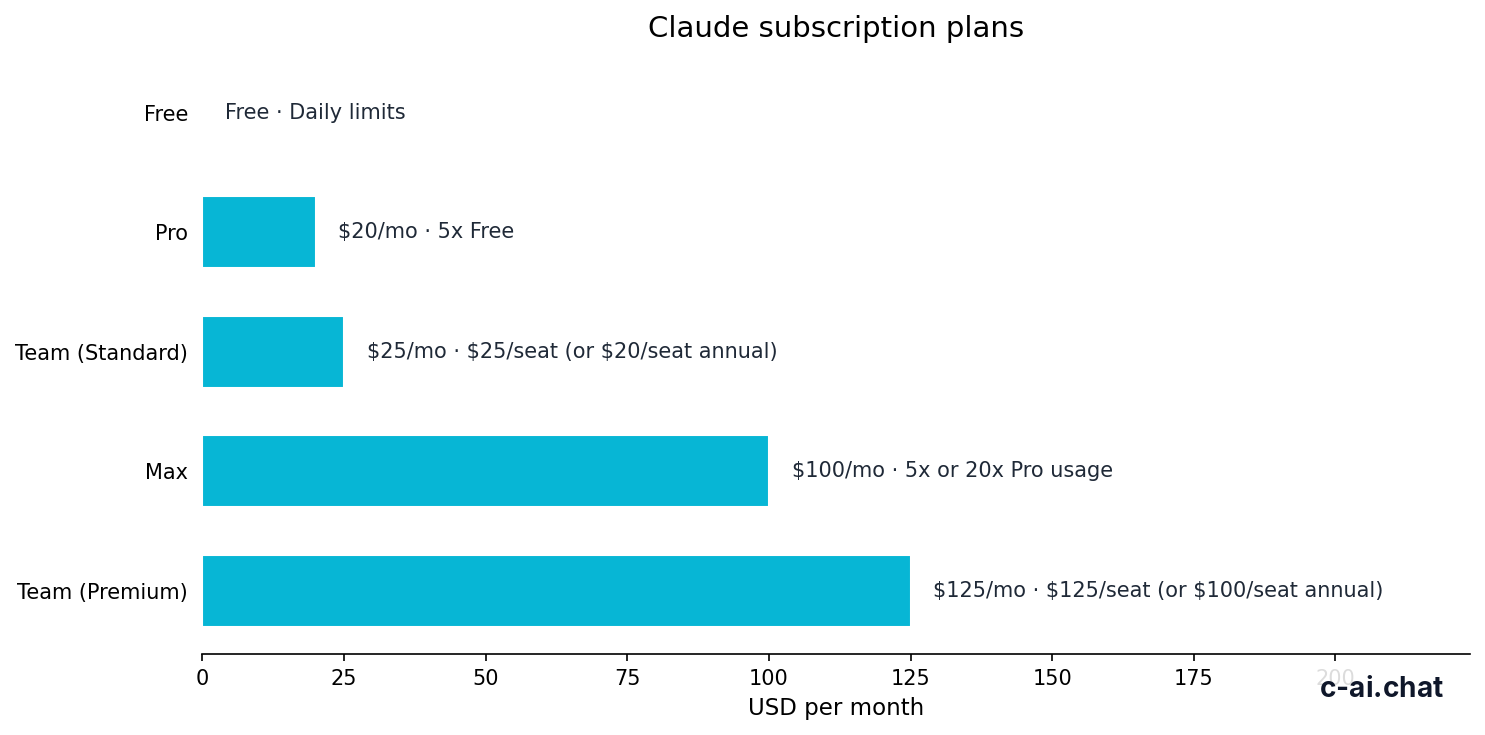
| Option | Price | What you get | Best for |
|---|---|---|---|
| Free | $0/month | Claude on web, iOS, Android, and desktop with daily usage limits | Casual users, testing the app |
| Pro | $20/month or $17/month annual | For individuals; adds Claude Code, Claude Cowork, unlimited Projects, Research access, additional models, and Excel/PowerPoint/Word beta integrations | Regular solo users |
| Max | From $100/month | 5x or 20x Pro usage, higher output limits, early feature access, and priority traffic | Heavy individual users |
| Team Standard | $25/seat/month or $20/seat/month annual | Shared workspace, SSO, and admin controls | Small teams |
| Team Premium | $125/seat/month or $100/seat/month annual | Higher-capacity team tier with priority traffic and expanded admin controls | Teams that need more capacity and control |
| Enterprise | $20/seat base + usage at API rates | Custom contracts, SCIM, audit logs, HIPAA-ready options, role-based access, spend controls, and regional data residency | Large organisations with governance requirements |
| API credits | Usage-based | Token-billed access to Claude models in your own apps and workflows | Developers and product teams |
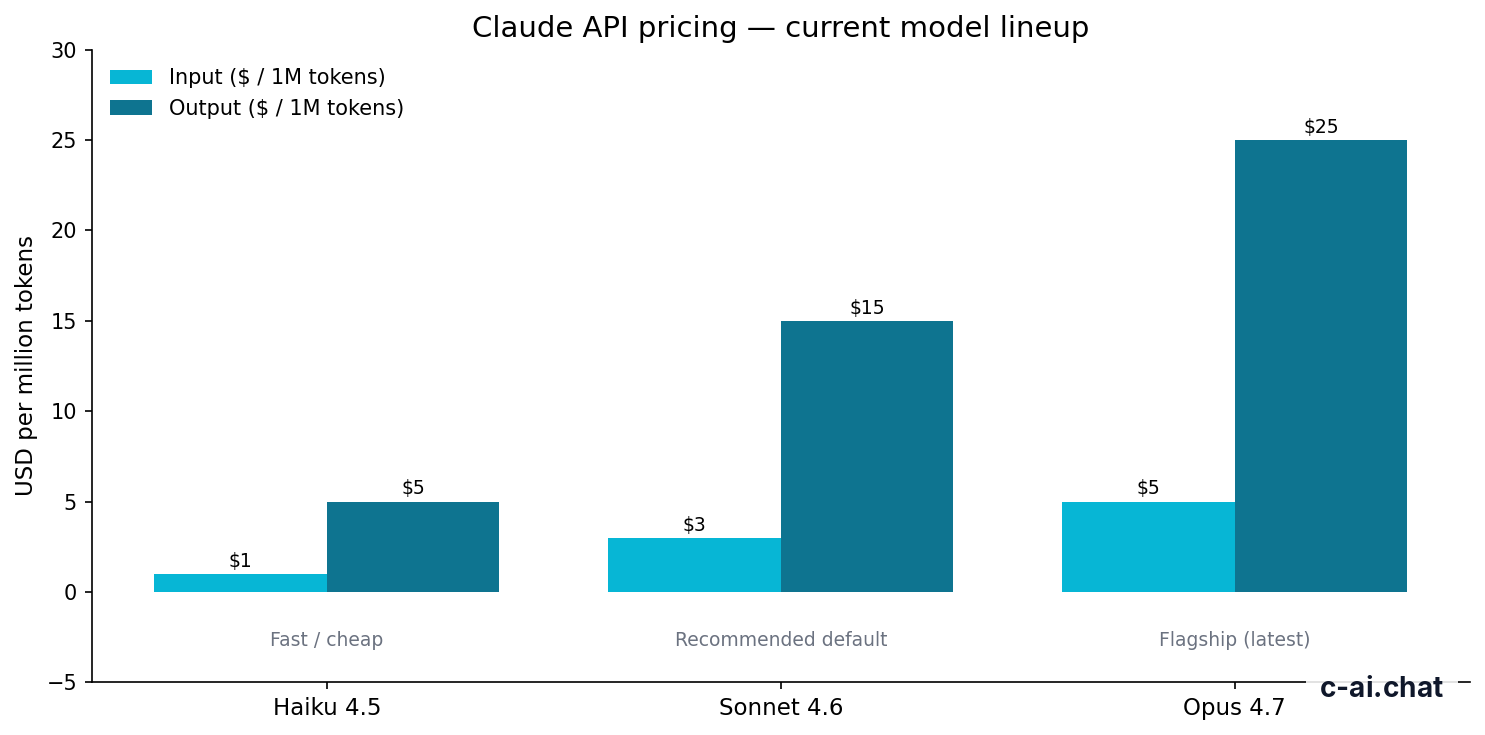
For API usage, the active model prices are straightforward. Claude Opus 4.7 is $5 per million input tokens and $25 per million output tokens. Claude Sonnet 4.6 is $3 input and $15 output. Claude Haiku 4.5 is $1 input and $5 output. Opus 4.7, Opus 4.6, and Sonnet 4.6 support up to 1,000,000 tokens of context at standard rates.
90% off
cached input tokens with prompt caching
That discount matters if your app reuses large system prompts, documents, or repeated context. Anthropic also offers the Batch API at 50% off both input and output pricing, which is often a better answer than moving up to a larger subscription if your need is purely programmatic.
Subscription plans
$0 to $125+/month or per seat
For app users and teams
- Use Claude on web, mobile, and desktop
- Feature bundles depend on plan
- Usage caps are plan-based, not pure token billing
API credits
$1 to $25 per million tokens
For developers and product teams
- Pay for actual model usage
- Choose Opus, Sonnet, or Haiku
- Supports caching and batch discounts
Another difference is predictability. Subscriptions are easier to budget for one person or a small team because the monthly cost is visible upfront. Credits are more flexible but require usage tracking. If your prompts or output lengths vary a lot, your bill can move more than you expect. That is why many companies combine both: employees get app subscriptions for day-to-day work, while the product team uses API credits for shipping features.
If you are unsure whether your need is “app access” or “model access”, ask one question: are you logging into Claude to chat yourself, or are you integrating Claude into software, scripts, automations, or a product? The first points to subscriptions. The second points to API credits.
Is it worth it for you?

The right choice depends less on budget than on workflow. A flat subscription is worth it when you use Claude personally and often enough to hit free limits. Credits are worth it when you need metered access, model control, or backend integration. Neither is “better” in the abstract.
Pick when
- You are an individual who mainly uses the Claude app for writing, analysis, coding help, or file work
- You want predictable monthly pricing and app features like Projects or Research access
- You are a team that needs shared workspace, SSO, or admin controls
- You do not want to monitor token-level usage every week
Skip when
- You are building software and need Claude inside your own product or workflow
- You want to pay only for exact model usage rather than a monthly plan
- Your usage is highly automated or batch-based
- You need API features such as prompt caching and usage-based scaling
Here is the simplest persona breakdown.
The least suitable match is also easy to spot. If you are only chatting with Claude on the web app, API credits add setup and complexity without helping much. If you are shipping Claude in an application, a Pro subscription will not solve your backend billing need. This is why people searching for “prepaid credits” often actually mean one of two different things: prepaid API spend, or a simple way to upgrade their app account. Those are separate paths.
-
Choose the surface
If you use
claude.aiyourself, think subscription. If your code calls Claude models, think API credits. -
Estimate consistency
Regular daily use with similar needs usually fits a monthly plan. Bursty or automated usage usually fits token billing better.
-
Check required features
Need Projects, Research access, or Office integrations? That points to subscriptions. Need caching, batch, or model routing? That points to the API.
Cheaper / better alternatives
Sometimes the best answer is not “credits versus subscription” but “which nearby option is cheaper for the same job?” The table below compares the common step down and step up choices.
| If you are considering | Cheaper alternative | Better alternative | When to switch |
|---|---|---|---|
| Pro at $20/month | Free at $0/month | Max from $100/month | Stay on Free if limits are fine; move to Max only if Pro still bottlenecks you |
| Max from $100/month | Pro at $20/month | Team Standard at $25/seat/month if work is shared | Drop to Pro if your usage is mostly individual; move to Team if collaboration and admin matter |
| API with Sonnet 4.6 at $3/$15 per million | Haiku 4.5 at $1/$5 per million | Opus 4.7 at $5/$25 per million | Use Haiku for speed and low cost; use Opus when higher-quality reasoning pays for itself |
| Team Standard at $25/seat/month | Individual Pro at $20/month | Team Premium at $125/seat/month or Enterprise | Use Pro if users do not need shared controls; move up for higher capacity or governance |
For app users, the usual cheaper alternative is simply staying on Free longer. Claude Free already includes web, iOS, Android, and desktop access with daily limits. If you only need a few strong sessions a day, the paid jump may not be worth it yet.
For API users, the cheapest useful alternative is often model selection rather than product selection. Moving from Sonnet 4.6 to Haiku 4.5 cuts cost sharply. Moving from Opus 4.7 to Sonnet 4.6 often gives the best cost-quality balance for production tasks. You can also lower spend with prompt caching and the Batch API before changing plans at all.
Worked example
When API credits are cheaper than a higher app plan
If your workload is automated and efficient, API billing can cost less than paying for a higher app tier that still does not give you backend integration.
If you want a broader view of how these options fit together, see our Claude pricing guide, API overview, and Claude FAQ. Those pages cover edge cases such as enterprise procurement, model access questions, and feature-specific limits.
The honest take
For most people searching “claude credits vs subscription,” the answer is not a close call. If you want to use Claude yourself in the app, pick a subscription plan and ignore API credits. Start with Free, then move to Pro if you need more usage or specific paid features. If you are building with Claude, use API credits and choose the model that matches your workload.
The overlap is smaller than it first appears. A subscription is about access and convenience inside Claude’s apps. Credits are about metered model usage in software. Once you separate those two jobs, the choice becomes practical instead of confusing.
FAQ
Are Claude credits the same as a Claude Pro subscription?
No. Claude Pro is a monthly app subscription for using Claude directly. Credits refer to API usage billed by token consumption on the developer platform.
Can I use a subscription to pay for API usage?
No. A Claude subscription does not convert into API balance. API usage is billed separately under platform pricing.
Can I prepay for Claude instead of subscribing?
For the Claude app, Anthropic’s listed plans are subscriptions such as Free, Pro, Max, Team, and Enterprise. For developer access, API costs are usage-based. If you mean “prepay credits” for chatting on claude.ai, that is not how the app plans are structured.
Which is better for coding: Pro or API credits?
It depends on where the coding happens. If you want Claude to help you personally inside the app, Pro can make sense because it adds Claude Code and higher-value app features. If you want to build coding tools, automations, or developer workflows, use API credits.
What is the cheapest way to use Claude?
For direct app use, Free at $0/month is the cheapest option. For API usage, Haiku 4.5 is the lowest-priced active model at $1 per million input tokens and $5 per million output tokens.
When should I choose Max instead of Pro?
Choose Max only if Pro limits are holding you back and you need much more usage, higher output limits, early feature access, or priority traffic. For many individual users, Pro is enough.
Do Team and Enterprise replace API billing?
No. Team and Enterprise cover organisation-level app access and controls. Enterprise also includes seat-based pricing plus usage at API rates. If your company builds with Claude, API billing still matters.
How can I reduce Claude API costs without changing models?
Use prompt caching for 90% off cached input tokens and Batch API for 50% off both input and output pricing. Those two levers can materially reduce cost before you move from Sonnet to Haiku or from Opus to Sonnet.
Independent guide. Not affiliated with Anthropic. For the official Claude product, visit claude.ai.
Last updated: 2026-05-10
This article is part of the Claude pricing & plans hub on c-ai.chat.