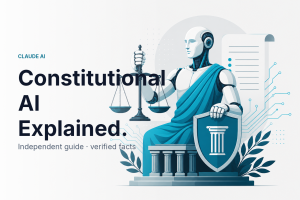

c-ai.chat is an independent guide, and the answer to “anthropic ai claude constitution trending” is that people are usually searching for Anthropic’s Constitutional AI approach behind Claude—the rule-guided training method that shapes how Claude responds, explains, and refuses risky requests. This page explains what the Claude “constitution” means, why the term trends, what it changes for users, and where it fits in the wider Claude AI overview.
- The short answer
- The full story
- What this means in practice
- Other questions readers ask
- The honest take
The short answer

“Anthropic AI Claude constitution trending” usually refers to rising interest in Constitutional AI, Anthropic’s method for training Claude with a set of guiding principles so the model can critique and improve its own answers, with less reliance on human-written correction at every step. In plain terms, the “constitution” is not a public rulebook you can switch on inside Claude; it is part of how Anthropic designs and aligns the model family described on anthropic.com and in its developer documentation at docs.claude.com.
- Constitutional AI is Anthropic’s alignment method
- It helps shape Claude’s behaviour, not just one feature
- Trending usually means growing search interest in Claude safety and training
- The official Claude product is at claude.ai
The full story
Anthropic uses the term Constitutional AI to describe a training approach where an AI system learns from a set of principles, then uses those principles to review and revise its own outputs. That is the core reason the phrase “Claude constitution” exists at all. The company’s public research and product positioning connect Claude with a strong emphasis on safety, steerability, and explainable refusals, which is why searches about the “constitution” often rise whenever Claude gets broader attention or new model releases prompt fresh comparisons with other assistants. For company background, see our Anthropic guide and Anthropic’s official site at anthropic.com.
The important point is that the constitution is not a separate app, plan, or menu option on claude.ai. Users do not upload “the constitution” to make Claude work. Instead, it is part of the model training philosophy behind Claude itself. Anthropic’s model and platform pages explain Claude as a family of models available through the Claude app and the API, including Opus 4.7, Sonnet 4.6, and Haiku 4.5, with pricing and capabilities documented at platform.claude.com and the API pricing page.
Why does the topic trend? Usually for three reasons. First, people hear “Claude is safer” or “Claude explains refusals differently” and want to know why. Second, developers evaluating models want to understand how Anthropic’s alignment philosophy affects tone, compliance, and edge-case behaviour. Third, searchers often mix up the research concept with product plans, model names, or prompt rules. That confusion shows up in search terms like “Claude constitution,” “Anthropic constitution prompt,” and “what is constitutional AI in Claude.” If you want the broader product context first, our Claude features guide and Claude FAQ are the quickest next stops.
| Term people search | What it usually means | What it does not mean |
|---|---|---|
| Claude constitution | Anthropic’s Constitutional AI approach behind Claude | A paid add-on or special user mode |
| Constitutional AI | Training with guiding principles and self-critique | A public consumer settings panel |
| Claude safety rules | How Claude is aligned to respond or refuse | A fixed list users must manually enable |
| Anthropic AI Claude constitution trending | Growing interest in the concept and its effect on Claude | A newly launched standalone feature |
What this means in practice

For most people, the practical effect is simple: Claude often aims to be more structured, more transparent about uncertainty, and more willing to explain why it cannot help with a request. That does not mean it is always correct, and it does not mean every refusal will match what you want. It means the model is built to follow a more explicit alignment philosophy than “just answer whatever the prompt asks.” If you are choosing a general-purpose assistant for writing, coding, research, or business work, that usually translates into a model that feels careful and easier to steer.
For developers, the “constitution” matters because it can affect prompt design and output expectations. A strongly aligned model may be better at policy-sensitive workflows, summarisation, document reasoning, and enterprise use cases where consistency matters. The trade-off is that some users may find Claude more likely to refuse ambiguous harmful requests or to narrow the scope of an answer. Model choice still matters too: Opus 4.7 is the flagship, Sonnet 4.6 is the default recommendation for many users, and Haiku 4.5 is the lower-cost fast option. Those options are separate from Constitutional AI itself.
Pick when
- You want an assistant that is usually careful with risky or unclear requests
- You value transparent refusals over silent failure
- You need strong document work, reasoning, or business-friendly tone
- You care about Anthropic’s safety and trust positioning
Skip when
- You expect every prompt to be answered with no safety boundary
- You want the least constrained style possible in edge cases
- You are confusing the training method with a user-facing feature toggle
- You have not yet decided which Claude model or plan actually fits your use case
Other questions readers ask
- Is “Claude constitution” a plan or subscription? No. Claude plans are Free, Pro, Max, Team, and Enterprise on claude.com/pricing.
- Can I use Claude without paying? Yes. The Free plan is $0/month with daily usage limits across web, iOS, Android, and desktop.
- What if I need the API rather than the app? Then the relevant pages are platform.claude.com and the API pricing docs. For example, Opus 4.7 is $5/M input tokens and $25/M output tokens, Sonnet 4.6 is $3/M and $15/M, and Haiku 4.5 is $1/M and $5/M.
- Does Anthropic offer enterprise controls beyond the constitution concept? Yes. Anthropic documents trust, security, and admin capabilities through official product and trust pages, including items such as admin controls, SSO, and data-handling information.
- Where can I check outages or platform incidents? Use the official status page at status.claude.com.
The honest take
If you searched “anthropic ai claude constitution trending,” the useful answer is that people are trying to understand why Claude behaves the way it does. The constitution is Anthropic’s alignment idea, not a consumer feature. It matters because it helps explain Claude’s tone, boundaries, and decision-making style. It does not replace normal product evaluation: you still need to choose the right model, plan, and workflow for your job.
So, should you care? Yes—if trust, steerability, and safer defaults matter to you. No—if you were expecting a hidden settings page or a separate Claude upgrade. For most users, the right next step is to compare Claude as a product first, then treat Constitutional AI as part of the reason the product feels the way it does.
Independent guide. Not affiliated with Anthropic. For the official Claude product, visit claude.ai.
Last updated: 2026-05-12