
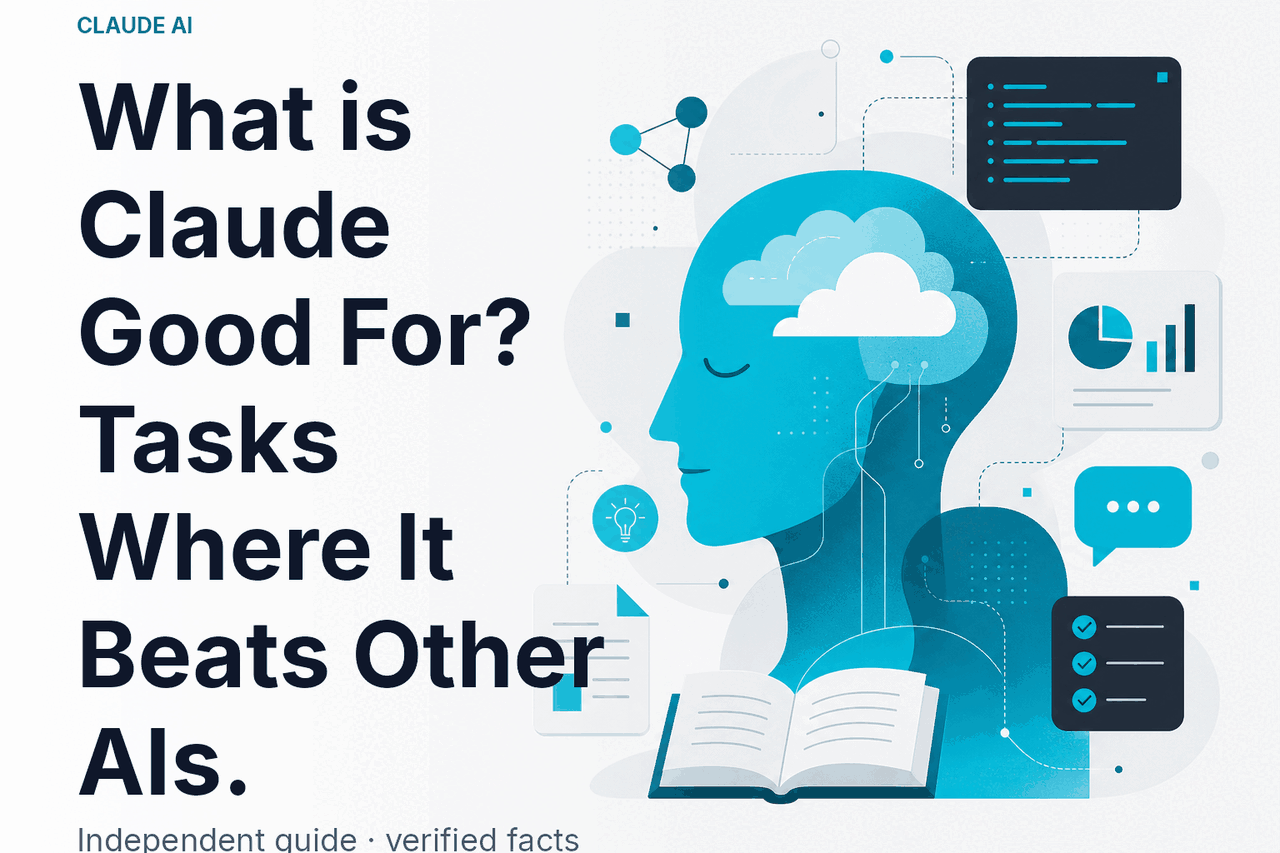
Claude is best for long-document work, careful writing, coding help, structured analysis, and tasks where you need a cautious assistant that can follow detailed instructions; c-ai.chat is an independent guide, not Anthropic, and our broader Claude AI guide explains the product family in more depth.
- The short answer
- The full story
- What this means in practice
- FAQ: other questions readers ask
- The honest take
- Sources
The short answer
Claude is good for reading and reasoning over large amounts of text, drafting and editing professional writing, helping with code, comparing options, extracting structured information, and acting as a careful thinking partner for work that needs context.
Best fit
Long documents, writing, coding help, research support, and structured analysis.
- Strong fit: document review, summaries, editing, planning, and code assistance.
- Use with care: legal, medical, financial, security, and factual claims that need verification.
- Not ideal: guaranteed live facts, exact arithmetic without tools, or fully automated decisions.
- Source: Claude is made by Anthropic. c-ai.chat is independent.
The simple test is this: use Claude when the task needs judgment, context, and well-structured language. Use another tool, or add verification, when you need a deterministic calculator, a live database, or a source of truth. The official Claude product is available at claude.ai. Anthropic publishes company information at anthropic.com and model details in the Claude model documentation.
| Task type | Claude is good for | Watch out for |
|---|---|---|
| Long documents | Summaries, risk review, comparison, extraction, contract or policy analysis | Ask it to cite passages or quote evidence when accuracy matters |
| Writing | Editing, rewriting, tone matching, briefs, outlines, emails, and reports | Generic prompts produce generic prose |
| Coding | Debugging, explaining code, refactoring, tests, and architecture discussion | Run the code and review security-sensitive changes |
| Research support | Question framing, synthesis, interview guides, and source comparison | Do not treat unsourced claims as final facts |
| Business planning | Decision memos, market notes, SOPs, meeting prep, and spreadsheet logic | It cannot know private business context unless you provide it |
The full story
Claude is a family of AI assistants and API models made by Anthropic. The web product, apps, paid plans, team features, and developer API sit around the same core pattern: you give Claude instructions and context, and it returns text, code, analysis, or structured output. Anthropic’s main models include Claude Opus 4.7 for flagship capability, Claude Sonnet 4.6 for the best balance, and Claude Haiku 4.5 for fast, lower-cost work. For model selection, see our Claude models guide.
Claude often stands out for long-context handling, natural writing, and instruction following. Claude Opus 4.7 supports a 1M-token context window. Claude Sonnet 4.6 also supports a 1M-token context window and a 128K maximum output. Claude Haiku 4.5 is better for high-volume, speed-sensitive tasks such as classification, short extraction, routing, and simple transformations.
The answer also depends on how you use Claude. In the chat product, Claude is useful for personal productivity, documents, Projects, writing, and day-to-day analysis. Through the API, it can power document review, support triage, code assistants, content pipelines, data extraction, and agent workflows. For a broader product map, see our guide to Claude features and our Claude API docs guide.
What this means in practice
If you are choosing whether to use Claude, start with the task rather than the brand. Claude is a strong choice when you have a messy pile of text and need a clear output: a decision memo from meeting notes, a table from PDFs, a rewritten proposal, a code review, or a list of risks from a policy document.
Do not use Claude as an unchecked authority. It can make mistakes, misread ambiguous prompts, omit edge cases, and produce plausible but wrong statements. For factual, legal, medical, financial, or security-sensitive work, use Claude as an assistant and verify the result against primary sources. Anthropic publishes service status at status.claude.com and trust information at trust.anthropic.com.
Pick Claude when
- You need to analyse long documents or many files.
- You want polished writing without a salesy tone.
- You need help debugging, explaining, or refactoring code.
- You can provide the source material Claude should use.
- You want a careful second reader for plans, policies, or decisions.
Skip Claude when
- You need guaranteed live facts without retrieval or citations.
- You need exact arithmetic at scale without a calculator or code.
- You cannot share the required context with the tool.
- You need a fully automated decision with no human review.
- You expect one prompt to replace expert judgment.
The most productive Claude workflows are specific. “Improve this” is weak. “Rewrite this client email for a senior operations audience, keep it under 180 words, preserve the three deadlines, and make the risk section clearer” is better. Define the audience, source material, output format, and standard for success.
Give Claude the job
State the role and outcome:
You are helping me turn messy notes into an executive decision memo.Provide the source material
Paste the notes, upload the document, or explain the facts Claude should rely on.
Constrain the output
Ask for a table, memo, checklist, JSON object, email, test plan, or other concrete format.
Ask for evidence
For document work, ask Claude to quote the relevant passage or point to the section it used.
Review and iterate
Treat the first answer as a draft. Ask for corrections, missing cases, and a shorter final version.
For developers, the same pattern applies through prompts, system instructions, tools, and structured outputs. A support triage workflow might ask Claude to classify a ticket, extract the customer’s product, detect urgency, draft a reply, and return a JSON object. A legal operations workflow might ask Claude to identify clauses, compare them to a policy, and flag exceptions for a human reviewer. Anthropic documents the API at platform.claude.com.
Worked example
Turning a policy into an action list
This is a task where Claude’s long-context handling and structured writing matter more than a short chatbot answer.
Pricing and model choice matter if you use the API. Claude Opus 4.7 costs $5 per million input tokens and $25 per million output tokens. Claude Sonnet 4.6 costs $3 per million input tokens and $15 per million output tokens. Claude Haiku 4.5 costs $1 per million input tokens and $5 per million output tokens. Prompt caching reduces cached input costs by 90%, and the Batch API reduces costs by 50% in both directions. See our Claude pricing guide and Anthropic’s pricing documentation.
90% off
cached input tokens with prompt caching
For non-developers, the plan choice is simpler. Free is for testing Claude. Pro is for individuals who use it regularly. Max is for power users who need more usage. Team plans are for shared workspaces and administration. Enterprise adds custom purchasing and usage at API rates.
Free
$0
Good for trying Claude and occasional use.
Pro
$20/month or $17/month annual
Good for regular individual use.
Max
From $100/month
Good for high-usage individual work.
Team Standard
$25/seat/month or $20/seat/month annual
Good for teams that need a shared workspace.
Team Premium
$125/seat/month or $100/seat/month annual
Good for teams that need higher-tier controls and usage.
Enterprise
$20/seat base plus API rates
Good for custom contracts and organisation-wide deployment.
Check the official Claude plans page before buying, because plan details can change.
FAQ: other questions readers ask
Is Claude better than ChatGPT?
It depends on the job. Many users prefer Claude for long documents, careful writing, and nuanced analysis. Other AI tools may be better for different integrations, image workflows, browsing features, or app ecosystems. Test the same task in both tools before deciding.
Is Claude good for coding?
Yes. Claude is useful for explaining code, finding bugs, writing tests, refactoring, and planning architecture. Do not trust it blindly with production code. Run tests, review diffs, and be careful with secrets, permissions, and security-sensitive logic.
Is Claude good for students?
Claude can help students understand readings, outline essays, generate study questions, and explain difficult concepts. It should not replace original work or citation checking. Students should follow their school’s AI policy and verify facts against assigned sources.
Is Claude good for business users?
Yes, especially for drafting, document review, meeting preparation, policy work, customer support drafts, and internal knowledge tasks. The main question is governance. Teams should check privacy, access controls, retention settings, and official support materials before putting sensitive data into any AI tool.
What is Claude not good for?
Claude is not a guaranteed fact database, a substitute for legal or medical advice, or a perfect autonomous worker. It can produce wrong answers. It works best when a person supplies context, checks the output, and makes the final decision.
Which Claude model should I use?
Use Claude Sonnet 4.6 for most work. Use Claude Opus 4.7 when quality matters more than cost. Use Claude Haiku 4.5 for fast, high-volume tasks. For a fuller comparison, see our Claude model guide.
Where can I learn more about Claude setup and limits?
Start with our Claude FAQ for common account, plan, and usage questions. The Claude resources page links to additional independent guides and official references.
The honest take
Claude is good for serious text work: documents, writing, code, analysis, plans, policies, research support, and structured outputs. It is strongest when you give it clear instructions and enough context. It is weakest when you ask for unsourced certainty, live facts, or expert judgment without review.
If you work with long documents or complex written decisions, Claude is worth testing. Start with a real task you understand well. Compare the output against your own standard. Decide whether it saves time without lowering quality. That is a better test than trivia questions or a single demo prompt.
Independent guide. Not affiliated with Anthropic. For the official Claude product, visit claude.ai.
Last updated: 2026-05-12
This article is part of the What is Claude AI hub on c-ai.chat.