
Anthropic hackathon searches usually mean one of two things: events run by Anthropic or hackathons where builders use Claude tools; this page explains the company behind those events, how its products fit in, and where to verify details on the official Anthropic website. c-ai.chat is an independent guide, not Anthropic, and if you want the broader company overview first, see our Anthropic guide.
- The short answer
- What Anthropic actually is
- People and leadership
- Products and revenue
- Other questions readers ask
- The honest take
The short answer
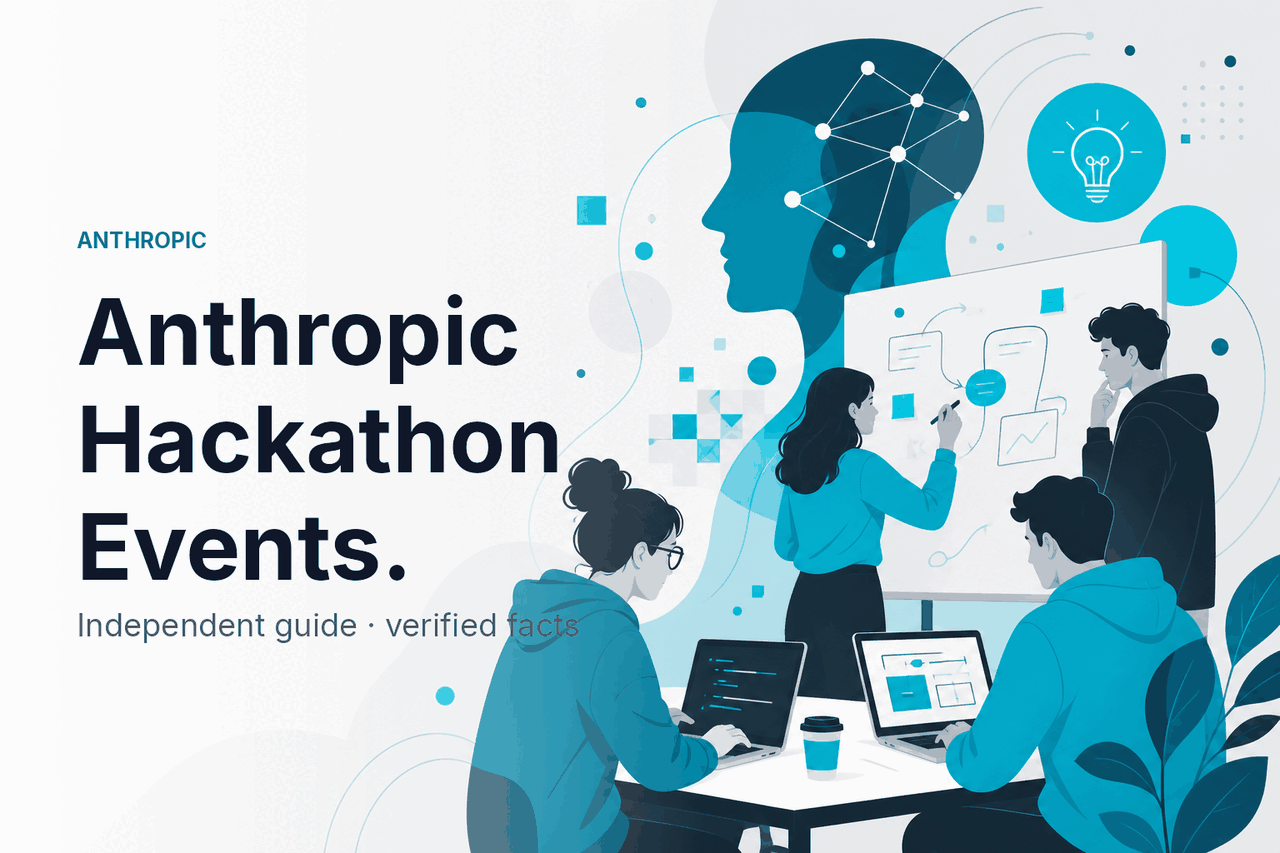
Anthropic is the AI company that makes Claude, and an Anthropic hackathon is typically a builder event centred on Claude, the Anthropic API, or related developer tooling rather than a separate standalone product.
- Founded in 2021
- Founders include Dario Amodei and Daniela Amodei
- HQ San Francisco
- Funding multibillion-dollar backing disclosed by Anthropic and partners
That matters because many people searching for anthropic hackathon are really trying to answer a more basic question: who runs the event, what tools are involved, and whether it is an official Anthropic initiative or a community event using Claude. The safest way to check is to start with anthropic.com, the official Claude product, and the model overview on Anthropic’s developer platform.
What Anthropic actually is
Anthropic is a public benefit corporation focused on AI systems and AI safety, best known for building Claude. The company was founded by former OpenAI researchers and leaders, and it presents itself as a research and product company working on reliable, steerable AI systems for consumers, developers, and businesses. Its official company pages and newsroom on anthropic.com are the best primary source for company announcements, partnerships, and policy positions.
In practical terms, Anthropic is not just a research lab. It sells access to Claude through the consumer app at claude.ai and through APIs on platform.claude.com. That is why Anthropic hackathon activity tends to attract developers, startups, students, and enterprise teams: the company has both a public chat product and a documented platform for shipping real software. If you are new to Claude itself, our what is Claude AI guide covers the product layer separately from the company story.
What Anthropic is
- The company behind Claude
- An AI research and product business
- An API provider for developers and teams
What Anthropic is not
- Not a single hackathon brand
- Not just a chatbot website
- Not the same thing as c-ai.chat
If you see an event labelled Anthropic hackathon, look for clues about whether it is hosted directly by Anthropic, co-hosted with a partner, or organised by a third party using Claude models. The distinction affects prizes, support, judging, terms, and data handling. For service health during live builds or demos, Anthropic’s official status page is status.claude.com.
People and leadership
Anthropic‘s public profile is closely tied to a small set of leaders who appear in company announcements, product launches, and policy discussions. If you are evaluating an Anthropic hackathon, these are the names most likely to appear in official materials or media coverage.
- Dario Amodei — Co-founder and CEO. He is the most visible executive voice on Anthropic’s research direction, model capabilities, and AI safety framing. He regularly appears in official announcements and company interviews.
- Daniela Amodei — Co-founder and President. She has been central to the company’s operations, policy posture, and institutional growth, and is one of the key public leaders behind Anthropic’s expansion.
- Mike Krieger — Chief Product Officer. Publicly associated with product strategy and Claude’s user-facing direction, especially as Anthropic has broadened from model provider to full product company.
- Jack Clark — Co-founder with a strong public presence on policy and research communication. He is often cited when Anthropic discusses AI governance, safety, and industry context.
For searchers asking about anthropic hackathon, the leadership angle matters for a simple reason: official events often reflect the company’s larger priorities. Anthropic tends to position Claude around practical work, strong writing, coding help, enterprise use, and safety-conscious deployment rather than pure demo theatrics. That is useful context if you are deciding whether an event is aimed at students, startup prototypes, internal tooling, or production applications.
Products and revenue
Anthropic sells Claude in several forms, and that product mix explains why its hackathon ecosystem spans consumer users, developers, and companies. The official pricing and model documentation live on claude.com/pricing and platform.claude.com.
- Claude consumer app — The main chat product on web, desktop, and mobile. Free, Pro, and Max plans are aimed at individuals and heavy users.
- Claude API — Programmatic access for developers and companies. This is the core layer most hackathon teams use to build apps, agents, workflows, and prototypes.
- Claude Code — Coding-focused capability included in paid Claude plans, relevant for builder workflows and rapid iteration during short events.
- Cowork — A collaboration-oriented capability referenced in Claude plan details, useful for structured work inside the product rather than only API use.
- Skills — Reusable capability patterns inside the Claude ecosystem that can matter for teams building repeatable workflows.
Anthropic does not publish a simple public revenue dashboard, so any exact revenue claim should be treated carefully unless Anthropic states it directly. What is public is that the company has raised very large amounts of funding and has secured major strategic backing and cloud partnerships, which is one reason Claude has moved from a niche AI assistant to a serious enterprise and developer platform. For current company announcements, the best source remains Anthropic’s official site.
| Offer | Who it is for | Published price | Why it matters for hackathons |
|---|---|---|---|
| Free | Casual users and first-time testers | $0/month | Good for trying Claude quickly without setup friction |
| Pro | Individual power users | $20/month or $17/month annual | Useful if you want Claude Code, Research, more features, and higher day-to-day limits |
| Max | Heavy individual users | From $100/month | Designed for much higher usage and earlier access |
| Team Standard | Small teams | $25/seat/month or $20/seat/month annual | Relevant when a team wants shared workspace and admin controls |
| Team Premium | Higher-capacity teams | $125/seat/month or $100/seat/month annual | Useful for bigger, more demanding team usage |
| Enterprise | Large organisations | $20/seat base + usage at API rates | Relevant if a hackathon prototype is heading toward deployment |
For API builds, the active Claude model lineup matters more than subscription branding. Anthropic’s published rates are Claude Opus 4.7 at $5 per million input tokens and $25 per million output tokens, Claude Sonnet 4.6 at $3 and $15, and Claude Haiku 4.5 at $1 and $5. Long context up to 1,000,000 tokens is available on Opus 4.7, Opus 4.6, and Sonnet 4.6 at standard rates.
- Opus 4.7 $5 in / $25 out
- Sonnet 4.6 $3 in / $15 out
- Haiku 4.5 $1 in / $5 out
- Context up to 1M tokens on eligible models
90% off
cached input tokens with prompt caching
That pricing detail matters for hackathon teams because fast prototypes can become expensive if prompts are large and outputs are long. Anthropic also advertises the Batch API at 50% off both input and output, which can help if your project evaluates many prompts asynchronously instead of relying only on live interactive responses.
Worked example
Small Claude Sonnet 4.6 prototype budget
For a weekend build, API cost can stay modest if you choose the right model and keep prompts efficient.
If you are comparing Claude against the broader assistant market rather than just Anthropic events, our homepage and Claude news coverage track product changes and releases from the independent side.
Other questions readers ask
These are the nearby questions that often sit behind an anthropic hackathon search.
If your question is less about events and more about the product itself, the fastest next stop is our Claude FAQ or the broader c-ai.chat homepage.
The honest take
If you searched anthropic hackathon, the useful answer is this: Anthropic is the company behind Claude, and hackathons tied to its name are usually about building with Claude rather than using some separate “Anthropic hackathon platform.” That sounds obvious, but it clears up most confusion. Before you join an event, confirm whether it is official, partner-led, or independent, then check the Claude models, pricing, and support links that apply to your build.
Anthropic matters because it is now a major AI company with a consumer app, a serious API business, and team and enterprise products that can carry a project beyond demo day. But the company name should not replace due diligence. Check the organiser, read the rules, verify the model docs, and budget for token usage if you are building something real.
Independent guide. Not affiliated with Anthropic. For the official Claude product, visit claude.ai.
Last updated: 2026-05-12