
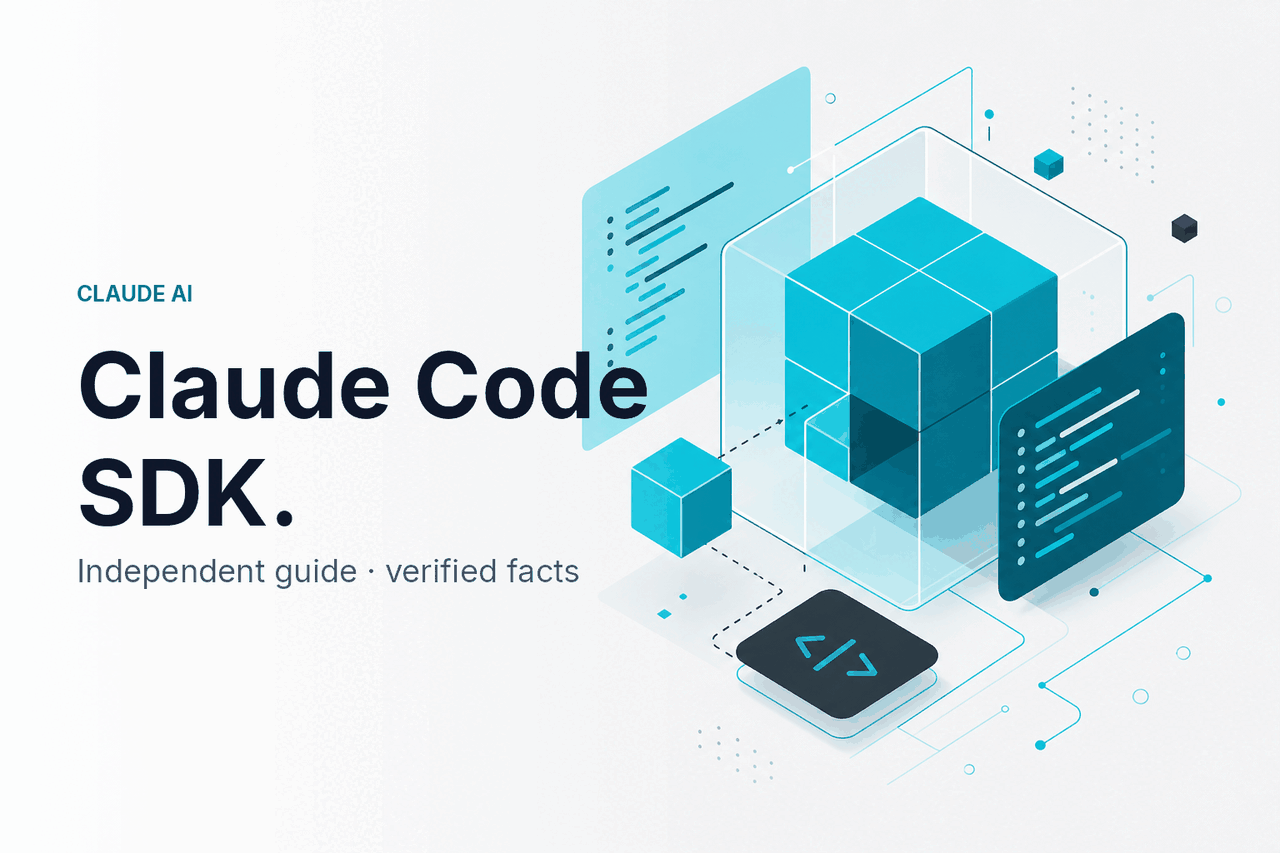
The Claude Code SDK lets developers embed Claude Code-style coding agents in scripts, tools, CI workflows, and internal apps; for broader developer context, see our Claude API docs guide.
- The short answer
- How the Claude Code SDK works
- Models, pricing, and cost controls
- When to use it
- FAQ
- The honest take
- Sources
The short answer
Use the Claude Code SDK when you want Claude Code’s coding-agent behavior inside your own software instead of only using the interactive Claude Code interface.
Best fit
Repository-aware coding automation with clear permissions, logs, tests, and review gates.
The SDK fits workflows where Claude needs to inspect code, plan changes, call approved tools, report progress, or work through a repeatable engineering task. If you only need one prompt and one response, the standard Claude API may be simpler.
Anthropic makes Claude and runs the official product at claude.ai. c-ai.chat is an independent reference. We explain the Claude ecosystem, including Claude features, Claude models, pricing, and developer options.
How the Claude Code SDK works
Claude Code is Anthropic’s coding-agent experience. The Claude Code SDK lets developers build programmatic workflows around that agent behavior. The official starting point is Anthropic’s Claude Code SDK documentation.
The practical difference is control. In a chat session, a person types a request and reads the answer. In an SDK workflow, your application can send a task, pass repository context, define permissions, observe progress, connect tools, and decide what happens next.
That makes the SDK useful for review bots, migration helpers, internal coding copilots, documentation generators, and controlled agents that work inside a repository. It does not remove the need for engineering judgment. You still need permission boundaries, logs, test gates, review steps, and cost controls.
Claude Code SDK versus Claude API versus claude.ai
| Option | Best for | How it behaves | Choose it when |
|---|---|---|---|
| Claude Code SDK | Agent-style coding workflows | Runs Claude Code-style tasks from your own software | You need repository-aware automation, tool use, and repeatable coding agents |
| Claude API | Custom AI features in apps | Sends messages to Claude models and receives model outputs | You need chat, extraction, classification, writing, structured generation, or direct model access |
| claude.ai | Interactive use by people | Provides Anthropic’s official web and app experience | You want to chat with Claude, upload files, use Projects, or work without building software |
Decision rule
Use the API for prompt-and-response product features. Use claude.ai for personal or team work in the official app. Use the Claude Code SDK when your system needs an agent to inspect files, reason through steps, call tools, and return progress inside a controlled workflow.
Common build pattern
Define the job
Give the agent a narrow task, such as “find the failing test and propose the smallest fix.” Avoid vague instructions such as “improve the repo.”
Attach context
Pass the repository, relevant files, issue text, logs, or test output. More context can help, but irrelevant context adds cost and noise.
Set boundaries
Limit file access, tool permissions, network access, write actions, and maximum turns. Use the least authority needed for the task.
Observe progress
Record messages, tool calls, errors, and outputs. Logs matter for debugging, audits, and cost analysis.
Verify the result
Run tests, linters, type checks, security scans, or human review before merging or deploying generated changes.
Worked example
A safer pull-request helper
This design keeps the agent useful while preventing unchecked code changes from reaching production.
Models, pricing, and cost controls
Cost depends on the model, context size, output length, tool use, retries, and whether you use platform cost controls. For model details, check Anthropic’s model overview and API pricing.
Claude Opus 4.7
$5 per million input tokens
$25 per million output tokens
Flagship model with 1M context.
Claude Sonnet 4.6
$3 per million input tokens
$15 per million output tokens
Balanced model with 1M context and 128K maximum output.
Claude Haiku 4.5
$1 per million input tokens
$5 per million output tokens
Faster, cheaper option for lower-risk support tasks.
For coding agents, Claude Sonnet 4.6 is often the practical starting point because it balances capability and cost. Use Claude Opus 4.7 for harder reasoning or larger, high-value tasks. Use Claude Haiku 4.5 for simpler support work where speed and cost matter more than maximum capability.
90% off
cached input tokens with prompt caching.
Prompt caching can reduce spend when the same large context appears across many calls. The Batch API can reduce costs by 50% in both directions when latency is not urgent. Long context helps with large repositories, but it is not a substitute for good retrieval, scoped file selection, and compact task prompts.
Claude product subscriptions are separate from API token prices. Current plan pricing includes Free at $0, Pro at $20/month or $17/month annual, Max from $100/month, Team Standard at $25/seat or $20/seat annual, Team Premium at $125/seat or $100/seat annual, and Enterprise at a $20/seat base plus API rates. See our Claude pricing guide and Anthropic’s official pricing pages before budgeting production usage.
When to use it
The Claude Code SDK changes the design problem. You are not only writing prompts. You are designing permissions, observability, fallback behavior, tests, and review gates around an agent that can act on code.
For small teams, the strongest use cases are repetitive engineering chores: explaining test failures, drafting migration patches, generating release notes from commits, updating documentation, or triaging simple issues. For larger teams, value depends on governance. You need clear ownership, secure authentication, data controls, and a policy for what the agent can touch.
Use it when
- You want Claude Code behavior inside your own product or internal tool.
- Your workflow needs repository context, tool calls, and multi-step reasoning.
- You can verify outputs with tests, CI, review, or other controls.
- You have a clear task boundary and a measurable success condition.
Skip it when
- You only need a one-off coding answer in the browser.
- You have no plan for permissions, logging, or review.
- Your task is general chat, writing, or simple classification.
- You cannot tolerate occasional wrong changes or incomplete reasoning.
The main risk is over-automation. A coding agent can be convincing and still be wrong. It can produce a plausible patch that passes one test but breaks another part of the system. Ask which parts of your workflow can safely accept agent-generated work, and how you will check it.
Security questions to ask before production
- Which repositories, files, secrets, logs, and tickets can the agent access?
- Can the agent write code, create branches, open pull requests, or merge changes?
- How are tool calls recorded and reviewed?
- Which tasks require human approval?
- How do you stop runaway loops or unexpected cost spikes?
- What happens when model output is incomplete, unsafe, or wrong?
For regulated or enterprise environments, review Anthropic’s security materials at trust.anthropic.com and service availability at status.claude.com. Enterprise procurement, data handling, and access controls should be reviewed against your own policies.
FAQ
These questions come up when developers compare the Claude Code SDK with the API, the official app, and other Claude workflows. For broader product questions, see our Claude FAQ.
Is the Claude Code SDK the same as the Claude API?
No. The Claude API gives you direct access to Claude models for messages and application logic. The Claude Code SDK is aimed at Claude Code-style agent workflows, especially coding tasks that need tools, repository context, and multiple steps.
Do I need claude.ai to use the Claude Code SDK?
Check Anthropic’s official setup instructions for the supported authentication path. The important distinction is product surface: claude.ai is the official user-facing app, while the SDK is for developers building programmatic workflows. Billing and access can depend on the product path and account type.
Can the Claude Code SDK edit files automatically?
It can support workflows where Claude works with code and tools, but you should not give broad write access by default. Safer designs start with read-only analysis, patch suggestions, or isolated branches. Add direct write actions only where tests and approvals protect the main codebase.
Which Claude model should I use for coding agents?
Use the strongest model the task justifies. Claude Sonnet 4.6 is a practical default for many coding-agent workflows. Claude Opus 4.7 fits harder reasoning and larger, higher-value tasks. Claude Haiku 4.5 fits faster, cheaper support tasks where the risk is lower.
When is a simpler option better?
Use a simple API call for ticket classification, short code snippets, log explanations, release-note drafts, or structured text generation. Use claude.ai for one-off help in the browser. The SDK becomes more useful when the same coding task repeats and needs file inspection, tool use, and iteration.
Where should beginners start?
Start with the official app at claude.ai to learn how Claude responds to coding prompts. Then review Anthropic’s SDK docs and build a small read-only prototype. Move toward automated changes only after you have tests, logs, permissions, and human review in place.
The honest take
The Claude Code SDK is a good candidate for serious developer automation around Claude Code. It is not the first tool every Claude user needs. It is most useful when a coding task is repeatable, bounded, observable, and verifiable.
If you want casual coding help, use claude.ai. If you need a custom AI feature, use the Claude API. If you want an agent that can work through coding tasks inside your own workflow, start with the official Claude Code SDK docs, build a small prototype, and add safeguards before production.
c-ai.chat is independent and not affiliated with Anthropic. For the official Claude product, visit claude.ai.
Last updated: 2026-05-12