
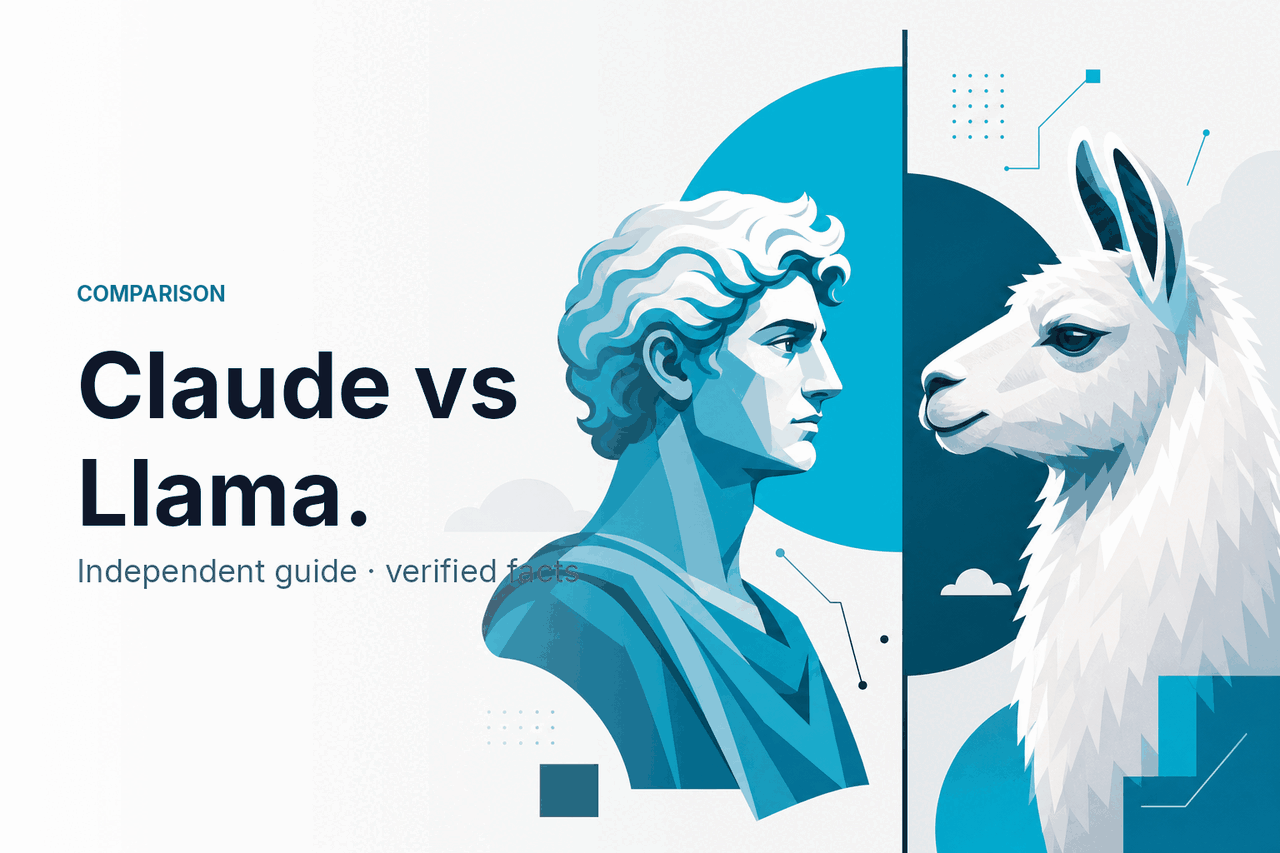
Claude comparisons start to make more sense when you separate product style from model philosophy: Claude is usually stronger for polished writing, long-document work, and a managed end-user experience, while Llama is stronger when you want open-weight flexibility, self-hosting options, or tighter control over deployment. This guide is independent, not affiliated with Anthropic, and it breaks the choice down by pricing, capabilities, tradeoffs, and who should pick what.
- The bottom line
- Head to head
- Where Claude is the better pick
- Where the other tool is better
- How to choose
- Other questions readers ask
The bottom line
Claude wins on ease of use, writing quality, long-context analysis, and a cleaner managed experience. Llama wins on openness, self-hosting, model customization, and deployment control. Pick Claude if you want a ready-to-use assistant or API model that performs well on real business writing, coding, and document tasks without building your own stack.
- Claude is easier to use out of the box
- Llama is better for self-hosting and open-weight workflows
- Claude API pricing starts at $1/M input and $5/M output with Haiku 4.5
- Claude offers up to 1,000,000-token context on supported models
If you are comparing the official Claude product with Llama-based tools, the practical difference is simple: Claude is a finished service from Anthropic, available through claude.ai and the Claude pricing guide, while Llama is a model family that often depends on which host, wrapper, or infrastructure layer you choose. That means Claude is easier to judge consistently. Llama can vary a lot depending on implementation.
Head to head
The phrase “Llama” covers multiple open-weight models and many third-party deployments, so a strict one-row comparison is imperfect. Still, the main decision points are clear enough: Claude gives you a stable official product and API with transparent pricing, while Llama gives you more freedom over where and how the model runs.
| Dimension | Claude | Llama |
|---|---|---|
| Pricing | Official Claude app plans range from Free to Pro at $20/month, Max from $100/month, Team Standard at $25/seat/month, Team Premium at $125/seat/month, and Enterprise at $20/seat base plus usage. API pricing is published by Anthropic: Haiku 4.5 at $1/M input and $5/M output, Sonnet 4.6 at $3/M and $15/M, Opus 4.7 at $5/M and $25/M. | No single official universal price. Costs depend on host, cloud provider, inference service, hardware, or whether you run the model yourself. |
| Models | Current Claude lineup includes Opus 4.7, Sonnet 4.6, and Haiku 4.5 through Anthropic’s official product and API. | Llama is a model family rather than one fixed product experience. Capability depends on the specific version and deployment. |
| Context window | Up to 1,000,000 tokens on supported Claude models including Opus 4.7 and Sonnet 4.6, with standard long-context pricing from Anthropic. | Varies by model version and provider. There is no single Llama context number you can rely on across all tools. |
| Coding ability | Strong coding performance in Claude apps and API, plus Anthropic positions Claude Code as part of paid plans for individuals and teams. | Can be excellent when tuned for coding or embedded in a developer workflow, but quality depends heavily on the exact Llama variant and wrapper. |
| Writing ability | Usually stronger for polished prose, editing, summarisation, and following nuanced style instructions. | Can be good, but output quality often varies more across deployments and fine-tunes. |
| Safety and refusals | More consistent safety behavior because the product, policies, and serving stack are controlled by Anthropic. | Depends on host and configuration. Open-weight deployment can mean fewer restrictions, but also less consistency and more responsibility on the operator. |
| Ecosystem | Official web app, mobile apps, desktop app, API, team plans, enterprise controls, trust documentation, and status page from Anthropic. | Broader open ecosystem with many integrations, local setups, custom runtimes, and private deployment options. |
For official Claude details, Anthropic publishes plan pricing on claude.com/pricing, API pricing on platform.claude.com, model information on the models overview, uptime on status.claude.com, and enterprise trust details on trust.anthropic.com. If you want a broader overview of the official lineup first, see our guides to Claude models and Claude features.
1M tokens
context window on supported Claude models for long-document analysis
One more practical point: with Claude, your cost planning is easier. Anthropic also documents prompt caching discounts of 90% off cached input tokens and Batch API discounts of 50% off input and output. With Llama, the total cost picture can be cheaper or more expensive depending on hardware, hosting, latency targets, engineering time, and traffic spikes.
Where Claude is the better pick
Claude is the better pick when you care more about dependable output quality and a managed experience than about raw deployment freedom. These are the use cases where it usually has the clearest edge.
-
Long-document analysis with 1M token context
If you need to load large reports, policy packs, codebases, contracts, or research collections into one session, Claude’s supported long context is a major advantage. You spend less time chunking, stitching, and managing retrieval workarounds.
-
Professional writing and editing
Claude is often better at rewriting for tone, tightening structure, preserving nuance, and producing cleaner business prose. That matters for marketing copy, client communication, executive summaries, and policy drafting.
-
Fast adoption by non-technical users
Teams that want a polished app on web, desktop, and mobile usually get value faster from Claude than from a Llama-based stack. There is less setup, less ambiguity, and fewer moving parts to validate.
-
Managed API usage with predictable documentation
For developers, Anthropic’s official docs, platform controls, and published pricing make planning simpler. You know which model you are calling, what it costs, and where support and status live.
-
Mixed workloads across writing, coding, and research
If your workload changes daily, Claude is a strong general default. One model family can cover brainstorming, code help, spreadsheet drafting, summarisation, and research-oriented tasks without much reconfiguration.
This is also where the official Claude plans matter. Free is enough for casual use. Pro at $20/month is aimed at individuals who want more capacity and added features such as Claude Code, Claude Cowork, unlimited Projects, Research access, additional models, and Office integrations in beta. If you are deciding between app plans rather than models, our Claude pricing guide breaks those tiers down.
Worked example
Why Claude often fits document-heavy knowledge work
When the job is “read a lot, keep track of details, then write clearly,” Claude is usually the safer choice.
Where the other tool is better
Llama is the better pick when openness and deployment control matter more than having a polished official product. This is the section many comparison pages avoid, but it is the main reason Llama exists in serious workflows.
- Self-hosting and private infrastructure: If you need the model to run in your own environment, Llama-based setups are often the more realistic option. Claude is a managed service from Anthropic, not an open-weight model you can deploy yourself.
- Custom fine-tuning and model experimentation: Teams that want to modify, adapt, or swap model variants at a low level generally have more room to work with Llama-based ecosystems.
- Avoiding vendor lock-in: If your strategy is to keep inference portable across providers, open-weight models can fit that goal better than relying on one managed vendor’s API and product interface.
- Offline or edge-oriented scenarios: Some local, private, or latency-sensitive deployments are easier to design around smaller open models than around a hosted assistant.
- Research and infrastructure-heavy workflows: If your team already knows how to manage GPUs, quantization, evals, and routing layers, Llama can offer more knobs to turn.
That variability is exactly why Claude remains the easier recommendation for most searchers. If you want one answer that applies broadly to real users, Claude is more predictable. If you have infrastructure talent and special deployment constraints, Llama can be the better strategic choice even when Claude is stronger out of the box.
How to choose
Use this simple decision split. It captures most real buying decisions better than benchmark screenshots do.
Pick Claude when
- You want a finished app or API with official support and documentation
- Your work involves writing, summarising, editing, coding, or long documents
- You want predictable pricing from Anthropic rather than variable infrastructure costs
- You need team features, admin controls, or enterprise trust documentation
- You prefer speed of adoption over model-level customization
Pick Llama when
- You need self-hosting or private deployment control
- You want open-weight flexibility and deeper model customization
- Your team can manage inference, hardware, and evaluation workflows
- You are optimizing for portability across vendors and runtimes
- You are building a custom AI stack rather than adopting a finished assistant
A useful shortcut is this: choose Claude if the main question is “Which assistant helps me today?” Choose Llama if the main question is “Which model family gives me more infrastructure freedom?” Those are different decisions. Many teams try to answer them as if they were the same.
Other questions readers ask
These are the follow-up questions that usually sit next to “claude vs llama” in search results and comparison research.
Independent guide. Not affiliated with Anthropic. For the official Claude product, visit claude.ai.
Last updated: 2026-05-12