
If you searched for current claude ai models 2024, the current Claude lineup is Claude Opus 4.7, Sonnet 4.6, and Haiku 4.5; this independent guide from c-ai.chat explains what each model is for, how they differ, and where to go next in our Claude models guide.

- Which model is this?
- What it’s best at
- Where it falls short
- When to pick this model
- Other questions readers ask
- The honest take
This page is a reference sheet, not the official Claude site. Anthropic makes Claude, and the official product lives at claude.ai. If you want broader context after this page, see our guides to Claude pricing, the Claude API, and key Claude features.
Which model is this?

The current Claude family has three active model lines: Opus, Sonnet, and Haiku. The latest flagship is Claude Opus 4.7; the recommended default for most users is Claude Sonnet 4.6; and the low-cost fast option is Claude Haiku 4.5. If you mean “current Claude AI models” in practical terms, these are the models to know.
- Opus 4.7 · input $5/M tokens
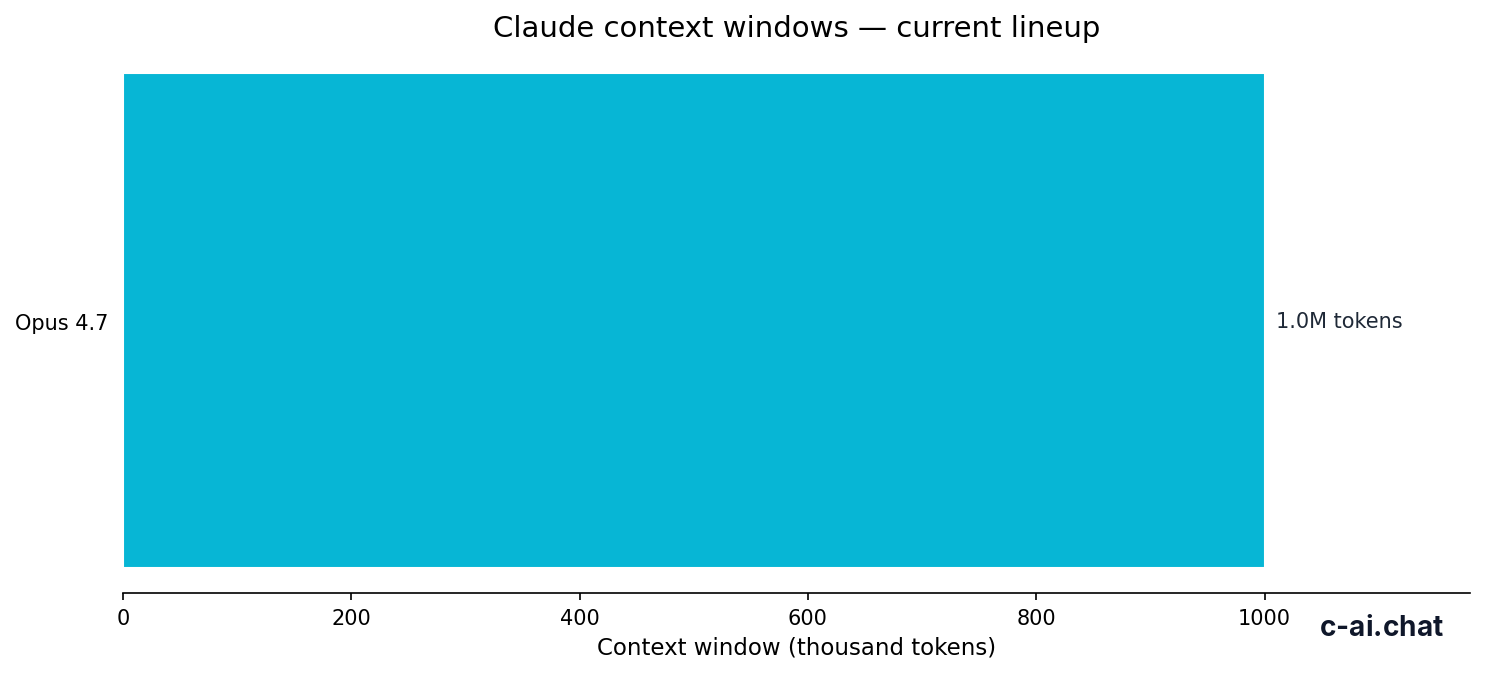
- Output $25/M tokens · context 1,000,000 tokens
- Sonnet 4.6 · input $3/M · output $15/M
- Haiku 4.5 · input $1/M · output $5/M
- Max output Sonnet 4.6 supports up to 128K output tokens
Here is the shortest accurate way to identify the lineup. Opus 4.7 is the newest high-end reasoning model. Sonnet 4.6 is the balanced mid-tier model and the one most people should start with. Haiku 4.5 is the speed-first, budget-first model for lighter workloads. Anthropic’s official pricing page is at claude.com/pricing, and the official model overview is at platform.claude.com.
| Model | Position in lineup | Input price | Output price | Context window | Best shorthand |
|---|---|---|---|---|---|
| Claude Opus 4.7 | Flagship | $5/M | $25/M | 1,000,000 tokens | Highest capability |
| Claude Sonnet 4.6 | Default recommendation | $3/M | $15/M | Long context supported | Best balance |
| Claude Haiku 4.5 | Fastest and cheapest | $1/M | $5/M | Lower-cost option | Speed and cost control |
What it’s best at
Opus 4.7 is best when quality matters more than cost. It is the model to choose for harder reasoning, complex writing, code-heavy work, long-context analysis, and tasks where a weak first answer wastes time downstream. If you are reviewing a large contract set, tracing a difficult bug, or asking for a structured plan across many documents, Opus is the model most likely to justify its higher price.
Sonnet 4.6 is best for general use. It is cheaper than Opus, still strong across writing and coding, and usually the safest default for teams and app builders who need predictable quality without flagship pricing. Haiku 4.5 is best for high-volume, lower-stakes tasks such as classification, extraction, quick summaries, simple chat flows, and cost-sensitive automation. If your task is simple and repeated thousands of times, Haiku often wins on economics.
- Opus 4.7: long document reasoning, difficult coding help, nuanced analysis, and higher-stakes drafting.
- Sonnet 4.6: everyday assistant work, mixed writing and coding, product workflows, and most business use cases.
- Haiku 4.5: extraction pipelines, lightweight support bots, tagging, moderation, and fast low-cost responses.
- Pick Opus over Sonnet when the extra quality prevents retries, manual review, or bad decisions.
- Pick Sonnet or Haiku over Opus when volume matters more than squeezing out the strongest answer.
For people using Claude in the app rather than the API, the same logic mostly holds. Pro and Max users get access to more capacity and models on the official product at claude.ai, while developers can choose directly by model in the API. If you are comparing plans rather than models, our pricing breakdown is the better next step. If you want implementation details, go to our API guide.
90% off
cached input tokens with prompt caching
Cost also changes the “best at” answer. A model that is stronger on paper may still be the wrong pick if your workload is large and repetitive. Anthropic also offers the Batch API at 50% off both input and output pricing, which can make Sonnet or Haiku especially attractive for asynchronous jobs. That matters more than model prestige if you process millions of tokens per day.
Where it falls short

Each Claude model has a clear trade-off. Opus 4.7 falls short on price efficiency for routine work. Sonnet 4.6 falls short when you need the very strongest reasoning or the highest-confidence answer on a difficult prompt. Haiku 4.5 falls short on more complex multi-step tasks, subtle judgment, and hard edge cases where a stronger model reduces failures.
- Opus 4.7: expensive for bulk summarisation, tagging, or simple chat responses.
- Sonnet 4.6: may need more prompt care than Opus on hard analytical or coding tasks.
- Haiku 4.5: more likely to underperform on nuance, long reasoning chains, and complex synthesis.
- If you are retrying the same task several times on Sonnet, Opus may be cheaper in practice despite the higher token rate.
- If the task is repetitive and low risk, using Opus is often unnecessary overspend.
When to pick this model
Use a simple rule. Start with Sonnet 4.6 unless you already know you need either top-end capability or the lowest possible cost. Move up to Opus 4.7 when answer quality matters enough to justify $5/M input and $25/M output. Move down to Haiku 4.5 when scale, latency, and budget matter more than maximum capability at $1/M input and $5/M output.
Pick when
- Opus 4.7: You need the strongest model for hard reasoning, coding, or long-context analysis.
- Sonnet 4.6: You want the best price-to-quality balance for most work.
- Haiku 4.5: You care most about speed, low cost, and high-volume simple tasks.
- You are matching model cost to task value rather than using one model for everything.
Skip when
- Skip Opus 4.7 for cheap bulk processing or lightweight automation.
- Skip Sonnet 4.6 if repeated failures on hard prompts are costing you time.
- Skip Haiku 4.5 for nuanced reasoning, difficult coding, or high-stakes outputs.
- Skip any model choice made without checking token cost, batch discounts, and prompt caching.
For app users, model choice also intersects with subscription tier. The official plans run from Free at $0/month to Pro at $20/month, Max from $100/month, Team Standard at $25/seat/month, Team Premium at $125/seat/month, and Enterprise at $20/seat base plus usage at API rates. If you are deciding between subscription levels instead of models, our Claude pricing guide covers that directly.
| Situation | Best pick | Why |
|---|---|---|
| Complex report across many files | Opus 4.7 | Better reasoning and synthesis justify the higher output price |
| General assistant for work | Sonnet 4.6 | Strong default quality at lower cost than Opus |
| Large-scale extraction or tagging | Haiku 4.5 | Lowest token cost for repetitive workloads |
| Async pipeline with flexible timing | Sonnet 4.6 or Haiku 4.5 via Batch API | 50% off both directions can change the economics |
Other questions readers ask
The honest take
If your question is simply “what are the current Claude models,” the answer is straightforward: Opus 4.7, Sonnet 4.6, and Haiku 4.5. If your question is which one to actually use, start with Sonnet 4.6, move to Opus 4.7 for harder or higher-stakes work, and use Haiku 4.5 when cost and speed are the main priorities.
The mistake most people make is treating model choice like a ranking contest. It is really a cost-versus-reliability decision. The strongest model is not always the right one, and the cheapest model is not always cheaper once rework is included. For a broader map of the lineup, use our Claude models reference. For the official product, use Anthropic’s own site.
Independent guide. Not affiliated with Anthropic. For the official Claude product, visit claude.ai.
Last updated: 2026-05-12