
Claude for sales works best as a research, writing, and workflow assistant for prospecting, account planning, follow-up drafting, call prep, and CRM-ready summaries; this guide from c-ai.chat is independent of Anthropic, and it shows you what Claude is good at, where it can mislead you, and how to set up a practical sales workflow that links back to our broader Claude AI guide.

- What you’ll learn
- Step by step
- Common mistakes to avoid
- Where to go next
- Other questions readers ask
- The honest take
- Free tier · no card
- API priced per million tokens
If you are deciding between chat use and automation, the split is simple: use Claude in the app for rep workflows and manager reviews, and use the Claude API when you need repeatable lead research, enrichment, summarisation, or outbound drafting inside your own tools.
What you’ll learn
By the end, you should have a usable Claude for sales workflow rather than a vague list of prompt ideas.
- Choose the right Claude setup for individual reps, sales managers, or RevOps teams.
- Build prompts for account research, discovery prep, objection handling, and follow-up emails.
- Turn call notes and messy transcripts into structured summaries and next-step lists.
- Reduce token cost when you automate repeat sales tasks through the API.
- Spot the failure modes that matter in sales, especially invented facts and overconfident wording.
Step by step
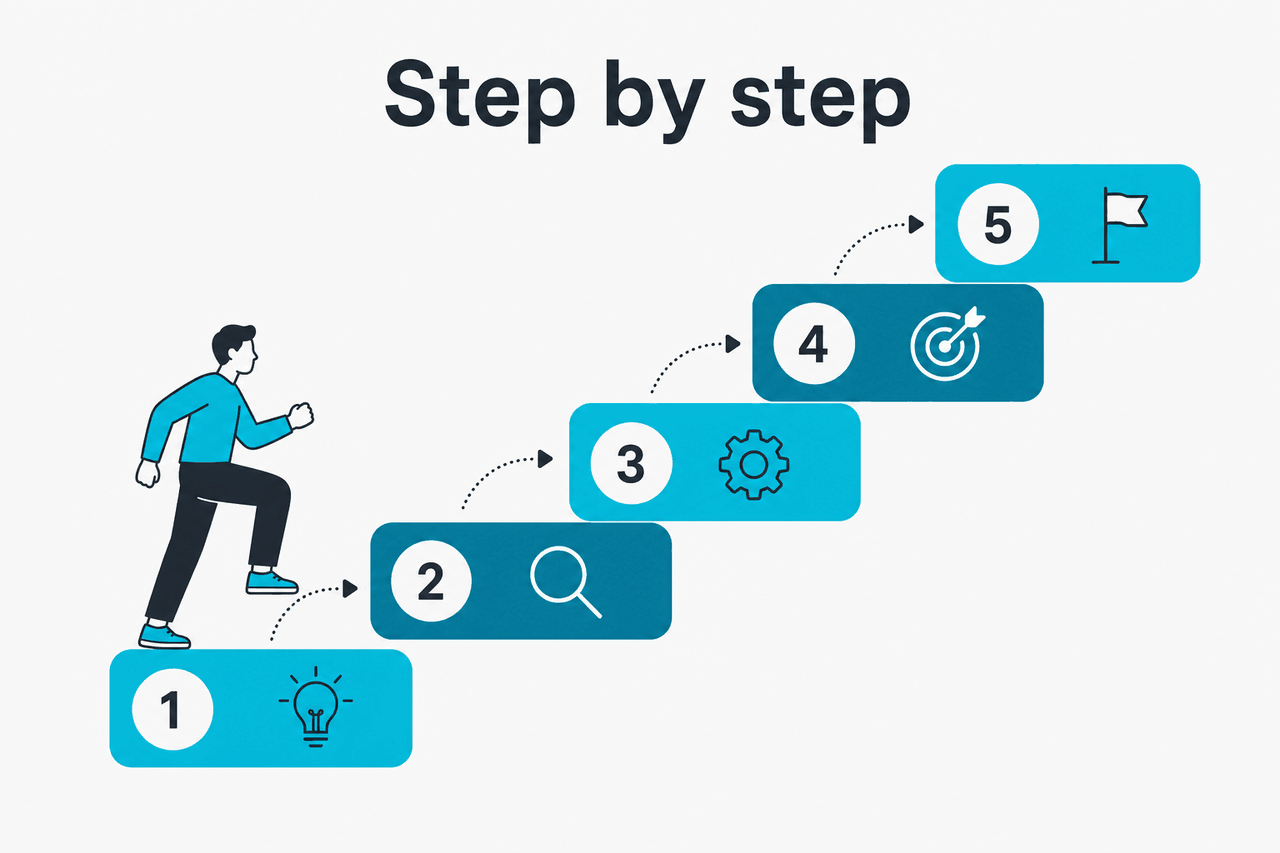
This walkthrough shows a practical way to use Claude for sales from first research to final follow-up. You can run most of it in the Claude app at claude.ai, then adapt the same prompts for automation later.
-
Pick the right Claude plan and model for your sales workflow
Use Free if you are testing prompts and daily habits. Use Pro at $20/month or $17/month annual if one rep or manager needs more capacity, Claude Code, Claude Cowork, unlimited Projects, Research access, additional models, and Office integrations. Use Team (Standard) at $25/seat/month or $20/seat/month annual when a sales team needs shared workspace, SSO, and admin controls. For model choice, Sonnet 4.6 is the default for most sales work, while Haiku 4.5 is useful for high-volume, low-cost classification tasks, and Opus 4.7 is better for complex account analysis.
-
Create one reusable sales brief Claude can rely on
Give Claude your ICP, sales motion, offer, tone, banned claims, common objections, competitors, and CRM field names. Put this in a Project so reps do not re-explain the same context every session. The quality jump usually comes from better context, not more clever prompt wording.
-
Use Claude for account research before discovery calls
Paste the prospect company site copy, public product pages, job posts, and your own notes. Then ask Claude to identify likely priorities, change signals, buying committee clues, and possible pains. Tell it to separate facts from inference, because sales research goes wrong when assumptions are presented as confirmed truth.
-
Generate discovery questions tied to the account, not generic scripts
After the account brief, ask Claude for 8 to 12 discovery questions grouped by business priority, process, risk, budget, and timeline. Also ask for 3 questions to validate or disprove your current hypothesis. This keeps reps from walking into calls with canned talk tracks that miss the real buying context.
-
Turn call notes into a clean summary with next actions
Paste rough notes or transcript excerpts and ask for a structured output: goals, pains, current process, blockers, stakeholders, objections, agreed actions, and CRM-ready next step fields. Tell Claude to mark unknown items as unknown. That one instruction reduces bad data entry.
-
Draft follow-up emails in the rep’s real voice
Feed Claude one or two real emails that the rep actually sent, then ask it to mirror that style without adding fake certainty or fake urgency. Good sales follow-ups are specific, short, and tied to the meeting. Ask Claude to produce two versions: one direct and one softer.
-
Prepare objection-handling notes instead of one-size-fits-all rebuttals
Ask Claude to map each objection to likely root concerns, supporting proof points you already have, and one clarifying question the rep should ask before responding. This works better than asking for “best rebuttals” because it keeps the rep curious rather than defensive.
-
Automate repeat tasks with the API once the manual workflow is stable
When your prompt pattern is consistent, move repetitive work into your own systems through the API guide. Typical automation candidates are lead qualification summaries, transcript-to-CRM formatting, pipeline risk tagging, and batch account briefs. Anthropic prices API use per million tokens, so workload shape matters.
-
Control cost with caching and batch processing
If your sales workflow reuses the same long context, such as product messaging, ICP rules, or CRM schema instructions, prompt caching can cut cached input tokens by 90%. If you can process work asynchronously, Batch API can cut both input and output costs by 50%.
Free
$0/month
For testing Claude for sales
- Web, iOS, Android, and desktop access
- Daily usage limits
Pro
$20/month
For individual reps and managers
- Claude Code and Claude Cowork
- Unlimited Projects and Research access
- Additional models and Office integrations
Team (Standard)
$25/seat/month
For sales teams that need shared controls
- Shared workspace
- SSO and admin controls
If your team needs more throughput, Max starts at $100/month and adds 5x or 20x Pro usage, higher output limits, early feature access, and priority traffic. For larger organisations, Enterprise starts at $20/seat base plus usage at API rates, with features such as SCIM, audit logs, role-based access, spend controls, and regional data residency. You can cross-check official plan details on Claude pricing.
| Model | Best sales use | Input price | Output price |
|---|---|---|---|
| Claude Opus 4.7 | Complex account analysis and nuanced messaging | $5/M tokens | $25/M tokens |
| Claude Sonnet 4.6 | Default choice for most rep workflows | $3/M tokens | $15/M tokens |
| Claude Haiku 4.5 | Fast classification, tagging, and lightweight summaries | $1/M tokens | $5/M tokens |
90% off
cached input tokens with prompt caching
Worked example
Prompt for account research before a discovery call
Use a prompt like: “You are helping with account planning for a sales call. Based only on the material below, list confirmed facts, then likely inferences, then open questions. Draft 10 discovery questions tied to business priorities, process, risk, and buying timeline. Do not invent metrics or stakeholders that are not supported by the source text.”
Worked example
Prompt for post-call follow-up and CRM summary
Use a prompt like: “Convert the notes below into: 1) concise internal summary, 2) customer follow-up email draft, and 3) CRM field suggestions. If a field is missing, write ‘unknown’ rather than guessing. Keep the email specific to the meeting and avoid promises that were not made.”
Teams that want to formalise these workflows usually benefit from a simple prompt library and a short internal policy. Keep one version for prospect research, one for meeting prep, one for follow-up, and one for manager review. If you want to understand Claude features that support this, see our Claude features guide. If you want prompt iteration patterns, our tutorials section is the next place to look.
Common mistakes to avoid
Most problems with Claude for sales are process problems, not model problems.
- Letting Claude invent account facts. Fix: always ask for confirmed facts, inferred possibilities, and unknowns as separate sections.
- Using generic prompts for every deal. Fix: provide account context, deal stage, role, and desired outcome before asking for output.
- Asking for “the perfect sales email.” Fix: ask for a short follow-up tied to one meeting, one audience, and one next step.
- Copying outputs into CRM without review. Fix: require human review for opportunity stage changes, stakeholder mapping, and forecast risk notes.
- Choosing the most expensive model by default. Fix: start with Sonnet 4.6 for most sales work and move up or down only when accuracy or cost requires it.
- Ignoring cost on repeated API workflows. Fix: reuse stable instructions with prompt caching and use batch processing where latency is not important.
Pick when
- Your reps need faster prep, cleaner follow-up, and better note quality
- You can give Claude strong context and clear review rules
- You want to automate repetitive text-heavy work later
Skip when
- You expect it to replace rep judgment in live deals
- Your team has no standard messaging or CRM discipline yet
- You need real-time verified data without supplying source material
Where to go next

These guides help once your basic Claude for sales workflow is working.
- Go through more Claude tutorials for reusable prompting patterns, structured outputs, and workflow design.
- Review Claude features to understand Projects, Research, and other tools that support repeatable team usage.
- Learn the Claude API if you want to automate lead summaries, transcript processing, or sales ops tasks.
If your team also needs engineering support for internal tools around sales workflows, our Claude Code guide covers the coding side.
Other questions readers ask
These are the nearby questions people usually mean when they search for Claude for sales.
The honest take
Claude for sales is useful when you treat it like a skilled assistant, not an autonomous seller. It is strong at turning messy inputs into clear outputs: call prep, summaries, follow-ups, objection maps, and account briefs. It is weaker when asked to produce verified facts without source material or when teams expect one prompt to solve every stage of the sales process.
For most teams, the sensible path is to start with the app, standardise a few prompts, review outputs carefully, and only then automate the repeatable parts. If you want the official product, use Claude directly; if you want implementation help, keep exploring this independent guide.
Independent guide. Not affiliated with Anthropic. For the official Claude product, visit claude.ai.
Last updated: 2026-05-12