
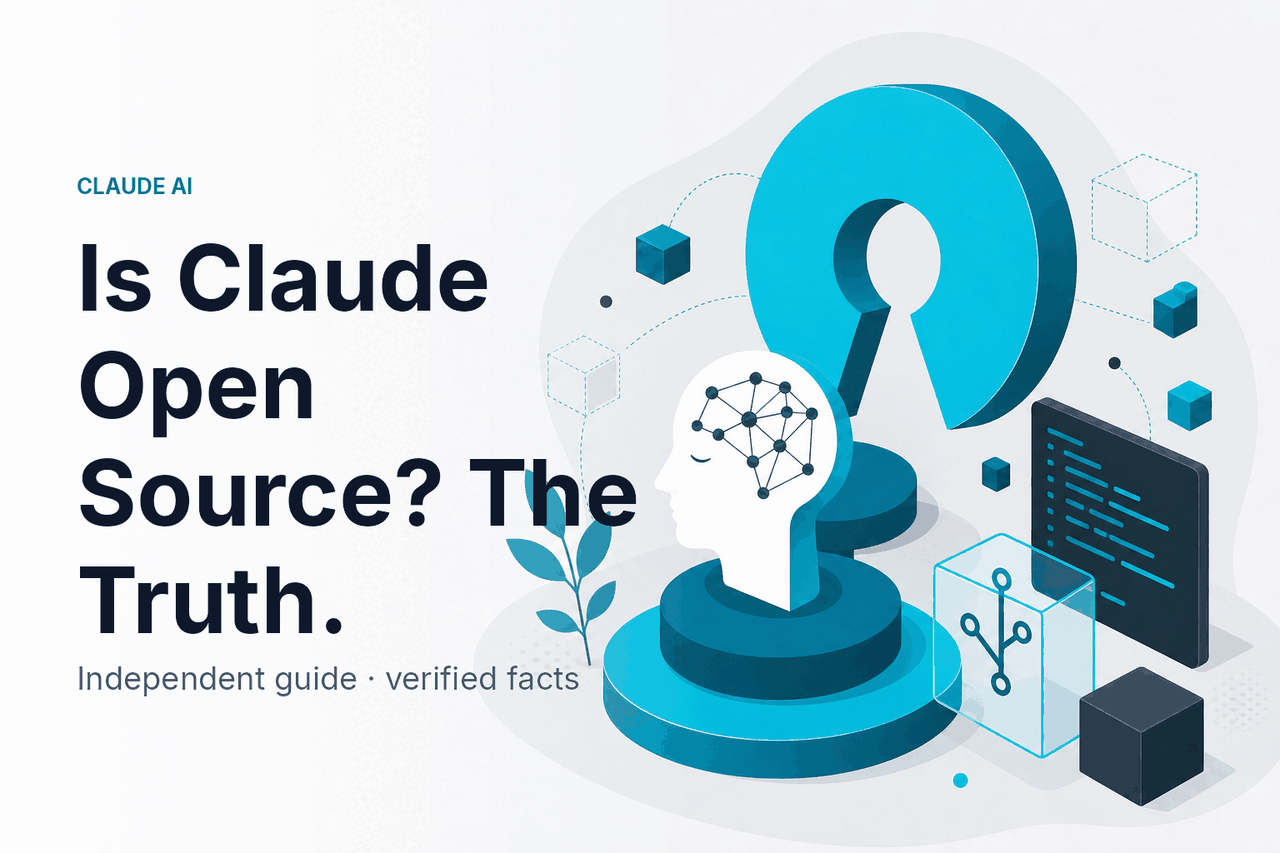
No, Claude AI is not open source; Claude is a proprietary AI assistant and model family made by Anthropic, available through hosted products and APIs rather than public weights or an open-source license.
The short answer
Claude is closed-source software. You can use it through the official claude.ai product and Anthropic’s hosted API, but you cannot download Claude’s model weights, inspect its full training process, modify the base model, or redistribute it under an open-source license.
Open source usually means users can inspect, modify, run, and redistribute software under an open license. In AI, people often also ask whether the model weights are public and whether the model can be self-hosted. Claude does not meet those requirements.
Use Claude if you want a managed assistant for writing, coding, analysis, and document workflows. Do not choose Claude if your hard requirement is public weights, local deployment, or direct control over the base model.
The full story
Claude is a product and model family from Anthropic. Anthropic publishes product information, developer documentation, safety materials, pricing, and model guidance. It does not publish Claude’s full model weights or training code under an open-source license.
This distinction matters. Public documentation is not the same as open source. Anthropic’s Claude developer docs and API platform explain how to call Claude, format requests, use tools, choose models, and manage usage. They do not give users ownership of the model.
Claude has documented interfaces, not an open model. Developers can build reliable integrations with the Messages API, model parameters, context windows, tool use, and rate limits. But they cannot fork Claude, inspect every training step, or deploy an identical copy in their own data center.
| Question | Claude | Open-source or open-weight model |
|---|---|---|
| Can you use it through a web app? | Yes, through claude.ai. | Sometimes, depending on the provider. |
| Can developers use an API? | Yes, through Anthropic’s hosted API. | Often, if hosted by a provider or deployed by your team. |
| Are model weights public? | No. | Often yes, depending on the license. |
| Can you self-host the same model? | No. | Often yes, if hardware and license terms allow it. |
| Can you modify the base model directly? | No. | Sometimes, depending on access and license terms. |
| Can you redistribute the model? | No. | Sometimes, subject to the license. |
Claude’s hosted design lets Anthropic manage availability, safety systems, abuse prevention, account access, model updates, and product reliability. That is useful for many users. It is also a dependency. If you build on Claude, you depend on Anthropic for service access, pricing, policy enforcement, and model availability.
For related guidance, see our guides to Claude features, Claude models, and the Claude API.
What this means in practice
For most everyday users, Claude not being open source is not a blocker. You can still ask questions, draft content, analyze files, summarize long documents, generate code, and use Claude in team workflows. Anthropic handles hosting and model operations.
For technical teams, the trade-off is control. Claude is easier to adopt than running your own model infrastructure, but it does not give you full deployment control. Review official pricing, trust, and status pages before putting Claude inside a production workflow.
Pick Claude when
- You want a hosted assistant for writing, coding, analysis, and document work.
- You prefer managed access through claude.ai or the Anthropic API.
- You do not want to run model-serving infrastructure.
- You can work within Anthropic’s usage rules, limits, and account system.
Skip Claude when
- You need public model weights.
- You must self-host the exact model.
- You need to modify the base model directly.
- You require offline inference with no hosted provider dependency.
Plans affect access, usage, and administration. They do not change Claude’s license status.
Free
$0
Entry-level access with usage limits.
Pro
$20/mo or $17/mo annual
Higher usage for individual users.
Max
From $100/mo
Expanded access for heavy individual use.
Team
Standard: $25/seat or $20/seat annual
Premium: $125/seat or $100/seat annual
Enterprise
$20/seat base + API rates
Organization controls and usage-based API costs.
API pricing is also separate from open-source status. The current model prices are Opus 4.7 at $5 input and $25 output per million tokens, Sonnet 4.6 at $3 input and $15 output per million tokens, and Haiku 4.5 at $1 input and $5 output per million tokens. Opus 4.7 and Sonnet 4.6 support 1M context. Sonnet 4.6 also supports 128K maximum output. Prompt caching gives 90% off cached input. Batch API gives 50% off both input and output.
The privacy question is separate too. A closed model can still offer enterprise controls and published trust materials. An open model can still create privacy risk if your team deploys it poorly or sends sensitive data to an unmanaged endpoint. For Claude, review Anthropic’s Trust Center, Support, and status page.
Example: A legal team that wants fast document review may prefer Claude because Anthropic hosts the service and manages updates. A research lab that must inspect weights and run experiments locally should choose an open model instead.
Many teams use both. They use Claude for managed productivity, customer-support drafting, coding assistance, and document analysis. They use open models for workloads that require local deployment or deeper infrastructure control. For product-level questions, see our Claude pricing guide and Claude FAQ.
FAQ: Claude and open source
Is Claude open source?
No. Claude is proprietary software from Anthropic. Its model weights are not public, and it is not released under an open-source license.
Can I download Claude and run it locally?
No. Anthropic does not provide Claude as a downloadable local model. You use Claude through the official product or hosted API.
Is the Claude API open source?
No. The API is publicly documented, but it is a hosted interface to Anthropic’s models. Documentation does not make the underlying model open source.
Does Anthropic publish Claude’s training data?
No complete public dataset is available that would let users recreate Claude. Anthropic publishes research, product information, policy materials, and developer documentation, but not the full training corpus.
Can I fine-tune Claude?
You can customize Claude’s behavior with prompts, system instructions, context, retrieval, tools, Projects, and API orchestration. That is not the same as changing the base model weights.
Does Claude being closed-source mean it is unsafe?
No. Closed-source and unsafe are not the same thing. Evaluate Claude through Anthropic’s trust materials, product controls, terms, and your own data-handling requirements.
Should I use Claude or an open model?
Use Claude when you want a managed assistant or API. Use an open model when you need local hosting, public weights, deeper inspection, or redistribution rights.
Verdict
Claude is not open source, and Anthropic does not present it as an open-source model. The official product is hosted, and the developer platform is a hosted API. You can build with Claude, but you cannot inspect, modify, self-host, or redistribute the underlying model as open-source software.
Decision rule: Choose Claude for managed access and strong assistant capabilities. Choose an open model if public weights, local deployment, or direct model modification is non-negotiable.
Independent guide. Not affiliated with Anthropic. For the official Claude product, visit claude.ai.
Last updated: 2026-05-12
This article is part of the What is Claude AI hub on c-ai.chat.