
The claude 3.7 ai model most searchers mean is Claude Sonnet 3.7, Anthropic’s earlier mid-tier Claude release; on c-ai.chat, we track it as part of the wider Claude models guide and explain how it compares with the current Opus, Sonnet, and Haiku lineup so you can tell whether it is still the right pick.

- Which model is this?
- What it’s best at
- Where it falls short
- When to pick this model
- Other questions readers ask
- The honest take
Which model is this?

Claude 3.7 refers to an older Claude generation rather than one of Anthropic’s current headline models. In practical terms, if you are choosing a Claude model today, you should treat “Claude 3.7” as a historical point in the Sonnet line and compare it against the current options that Anthropic actively presents: Opus 4.7, Sonnet 4.6, and Haiku 4.5.
- Family · Sonnet-line Claude model
- Version · 3.7 generation
- Current default alternative · Sonnet 4.6
- Status for new buyers · Check official availability in Claude and API docs
| Model | Role in lineup | Input price | Output price | Context window | Max output |
|---|---|---|---|---|---|
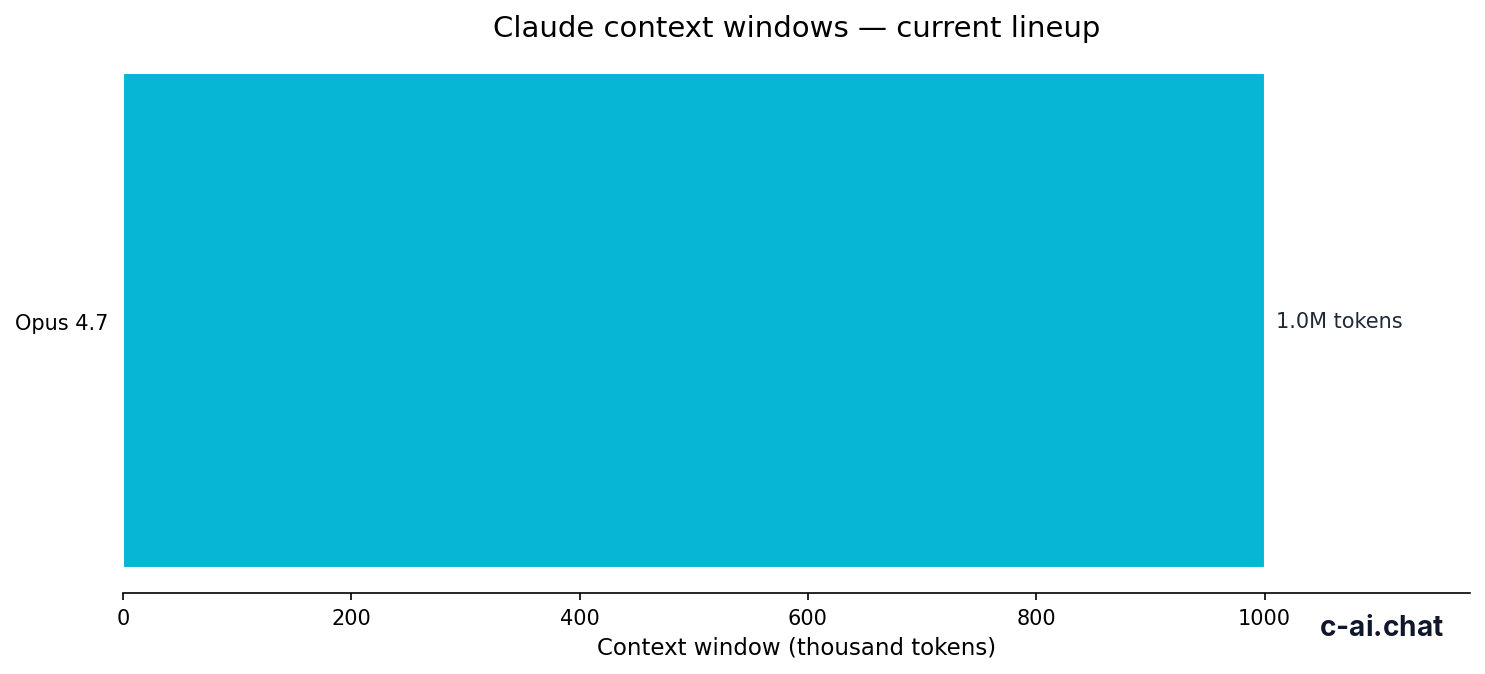
| Claude Opus 4.7 | Flagship | $5/M tokens | $25/M tokens | 1,000,000 tokens | Varies by tool and surface |
| Claude Sonnet 4.6 | Recommended default | $3/M tokens | $15/M tokens | 1,000,000 tokens | 128K |
| Claude Haiku 4.5 | Fastest and cheapest current option | $1/M tokens | $5/M tokens | Check current official limits | Check current official limits |
If your question is really “what should I use instead of Claude 3.7?”, the short answer is Sonnet 4.6 for most work, Opus 4.7 for the hardest reasoning and writing tasks, and Haiku 4.5 when speed and low API cost matter most. Anthropic’s current pricing and model pages are the source of truth for which models are exposed in your plan or workspace.
What it’s best at
Claude 3.7 is best understood as a capable general-purpose Claude model that people often remember because it sat in the sweet spot between quality, speed, and cost. That makes it relevant in search, but less relevant in fresh buying decisions. For many users, the real comparison now is whether the old Sonnet-era balance they liked is better matched by Sonnet 4.6 today.
Against the current lineup, Sonnet 4.6 is the closest fit for “do most things well without paying flagship rates.” Opus 4.7 is stronger when the task is long-form synthesis, nuanced analysis, or harder coding loops. Haiku 4.5 is the better pick for high-volume classification, lightweight chat, or latency-sensitive product flows. If you came here looking for a practical replacement path, the API choice and the in-product choice point to the same answer: use the modern Sonnet tier unless you clearly need either top-end quality or minimum cost.
- General writing, summarising, and rewriting where you want good quality without paying Opus rates.
- Everyday coding help, especially when the task is not large enough to justify a flagship model.
- Document analysis and question answering for normal business workflows.
- Balanced chat experiences where you care about both responsiveness and answer quality.
- Teams upgrading from older Claude habits who want the nearest current equivalent in the Claude feature set.
Where it falls short
The main weakness of Claude 3.7 today is not that it was bad. It is that it is no longer the clearest answer for a new user choosing a Claude model. Searchers often use the old name when they really need current guidance on access, pricing, limits, and whether the model is still exposed in Claude or the API. That is where newer lineup members are easier to recommend and easier to support long term.
- It is not the current flagship; Opus 4.7 is the higher-end choice for demanding reasoning and writing.
- It is not the lowest-cost current path; Haiku 4.5 is much cheaper at $1/M input and $5/M output.
- It is not the cleanest default recommendation now; Sonnet 4.6 is the present-day “most people should start here” option.
- Availability can differ by plan, product surface, and API support, so older model names create confusion.
- Documentation, pricing pages, and plan descriptions focus on the active lineup rather than legacy search terms.
90% off
cached input tokens with prompt caching on supported API workflows
That last point matters because many users looking for Claude 3.7 are really trying to estimate cost. The bigger lever is usually not an older model name but whether your workload fits prompt caching, Batch API, or a cheaper current model tier. Anthropic states prompt caching can cut cached input cost by 90%, and Batch API can cut both input and output costs by 50%.
When to pick this model
The clean decision rule is simple: only pick Claude 3.7 if you specifically need that exact model for continuity, compatibility testing, or comparison against older workflows. If you are starting fresh, the pricing trade-off favors the current lineup because Sonnet 4.6 gives you the modern default at $3/M input and $15/M output, while Haiku 4.5 is cheaper and Opus 4.7 is stronger.
Pick when
- You are validating results against an older internal benchmark that used Claude 3.7.
- You need continuity in an existing workflow and have confirmed the model is still available to you.
- You are comparing older and newer Claude behavior for quality testing or migration planning.
- You liked the historical Sonnet-style balance and want a reference point before moving to Sonnet 4.6.
Skip when
- You are choosing a model for a new product, team rollout, or fresh API integration.
- You want the strongest current Claude output; use Opus 4.7 at $5/M input and $25/M output.
- You want the best mainstream value; use Sonnet 4.6 at $3/M input and $15/M output.
- You want the cheapest current option for scale; use Haiku 4.5 at $1/M input and $5/M output.
On the subscription side, the same logic applies. Most individual users do not choose a named legacy model first; they choose a plan first. Claude Free costs $0/month with daily limits. Pro costs $20/month or $17/month annual. Max starts at $100/month. Team Standard is $25/seat/month or $20/seat/month annual, Team Premium is $125/seat/month or $100/seat/month annual, and Enterprise starts with a $20/seat base plus usage at API rates. If your goal is access rather than historical comparison, plan selection matters more than chasing an older version number.
Free
$0/month
For casual users and first-time testing
- Web, iOS, Android, and desktop access
- Daily usage limits
Pro
$20/month
For individuals who use Claude regularly
- Claude Code and Claude Cowork
- Unlimited Projects and Research access
- Additional models and Office integrations
Max
$100/month
For power users
- 5x or 20x Pro usage
- Higher output limits and priority traffic
Other questions readers ask
If you are comparing old and new Claude naming, the useful distinction is this: historical version numbers help when you are auditing past workflows, but current lineup names help when you are making a buying or implementation decision now. That is why our independent Claude guide centers the live lineup and then maps older searches like “claude 3.7 ai model” back to current options.
The honest take
Claude 3.7 matters mostly as a reference point, not as the model most people should actively seek out. If you searched for the claude 3.7 ai model because you want to know what it is, the answer is: an older Sonnet-line Claude model that sits behind Anthropic’s current Opus 4.7, Sonnet 4.6, and Haiku 4.5 lineup.
If you are making a real choice today, do not over-focus on the old version number. Use Sonnet 4.6 as your default, Opus 4.7 when answer quality is worth the higher $5/M input and $25/M output price, and Haiku 4.5 when low latency and low cost matter most. If you specifically need historical continuity, verify Claude 3.7 availability in the official docs before building around it.
Independent guide. Not affiliated with Anthropic. For the official Claude product, visit claude.ai.
Last updated: 2026-05-12