
The Claude AI Anthropic Claude language model refers to Anthropic’s family of large language models inside Claude, led by Opus, Sonnet, and Haiku; on c-ai.chat we explain how they differ, what each is good at, and when to choose one without pretending to be Anthropic or the official Claude guide.

If you want the broader lineup first, see our Claude models overview; if you are choosing between app plans and API costs, also check Claude pricing and our Claude API guide.
- Which model is this?
- What it’s best at
- Where it falls short
- When to pick this model
- Other questions readers ask
- The honest take
Which model is this?

Anthropic’s Claude language model is not one single model. It is a model family with three main branches: Opus for highest-end reasoning, Sonnet as the default balanced option, and Haiku for speed and low cost. In the current lineup, the newest flagship is Claude Opus 4.7.
- Input price: $5 per million tokens
- Output price: $25 per million tokens
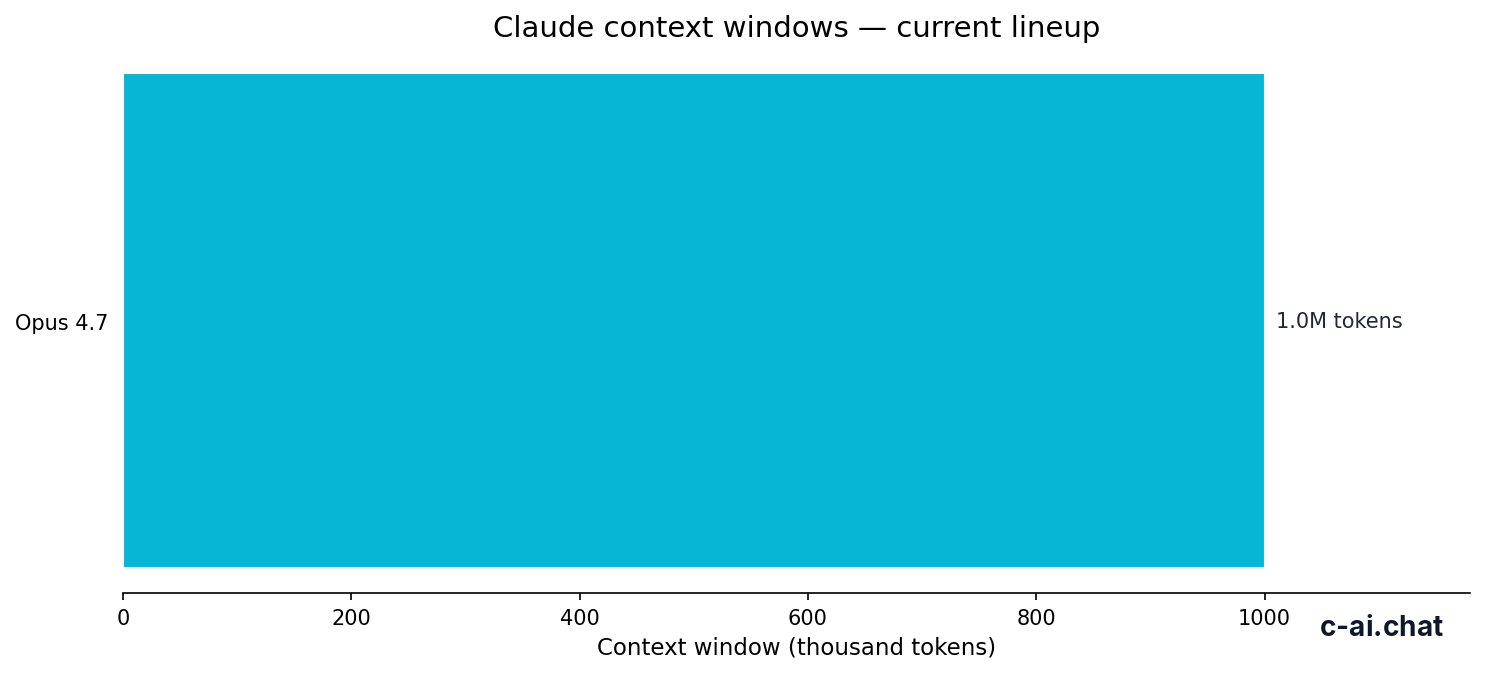
- Context window: 1,000,000 tokens
- Max output: see current platform limits by model endpoint
More precisely, when people search for “Claude AI Anthropic Claude language model,” they usually mean one of two things: the overall Claude model family made by Anthropic, or the latest flagship model available through Claude and the Anthropic platform. Today, that flagship is Opus 4.7, while Sonnet 4.6 is the practical default for most users and Haiku 4.5 is the low-cost fast option.
At the model level, the differences are mostly about reasoning depth, speed, output quality, and price. At the product level, Claude appears in the consumer app and in developer APIs. That is why a searcher can see “Claude” described as both a chatbot and a language model stack: both are true. Anthropic makes the models; Claude is the product experience that uses them.
| Model | Position in lineup | Input price | Output price | Context window | Best fit |
|---|---|---|---|---|---|
| Claude Opus 4.7 | Latest flagship | $5/M | $25/M | 1,000,000 tokens | Hard reasoning, complex writing, high-stakes tasks |
| Claude Sonnet 4.6 | Recommended default | $3/M | $15/M | 1,000,000 tokens | Most business, coding, and knowledge work |
| Claude Haiku 4.5 | Fastest and cheapest | $1/M | $5/M | Smaller-cost option in the family | Classification, routing, lightweight chat, bulk tasks |
What it’s best at
The Claude language model family is strongest when you need long-context reasoning, structured writing, document analysis, and coding help in plain language. Opus 4.7 is the top end of that range. It is the best fit for multi-step tasks where mistakes are expensive, such as reviewing large contracts, planning architecture changes, producing careful research drafts, or working through ambiguous prompts that require judgment rather than just retrieval.
Compared with sibling models, Sonnet 4.6 gives up some top-end capability in exchange for a better price-performance balance, which is why it is the default recommendation for many users. Haiku 4.5 is better when latency and volume matter more than nuance. If your workload involves long documents, codebases, or back-and-forth reasoning, Claude stands out because the stronger models can use very large context windows without forcing you into a separate “long context” pricing tier. You can see how that fits into the wider product set in our Claude features guide.
- Complex document work: summarising, comparing, or extracting from long files and multi-document sets.
- Careful writing: rewriting for tone, drafting memos, polishing reports, and producing clearer business communication.
- Coding assistance: planning functions, explaining code, debugging, and helping with repository-level tasks in the stronger models.
- Reasoning-heavy prompts: cases where the model must weigh trade-offs instead of giving a quick generic answer.
- Knowledge workflows: research organisation, project notes, and synthesis across large context windows.
90% off
cached input tokens with prompt caching
That cost optimisation matters more than many buyers expect. If your prompts include large repeated instructions, reference material, or framework text, prompt caching can narrow the practical cost gap between a stronger Claude model and a cheaper one. On API workloads, that sometimes makes Sonnet or Opus economically viable where a sticker-price comparison alone would suggest otherwise.
Where it falls short

Claude’s language models are not automatically the right choice for every task. The stronger models can cost meaningfully more, and the flagship’s advantages are easiest to justify on difficult work rather than routine prompts. If you only need fast classification, high-volume templated output, or lightweight chat, paying Opus prices is usually unnecessary. Even Sonnet can be more model than you need for simple routing or extraction pipelines.
- High-volume low-value tasks: Haiku 4.5 is usually the better pick on price and speed.
- Simple consumer chat: you may not notice much practical benefit from Opus over Sonnet.
- Strict budget caps: output-heavy workloads can get expensive because output tokens cost more than input tokens.
- Latency-sensitive automations: faster models are often easier to scale.
- Tasks needing guaranteed factual correctness: Claude can still make mistakes, so human review or grounded retrieval remains necessary.
When to pick this model
The simplest decision rule is this: pay for the strongest Claude model only when the task is hard enough to earn that extra cost. Otherwise, move down the lineup.
Pick when
- You need the highest reasoning quality in the Claude family.
- You work with long documents, complex prompts, or large code context.
- Better answers save more money than the extra token cost.
- You can justify $5/M input and $25/M output for important tasks.
- You want the flagship option and will actually use its strengths.
Skip when
- Your workload is routine and Sonnet 4.6 is good enough.
- You care more about throughput and budget than top-end reasoning.
- You are building bulk processing pipelines where Haiku 4.5 fits better.
- Your main concern is response speed for simple tasks.
- You do not have a review process for expensive output-heavy jobs.
For most people, the right operational default is Sonnet 4.6, not the flagship. Sonnet costs $3 per million input tokens and $15 per million output tokens, which is materially lower than Opus while still covering most writing, coding, and document workflows. Haiku 4.5 drops that further to $1/M input and $5/M output when speed and scale matter most. If you are comparing app subscriptions rather than API billing, see our breakdown of Claude plans and pricing.
Other questions readers ask
The honest take
If you searched for “Claude AI Anthropic Claude language model,” the clearest answer is that Claude is a family of Anthropic language models, not a single fixed model. Opus 4.7 is the current flagship, Sonnet 4.6 is the default recommendation for most users, and Haiku 4.5 is the fast low-cost option. That lineup matters because the right choice depends less on brand and more on your actual workload.
For careful reasoning and high-stakes work, Claude earns its place. For ordinary prompts, the flagship is often more expensive than necessary. The smart move is usually to start with Sonnet, test against your own tasks, and move up to Opus only when the quality gap is real. If you want the official product, use Claude directly; if you want the broader independent context, keep exploring our Claude model guides.
Independent guide. Not affiliated with Anthropic. For the official Claude product, visit claude.ai.
Last updated: 2026-05-12