
Claude model capabilities differ mainly by family, price, speed, reasoning depth, and output limits: Opus is the highest-capability tier, Sonnet is the default balance, and Haiku is the low-cost fast option. This is an independent guide from c-ai.chat, not Anthropic, and this page maps the current lineup before you decide whether to use Claude on the web, in apps, or through the Claude API.

- Which model is this?
- What it’s best at
- Where it falls short
- When to pick this model
- Other questions readers ask
- The honest take
Which model is this?

If you searched for claude model capabilities, the short answer is that Claude currently spans three active families: Opus, Sonnet, and Haiku. The latest flagship is Claude Opus 4.7, Sonnet 4.6 is the recommended default for most users, and Haiku 4.5 is the fastest and cheapest model. For web and app plans, model access depends on your Claude subscription; for developers, capability differences show up most clearly in API pricing, context size, and output limits.
- Opus 4.7 · input $5/M tokens
- Output $25/M tokens
- Context 1,000,000 tokens
- Max output higher-capability flagship tier
Precisely: Claude Opus 4.7 is the Opus family flagship and the newest top-tier model in the current Claude lineup. Claude Sonnet 4.6 sits below it as the balanced general-purpose model at $3 per million input tokens and $15 per million output tokens, while Claude Haiku 4.5 is the budget speed-first option at $1 per million input tokens and $5 per million output tokens. If your question is really “which Claude model should I start with?”, the default answer is usually Sonnet 4.6 unless you need stronger reasoning or lower cost.
| Model | Family | Position in lineup | Input price | Output price | Context window | Best fit |
|---|---|---|---|---|---|---|
| Claude Opus 4.7 | Opus | Latest flagship | $5/M | $25/M | 1,000,000 tokens | Hard reasoning, complex agent work, high-stakes outputs |
| Claude Sonnet 4.6 | Sonnet | Recommended default | $3/M | $15/M | 1,000,000 tokens | Most production apps, writing, coding, analysis |
| Claude Haiku 4.5 | Haiku | Fastest and cheapest | $1/M | $5/M | Lower-cost tier | High-volume, low-latency tasks |
What it’s best at
Claude model capabilities are easiest to understand as trade-offs. Opus 4.7 is best when the task is difficult enough that stronger reasoning changes the outcome: multi-step analysis, nuanced writing, deeper code generation, agent-style workflows, and long-context synthesis across large document sets. Sonnet 4.6 handles a wide range of these tasks well, but Opus is the model you pick when mistakes are expensive or when the work needs more persistence and judgment.
Sonnet 4.6 is the practical middle ground. It is cheaper than Opus, more capable than Haiku for complex work, and is the safest starting point for most teams building with Claude. Haiku 4.5 wins on speed and cost, especially for classification, extraction, templated responses, and other high-volume jobs where low latency matters more than top-end reasoning quality. Across the lineup, the main pattern is simple: Opus for maximum capability, Sonnet for balance, Haiku for throughput.
- Complex reasoning: Opus 4.7 is the strongest pick for layered prompts, tricky edge cases, and tasks that need careful inference.
- Coding and agent workflows: Sonnet 4.6 is often enough, but Opus 4.7 is better when tool use, debugging, and long chains of work need more reliability.
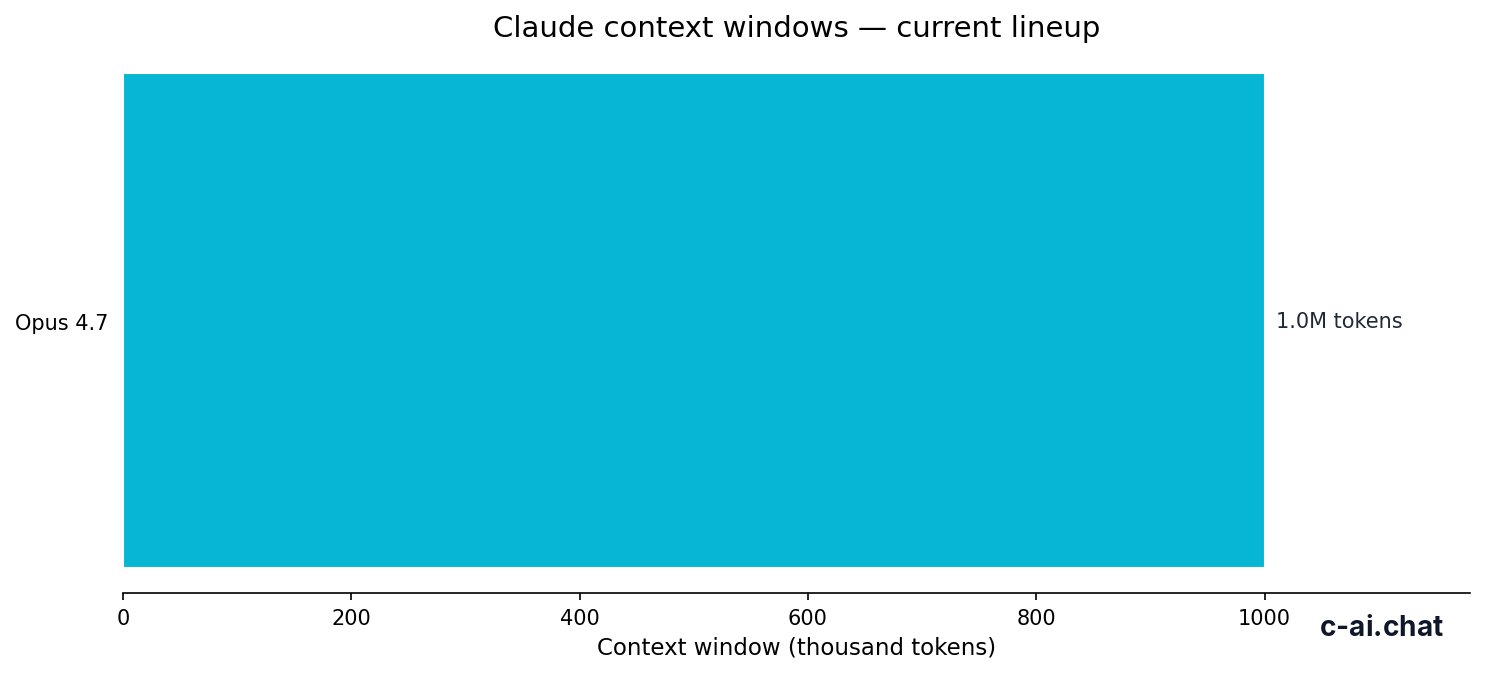
- Long-context analysis: Opus 4.7 and Sonnet 4.6 both support 1,000,000-token context, which helps with large repositories, contract packs, or research sets.
- Fast production traffic: Haiku 4.5 is the better fit for low-cost customer support, routing, extraction, and lightweight summarisation.
- Everyday knowledge work: Sonnet 4.6 is usually the right answer for drafting, revision, spreadsheets, presentations, and mixed business tasks.
90% off
cached input tokens with prompt caching
That cost optimisation matters for capability planning too. A stronger model can be affordable in production if much of the prompt stays stable and cacheable. Anthropic also offers Batch API pricing with 50% off input and output, which changes the math for offline workloads where latency is less important than model quality and total spend.
Where it falls short
No Claude model is “best” at everything. Opus 4.7 costs materially more than Sonnet 4.6 and much more than Haiku 4.5, so it is often the wrong choice for simple repetitive tasks. Sonnet 4.6 is stronger than Haiku, but if your workload is mostly straightforward extraction or short replies at scale, you may be paying for capability you do not need. Haiku 4.5 is excellent for speed and cost, but it is the weakest option for difficult reasoning, subtle writing, and high-stakes outputs where quality matters more than raw throughput.
- Opus 4.7 falls short on cost efficiency for bulk classification, routing, or templated generation.
- Sonnet 4.6 falls short when a task is complex enough that the stronger flagship noticeably improves accuracy or consistency.
- Haiku 4.5 falls short on nuanced instruction-following, long multi-step logic, and premium-quality prose.
- All models can still make mistakes on factual claims, calculations, and unstated assumptions, so verification is still required.
- Large context does not guarantee good judgment; more tokens help with scope, not with truthfulness by themselves.
When to pick this model
The decision rule is straightforward: pay for Opus only when better outputs justify the higher token price, use Sonnet as the default when you want strong capability without flagship cost, and use Haiku when response speed and budget matter most. The pricing trade-off is clear across the API: Opus 4.7 is $5 per million input tokens and $25 per million output tokens, Sonnet 4.6 is $3 and $15, and Haiku 4.5 is $1 and $5.
Pick when
- You need the strongest reasoning and the budget can support it.
- You are building a general-purpose product and want the safest default balance.
- You run high-volume, latency-sensitive workloads where cost per token matters most.
- You need 1,000,000-token context for large inputs on Opus or Sonnet.
- You can combine prompt caching or Batch API discounts with a stronger model.
Skip when
- You are paying Opus prices for simple extraction, tagging, or routing.
- You are using Sonnet for work that clearly needs top-tier reasoning quality.
- You are using Haiku for subtle analysis, difficult code tasks, or premium writing.
- You are comparing plans and API costs as if they are the same product decision.
- You expect any model to replace human review for critical decisions.
| If your priority is… | Pick this model | Why | Main trade-off |
|---|---|---|---|
| Highest capability | Claude Opus 4.7 | Best for difficult reasoning and complex work | Highest output cost at $25/M |
| Best overall balance | Claude Sonnet 4.6 | Strong enough for most real workloads | Not as strong as Opus on the hardest tasks |
| Lowest cost and fastest responses | Claude Haiku 4.5 | Ideal for scale and latency | Less capable on nuanced or high-stakes tasks |
Other questions readers ask
The honest take
The claude model capabilities matrix is not complicated once you strip away branding. Claude Opus 4.7 is the top-capability model. Claude Sonnet 4.6 is the sensible default for most people and most apps. Claude Haiku 4.5 is the cost-and-speed option. If you are unsure, start with Sonnet, test Opus on the hardest cases, and use Haiku where volume and latency dominate.
The main mistake is choosing by status instead of workload. Many teams overpay for flagship quality they do not need, while others push cheap models into tasks that need stronger judgment. Match the model to the job, validate on real prompts, and check whether pricing features like caching or batch processing change the result.
Independent guide. Not affiliated with Anthropic. For the official Claude product, visit claude.ai.
Last updated: 2026-05-12