
Claude Opus is Anthropic’s flagship Claude model family for the hardest reasoning, coding, analysis, and long-context tasks.

c-ai.chat is an independent guide, not Anthropic and not claude.ai. Use this page as a practical Opus guide, then compare the wider lineup in our Claude models overview, API notes, and pricing guide.
- Which model is this?
- What it’s best at
- Where it falls short
- When to pick this model
- Other questions readers ask
- The honest take
- Sources
Which model is this?
Claude Opus is the highest-capability Claude family, and Claude Opus 4.7 is the latest Opus version. It sits above Sonnet and Haiku in Anthropic’s model lineup: Opus is built for maximum capability, Sonnet is the balanced default, and Haiku is the fast, lower-cost option.
Claude Opus 4.7
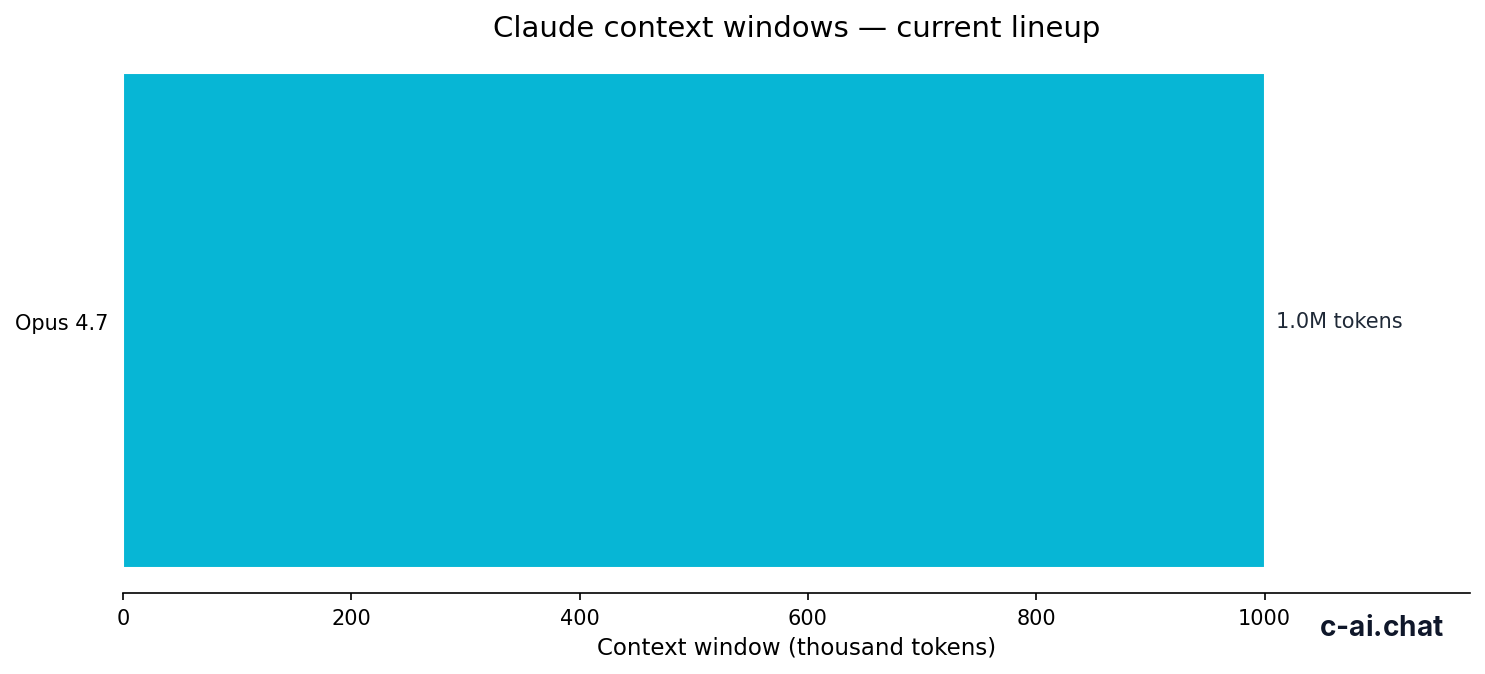
Flagship Claude model · $5/M input tokens · $25/M output tokens · 1,000,000-token context window
Anthropic positions Claude Opus 4.7 as the flagship model for demanding work. That does not mean every Claude user should choose it by default. For many everyday prompts, Claude Sonnet 4.6 gives a better cost-to-quality balance. For high-volume classification, extraction, routing, and short responses, Claude Haiku 4.5 is usually the cheaper fit.
You can use Opus through the official Claude product at claude.ai or through Anthropic’s API on platform.claude.com. Plan availability, rate limits, and model access can vary by account type. Check the official Claude pricing page before making a budget decision.
| Model | Role in the lineup | Input price | Output price | Context | Best fit |
|---|---|---|---|---|---|
| Claude Opus 4.7 | Flagship | $5/M tokens | $25/M tokens | 1,000,000 tokens | Hard reasoning, complex coding, large-context analysis |
| Claude Sonnet 4.6 | Recommended default | $3/M tokens | $15/M tokens | 1,000,000 tokens; 128K max output | Most business, writing, coding, and agent workflows |
| Claude Haiku 4.5 | Fast and cheaper | $1/M tokens | $5/M tokens | Check current model limits | High-volume, low-latency, structured tasks |
What it’s best at

Claude Opus is best when the task is difficult enough that quality matters more than unit cost. It is the model to test when prompts involve many constraints, long source material, ambiguous instructions, or multi-step reasoning. Common examples include legal-style document review, large codebase planning, scientific literature analysis, and decision support where a shallow answer would be expensive.
Compared with Sonnet 4.6, Opus is the premium option for tougher cases rather than the everyday default. Compared with Haiku 4.5, it is slower and more expensive for simple throughput work. It is more useful when nuance and reasoning depth matter. A sensible workflow is to start with Sonnet, move only the hardest prompts to Opus, and use Haiku for simple routing or extraction. Our Claude API guide explains how teams often implement model routing.
- Complex coding: architecture planning, multi-file refactors, bug investigation, and code review where the model must track dependencies.
- Long-context synthesis: analysis of large document sets, transcripts, policies, contracts, or research material inside a single task.
- High-stakes reasoning: comparing options, identifying trade-offs, and checking assumptions before a human decision.
- Agent planning: breaking large goals into steps, evaluating tool results, and recovering when a workflow gets messy.
- Technical writing: producing specifications, migration plans, test plans, and implementation notes from scattered inputs.
Opus also benefits from careful prompt design. Give it source material, constraints, acceptance criteria, and examples of what good output looks like. If you ask a vague question, you can still get a polished but incomplete answer. The model is strongest when the problem is clearly framed.
Where it falls short

Claude Opus is not the right model for every Claude task. Its main weakness is cost. At $5/M input tokens and $25/M output tokens, it can become expensive if you use it for simple prompts, repeated drafts, or high-volume automation. It can also be unnecessary when Sonnet gives similar practical quality for the task at a lower price.
- Simple chat and drafting: Sonnet 4.6 is usually enough for everyday writing, summarisation, brainstorming, and editing.
- Bulk extraction: Haiku 4.5 is often the better pick for structured fields, labels, moderation-style checks, and short transformations.
- Latency-sensitive apps: a smaller model may feel faster for user-facing flows that need quick responses.
- Loose prompts: Opus can still misunderstand vague goals, missing context, or conflicting instructions.
- Unverified facts: like other AI models, Opus can produce confident errors. Use citations, retrieval, or human review where accuracy matters.
- Budget-limited testing: if you are experimenting, begin with Sonnet or Haiku before moving the final version of a prompt to Opus.
For product teams, the common mistake is using Opus for every request because it is the flagship model. That raises cost without always improving the user experience. A better pattern is to match the model to the task. Use Opus where it changes the answer, not where it makes an easy answer more expensive.
90% off
cached input tokens with prompt caching
If you use Opus through the API, cost controls matter. Anthropic’s pricing documentation describes prompt caching for repeated input and Batch API discounts for eligible workloads. Prompt caching can reduce cached input cost by 90%, and Batch API can reduce eligible input and output costs by 50%. See Anthropic’s API pricing documentation for current details.
When to pick this model
Pick Claude Opus when the marginal improvement in quality is worth the higher token price. Skip it when the task is routine, short, or easy to validate with a cheaper model.
Decision rule
Use Opus only after Sonnet fails your real test.
Start with Sonnet 4.6. Move the task to Opus 4.7 only if Opus improves correctness, completeness, reasoning quality, or human review time enough to justify the higher price.
Pick when
- The task has many constraints and a wrong answer would cost more than the model call.
- You need stronger reasoning across long documents, code, or mixed evidence.
- You are building an agent that must plan, check, revise, and handle messy intermediate results.
- You have already tested Sonnet and need better performance on the hardest edge cases.
- You can use caching, batching, or routing to keep total cost under control.
Skip when
- You need cheap high-volume responses, labels, or structured extraction.
- The prompt is short, repetitive, and not especially complex.
- Latency matters more than the final quality margin.
- Your budget cannot support $5/M input tokens and $25/M output tokens at scale.
- Sonnet already meets the acceptance criteria in testing.
The pricing trade-off is clear. Opus costs more than Sonnet and Haiku on both input and output. That can be acceptable for expert analysis, difficult coding, or important internal workflows. It is usually wasteful for basic customer support drafts, short summaries, and classification jobs.
For individual users, the question is often plan access rather than token math. Claude’s Free, Pro, Max, Team, and Enterprise plans differ in usage limits, features, and model availability. Our Claude pricing guide explains those plan differences, while Anthropic’s official pricing page is the source of record.
Free
$0
Entry-level access with usage limits.
Pro
$20/mo or $17/mo annual
For individuals who use Claude more often.
Max
From $100/mo
For heavier individual usage.
Team Standard
$25/seat or $20/seat annual
For teams that need shared access.
Team Premium
$125/seat or $100/seat annual
For teams with higher usage and admin needs.
Enterprise
$20/seat base + API rates
For organisations that need enterprise controls.
Worked example
A practical routing rule
This keeps Opus focused on tasks where the quality gain is most likely to justify the higher price.
Model routing also makes evaluation easier. Run a representative set of prompts through Sonnet and Opus, then compare the outputs against your acceptance criteria. If Opus wins only on style, use Sonnet. If it wins on correctness, completeness, or fewer human revisions, use Opus for that task class.
Other questions readers ask
These are the closely related questions people ask when comparing Claude Opus with the rest of the Claude ecosystem.
If you are still choosing between Claude as a product and Claude as an API, start with the feature set. The app is simpler for individual work. The API gives developers more control over prompts, routing, retrieval, logging, and evaluation. Our Claude features guide explains the main product capabilities in plain language.
The honest take
Claude Opus is the model to reach for when the problem is genuinely hard. It is not the model to use by habit. Its value comes from better handling of complex instructions, long context, difficult reasoning, and demanding coding work. Its drawback is simple: at $5/M input tokens and $25/M output tokens, careless use gets expensive quickly.
For most users, Claude Sonnet 4.6 should be the starting point. Move to Claude Opus 4.7 when your tests show a real quality gain. Use Claude Haiku 4.5 when speed and cost matter more than depth. That mix is usually stronger than treating the flagship model as the answer to every prompt.
Independent guide. Not affiliated with Anthropic. For the official Claude product, visit claude.ai.
Last updated: 2026-05-12