
The latest Claude AI model is Claude Opus 4.7, Anthropic’s flagship model for difficult reasoning, complex coding, and long-context analysis; c-ai.chat is an independent guide, and this page explains where Opus 4.7 fits in the Claude model lineup.

- Which model is this?
- What it is best at
- Where it falls short
- When to pick this model
- Other questions readers ask
- The honest take
- Sources
Which model is this?
Claude Opus 4.7 is the current flagship Claude model. It sits above Sonnet 4.6 and Haiku 4.5 in Anthropic’s model lineup.
Opus is the highest-capability Claude family. Use it when quality matters more than the lowest possible price. For many daily workflows, Sonnet 4.6 is the better default. For fast, high-volume work, Haiku 4.5 is usually the better fit.
Claude Opus 4.7
Latest Claude AI model and current flagship
$5 / $25
per million input tokens / output tokens
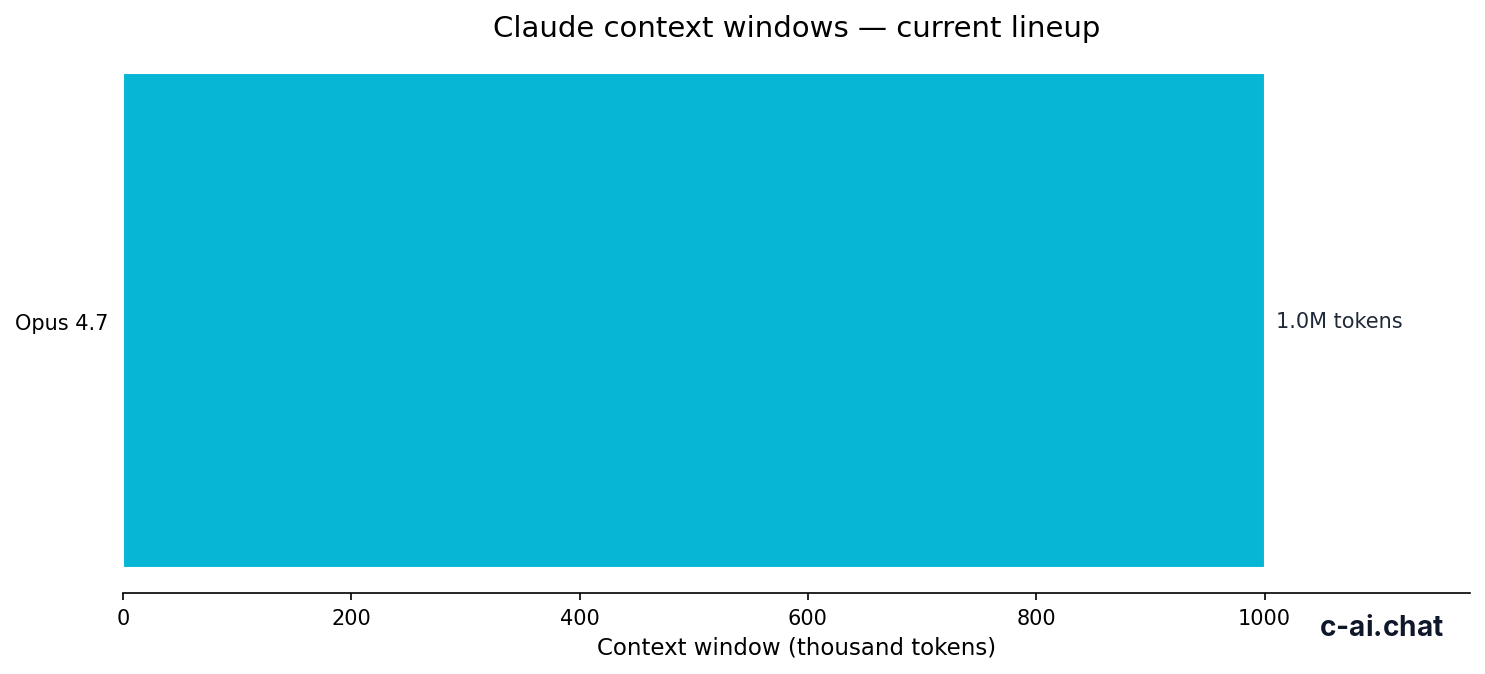
1M tokens
context window
You can verify the official model list in Anthropic’s Claude models overview and API prices in the Claude API pricing docs. If you are comparing model cost with subscriptions, see our independent Claude pricing guide.
| Model | Best role | Input price | Output price | Context | Typical pick |
|---|---|---|---|---|---|
| Claude Opus 4.7 | Flagship capability | $5/M tokens | $25/M tokens | 1M tokens | Hard reasoning, complex coding, high-value analysis |
| Claude Sonnet 4.6 | Best balance | $3/M tokens | $15/M tokens | 1M tokens; 128K max output | Most production workloads and daily professional use |
| Claude Haiku 4.5 | Fast and low cost | $1/M tokens | $5/M tokens | Check official docs | High-volume tasks, routing, extraction, quick replies |
What it is best at

Opus 4.7 is the model to consider when errors are expensive. It is strongest for multi-step software work, dense technical documents, strategic analysis, legal or policy review with human oversight, and long-context synthesis.
Its 1M-token context window helps when you need to provide a large codebase, long transcript set, or substantial document bundle in one prompt. That does not mean you should send everything by default. Large inputs still cost money and can add noise.
- Complex coding: debugging across files, planning migrations, reviewing architecture, and explaining unfamiliar code.
- Long-context analysis: comparing large documents, summarising evidence sets, and finding contradictions in long inputs.
- High-stakes drafting: producing first drafts for technical, policy, research, or executive work that a human will review.
- Agentic workflows: handling multi-step tasks where the model needs to plan, check intermediate results, and revise its approach.
- Reasoning-heavy decisions: evaluating trade-offs, identifying weak assumptions, and producing structured recommendations.
Example use case
Good Opus 4.7 task: “Review this migration plan, compare it with the attached codebase, identify risky dependencies, and propose a staged rollout with rollback steps.”
Better for Haiku 4.5: “Classify these support tickets into billing, login, bug, or feature request.”
If you build with the API, model choice affects both quality and unit economics. The same task can cost very different amounts depending on input length, answer length, prompt caching, and Batch API use. Our Claude API guide explains those choices for developers.
Where it falls short
Opus 4.7 is the highest-capability option in the current Claude lineup, but it is not a shortcut around clear prompts, verification, or cost control. It can still misunderstand vague instructions, overfit to misleading context, produce confident errors, or write longer answers than you need.
For teams, the main weakness is often price. The question is not whether Opus 4.7 is capable. The question is whether each task is valuable enough to justify Opus-level pricing.
- Routine extraction: use Haiku 4.5 for simple tagging, parsing, triage, or short structured outputs.
- General productivity: use Sonnet 4.6 for everyday writing, analysis, summarisation, and coding where flagship quality is not required.
- Very high-volume workflows: Opus 4.7 can become expensive if every request produces long answers.
- Latency-sensitive tasks: a smaller model may be better for chat routing, autocomplete-style help, and fast support workflows.
- Unsupported claims: Claude can reason over sources, but it should not be treated as a source of truth without citations or checks.
90% off
cached input tokens with prompt caching
50% off
both input and output tokens with Batch API
Cost controls matter most when prompts repeat instructions, schemas, policy text, or large reference material. Prompt caching and Batch API can make Opus 4.7 more practical, but they do not remove the need to route simple requests to cheaper models.
When to pick this model
Pick Opus 4.7 when a weaker answer would cost more than the model price difference. If the work is easy to check or cheap to redo, start with Sonnet 4.6 or Haiku 4.5.
Pick Opus 4.7 when
- The task involves complex reasoning, planning, or code changes.
- You need to analyse very large context in one request.
- The answer will guide an important business, technical, or research decision.
- You want the strongest Claude model before human review.
- You can manage token volume with caching, routing, or concise output instructions.
Skip Opus 4.7 when
- The task is short, repetitive, or easy to check automatically.
- You need the lowest cost per request.
- You are building a high-volume workflow where most requests are simple.
- Sonnet 4.6 already gives acceptable answers in testing.
- Haiku 4.5 can complete the job with a structured prompt.
A practical routing rule is simple: start with Sonnet 4.6, benchmark Haiku 4.5 for cheaper sub-tasks, and reserve Opus 4.7 for cases where tests show a clear quality lift.
For consumer use on claude.ai, model access depends on your plan, region, account settings, and usage limits. For product teams, the API gives more direct control over model selection, token spend, and routing. The official Claude pricing page is the source of record for plan availability.
Free
$0
Entry-level access with usage limits.
Pro
$20/month or $17/month annually
Individual plan with higher usage than Free.
Max
From $100/month
Higher-usage individual plan.
Team Standard
$25/seat or $20/seat annually
Team workspace with standard team features.
Team Premium
$125/seat or $100/seat annually
Higher-tier team plan.
Enterprise
$20/seat base plus API rates
Enterprise access with API-based usage charges.
Feature access also matters. Some users care less about raw model choice and more about Projects, Claude Code, Research, office integrations, or team administration. Our Claude features guide covers those product-level differences separately from model capability.
Other questions readers ask
If Claude appears unavailable, slow, or degraded, check Claude status. For security and compliance information, Anthropic maintains a separate trust center. For common usage questions, see our Claude FAQ.
The honest take
The latest Claude AI model is Claude Opus 4.7. Test it first when the work is hard, long, or expensive to get wrong. Do not make it the default for every prompt without measuring cost and quality.
Use Opus 4.7 when the output quality justifies $5/M input tokens and $25/M output tokens. Use Sonnet 4.6 when you want the best balance. Use Haiku 4.5 when speed and cost matter most.
Independent guide. Not affiliated with Anthropic. For the official Claude product, visit claude.ai.
Last updated: 2026-05-12