
Claude Code pricing is plan-based, not a separate standalone fee: individual access starts with Claude Pro at $20/month or $17/month annual, while heavier use may require Max from $100/month; c-ai.chat is independent and not affiliated with Anthropic, and our full Claude pricing guide explains the wider plan and API costs.

- The bottom line
- What you get
- Is it worth it for you?
- Cheaper or better alternatives
- The honest take
- FAQ
- Sources
The bottom line
If you want Claude Code as an individual, start with Claude Pro at $20/month or $17/month annual. If long coding sessions often hit usage limits, Max starts from $100/month and gives higher usage than Pro. Teams should compare Team Standard at $25/seat/month or $20/seat/month annual when admin controls, SSO, and shared workspace features matter.
Quick answer
- Entry price: Pro at $20/month or $17/month annual
- Higher individual usage: Max from $100/month
- Team entry: Team Standard at $25/seat/month or $20/seat/month annual
- Separate billing: API usage is charged per million tokens
Anthropic lists Claude Code as part of the paid Claude plan set on the official Claude pricing page. The important distinction is simple: Claude Code access is tied to Claude subscriptions. Direct API usage is separate and is billed through Anthropic’s developer platform. Our Claude API guide covers that route.
What you get
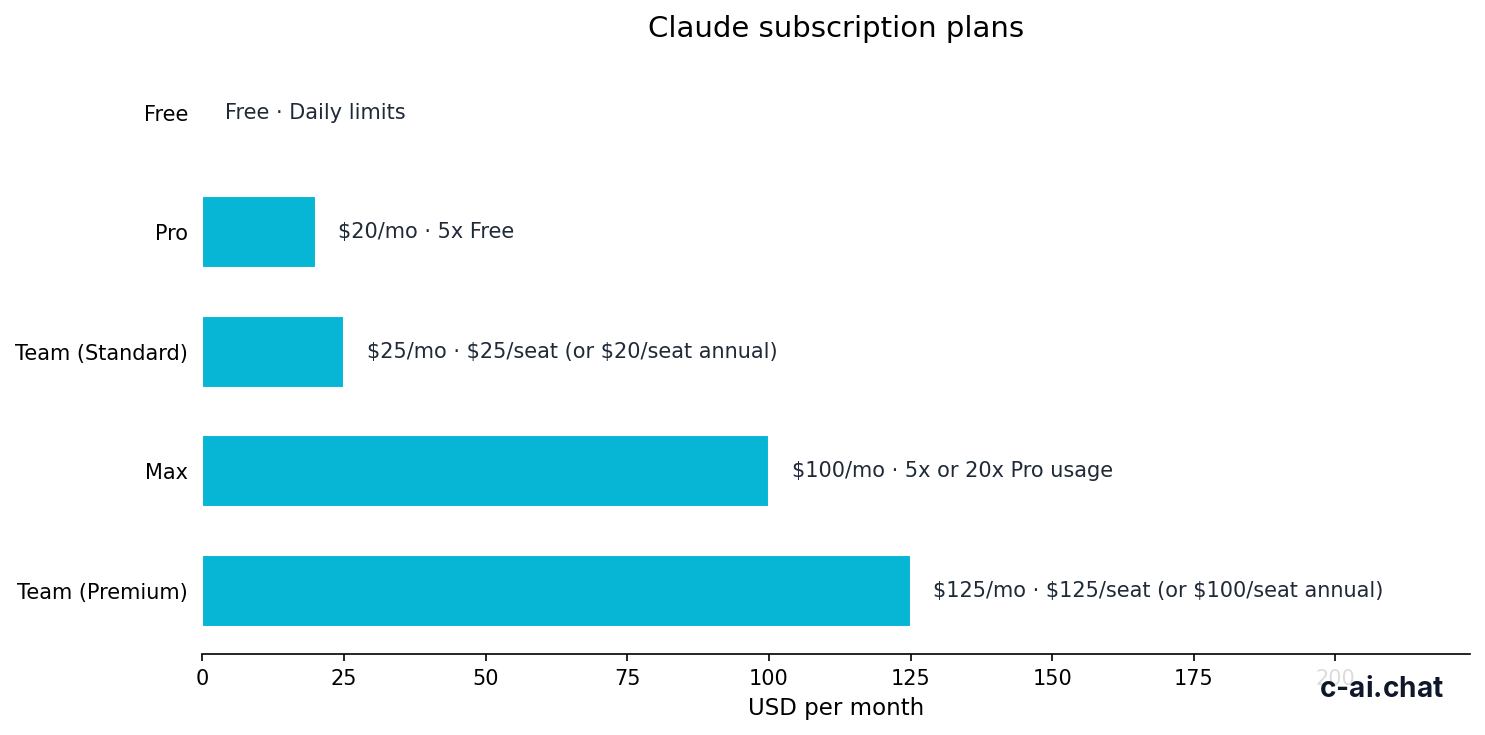
Claude Code sits inside Anthropic’s broader Claude subscription structure. The right plan depends on how often you code with it, whether you need team administration, and whether you also need Claude for research, documents, and office work.
Free
$0/month
For occasional Claude use
- Basic Claude access
- Usage limits
- Useful for trying Claude before paying
Pro
$20/month
For individual developers and regular users
- Claude Code access
- Higher usage than Free
- Additional Claude features and models, subject to plan availability
- Annual option at $17/month
Max
$100/month+
For heavy individual use
- Higher usage than Pro
- Better fit for long or frequent coding sessions
- Useful when Pro limits interrupt work
For many developers, Pro is the starting point because it includes Claude Code without moving straight to a high-capacity plan. Max is for users who already know their coding sessions regularly exceed Pro limits. Free is useful for testing Claude, but it is not the plan to choose if Claude Code is your main reason for subscribing.
| Plan | Price | Best fit | Claude Code relevance |
|---|---|---|---|
| Free | $0/month | Light Claude use | Good for casual testing, not regular Claude Code work |
| Pro | $20/month or $17/month annual | Individual developers | Main individual plan for Claude Code access |
| Max | From $100/month | Power users | Higher usage for heavier Claude Code sessions |
| Team Standard | $25/seat/month or $20/seat/month annual | Small teams | Team access with administration needs |
| Team Premium | $125/seat/month or $100/seat/month annual | Higher-capacity teams | Team access for heavier organisational use |
| Enterprise | $20/seat base + API rates | Large organisations | For procurement, governance, and custom control requirements |
Claude Code is most useful when you want Claude to help inside software work, not only answer coding questions in a chat window. Common workflows include understanding a codebase, editing files, drafting tests, planning refactors, and working through implementation steps. Availability can change, so check Anthropic’s official Claude documentation before you base a procurement decision on a specific workflow.
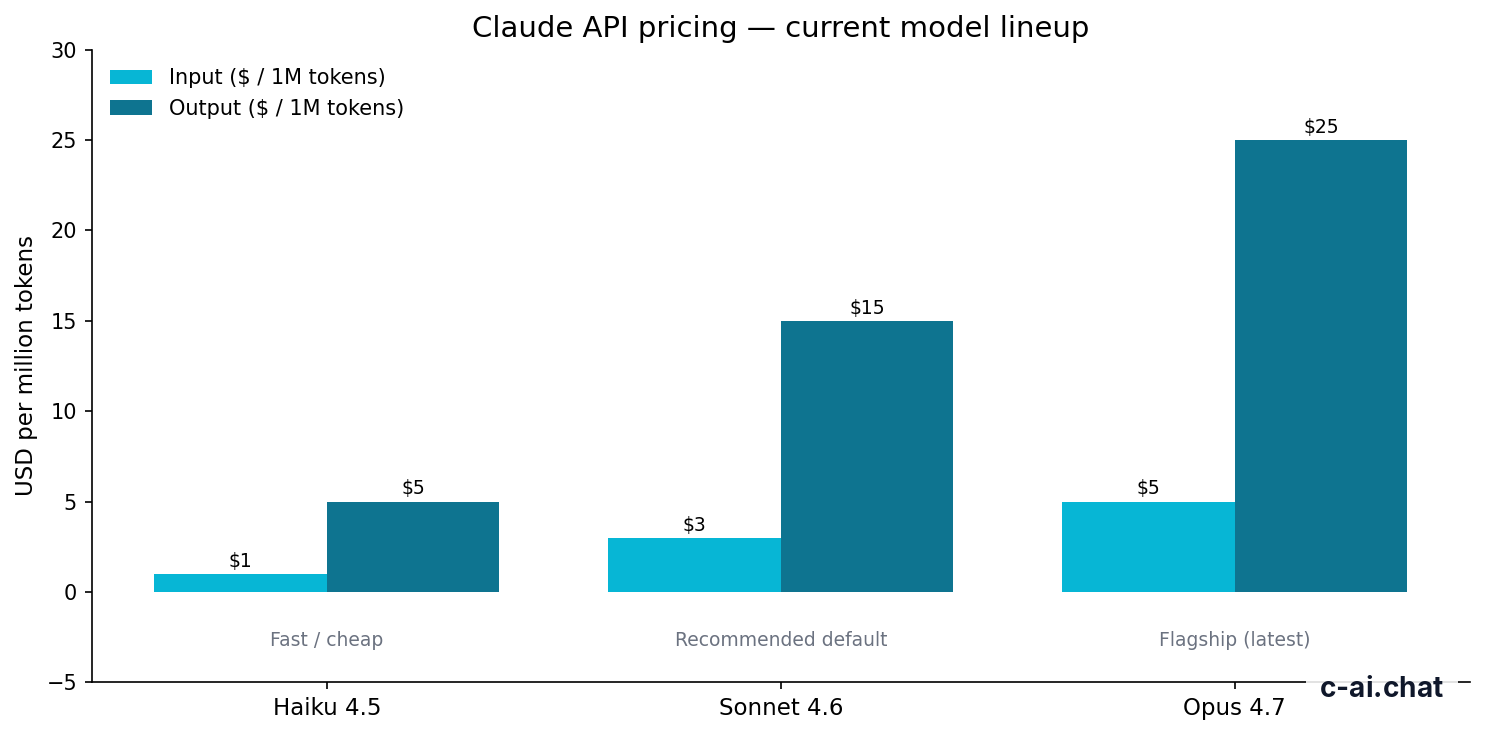
The model behind the experience also matters. Anthropic’s lineup includes Opus 4.7 as the flagship model at $5/M input and $25/M output with a 1M context window, Sonnet 4.6 at $3/M input and $15/M output with a 1M context window and 128K max output, and Haiku 4.5 at $1/M input and $5/M output. For model capabilities and availability, use Anthropic’s official models overview. Our Claude models guide explains the practical differences.
Is it worth it for you?

Claude Code is worth paying for when it saves real development time. It is less compelling if you only need quick explanations, occasional snippets, or general Claude chat access.
Pick it when
- You write or review code several times a week.
- You want Claude in a coding workflow, not only in a browser chat.
- You work with existing projects and need help understanding files, tests, and implementation steps.
- You can recover the monthly cost through a small amount of saved engineering time.
Skip it when
- You only ask Claude occasional programming questions.
- You need predictable infrastructure billing through the API instead of a user subscription.
- Your employer blocks local coding assistants or requires enterprise controls.
- You mainly need the cheapest Claude access, not coding-specific workflow help.
The best-fit personas are clear. A solo developer or technical founder can justify Pro quickly if Claude Code speeds up bug fixes, test writing, and code comprehension. A student or hobbyist should start more cautiously because value depends on usage frequency. A software team should avoid buying individual plans as a workaround if it needs SSO, admin controls, or a shared workspace.
For marketers, analysts, and non-technical professionals, Claude Code is usually not the reason to pay. They may still prefer Pro for Projects, research features, model access, or document work. Our Claude features guide covers those non-coding reasons separately.
Worked example
When Pro pays for itself
If Claude Code saves a regular developer even a small amount of focused time, Pro is easy to justify. If you use it only once or twice, wait.
There is also a privacy and governance angle. Individual plans are not a replacement for enterprise procurement. If your codebase includes regulated data, customer secrets, or internal security constraints, review Anthropic’s trust center and your company policy before adopting any coding assistant.
Cheaper or better alternatives
The cheaper alternative is Free, but only for evaluation or occasional coding questions. The better alternative for heavy individual use is Max. The better alternative for organisations is Team or Enterprise, because controls and governance usually matter more than the individual subscription price.
| Option | Price | Choose it when | Trade-off |
|---|---|---|---|
| Free | $0/month | You only need light Claude access | Usage limits make it a poor fit for regular Claude Code work |
| Pro | $20/month or $17/month annual | You want Claude Code as an individual | Usage may be limiting for heavy sessions |
| Max | From $100/month | You repeatedly outgrow Pro | Much higher monthly cost |
| Team Standard | $25/seat/month or $20/seat/month annual | Your team needs administration and shared workspace features | Per-seat management instead of a simple individual plan |
| Team Premium | $125/seat/month or $100/seat/month annual | Your team needs higher-capacity paid access | Materially higher per-seat cost |
| API | $1/M to $25/M depending on model and direction | You are building Claude into your own product or workflow | Token billing requires usage estimation and monitoring |
If you need usage-based budget control, the API may be better than a Claude Code subscription workflow. API pricing is per million tokens. Haiku 4.5 is $1/M input and $5/M output, Sonnet 4.6 is $3/M input and $15/M output, and Opus 4.7 is $5/M input and $25/M output. Anthropic documents this on the official API pricing page.
90% off
cached input tokens with prompt caching
Developers building repeatable tools should compare Claude Code with API-based automation. Prompt caching gives 90% off cached input tokens. The Batch API gives 50% off both directions. Those discounts matter when the same context, instructions, or evaluation set is reused many times. For one person working interactively in a repo, a plan subscription is simpler. For production systems, the API is usually cleaner.
Use the main Claude pricing breakdown for a broader plan-by-plan comparison, or the Claude FAQ for account limits, official access, and the difference between Anthropic and claude.ai.
Start with the work pattern
If you code often and want assistance inside development tasks, evaluate Pro first.
Check whether limits interrupt you
If Pro regularly stops useful work, compare Max before changing your workflow.
Separate product use from API use
If you are building software around Claude, estimate token costs through the API instead of treating Claude Code as infrastructure.
Escalate team needs early
If SSO, admin controls, shared workspace, auditability, or data residency matter, start with Team or Enterprise discussions.
The honest take
For most individual developers, Claude Code pricing is simple: start with Pro at $20/month or $17/month annual. Do not start with Max unless you already know high usage is central to your work. Do not use Free as your main plan if Claude Code is the feature you care about.
For teams, the subscription price is only part of the decision. Team Standard at $25/seat/month or $20/seat/month annual is the first team plan to evaluate. Enterprise is the route when procurement, governance, security review, or custom controls are required.
Official product access is through claude.ai. Anthropic’s service availability is published at status.claude.com, and company information is available from anthropic.com.
FAQ
Is Claude Code free?
Claude has a Free plan at $0/month, but Claude Code is listed as a paid plan feature. If Claude Code is your main reason for using Claude, treat Pro as the realistic individual starting point.
What is the cheapest paid plan for Claude Code?
The cheapest paid individual plan for Claude Code is Pro at $20/month or $17/month annual.
When should I upgrade from Pro to Max?
Upgrade when Pro usage limits repeatedly interrupt useful coding work. Max starts from $100/month and is intended for users who need much higher usage.
Is Claude Code billed per token?
Claude Code plan access is through Claude subscriptions. Direct API usage is separate and billed per million tokens on Anthropic’s developer platform.
Which plan should a small software team choose?
Small teams should look at Team Standard at $25/seat/month or $20/seat/month annual when they need team administration, SSO, and a shared workspace.
How much does Claude API usage cost?
API pricing depends on the model and whether tokens are input or output. Haiku 4.5 is $1/M input and $5/M output, Sonnet 4.6 is $3/M input and $15/M output, and Opus 4.7 is $5/M input and $25/M output.
Is Enterprise necessary for Claude Code?
Not for most individual users. Enterprise is for organisations that need procurement review, custom controls, governance features, or usage billed against API rates on top of a $20/seat base.
Independent guide. Not affiliated with Anthropic. For the official Claude product, visit claude.ai.
Last updated: 2026-05-12
This article is part of the Claude pricing & plans hub on c-ai.chat.