
Claude Code can work directly with Git repositories: it reads your codebase, helps plan changes, edits files, explains diffs, drafts commit messages, and supports common branch-and-review workflows, but you still need to review and approve what happens in your repo. c-ai.chat is an independent guide, not Anthropic, and this page covers how the workflow works, where it helps, where it does not, and when another tool may fit better.

- The short answer
- How it works
- What you’d actually do with it
- Vs. the alternatives
- Other questions readers ask
- The honest take
The short answer
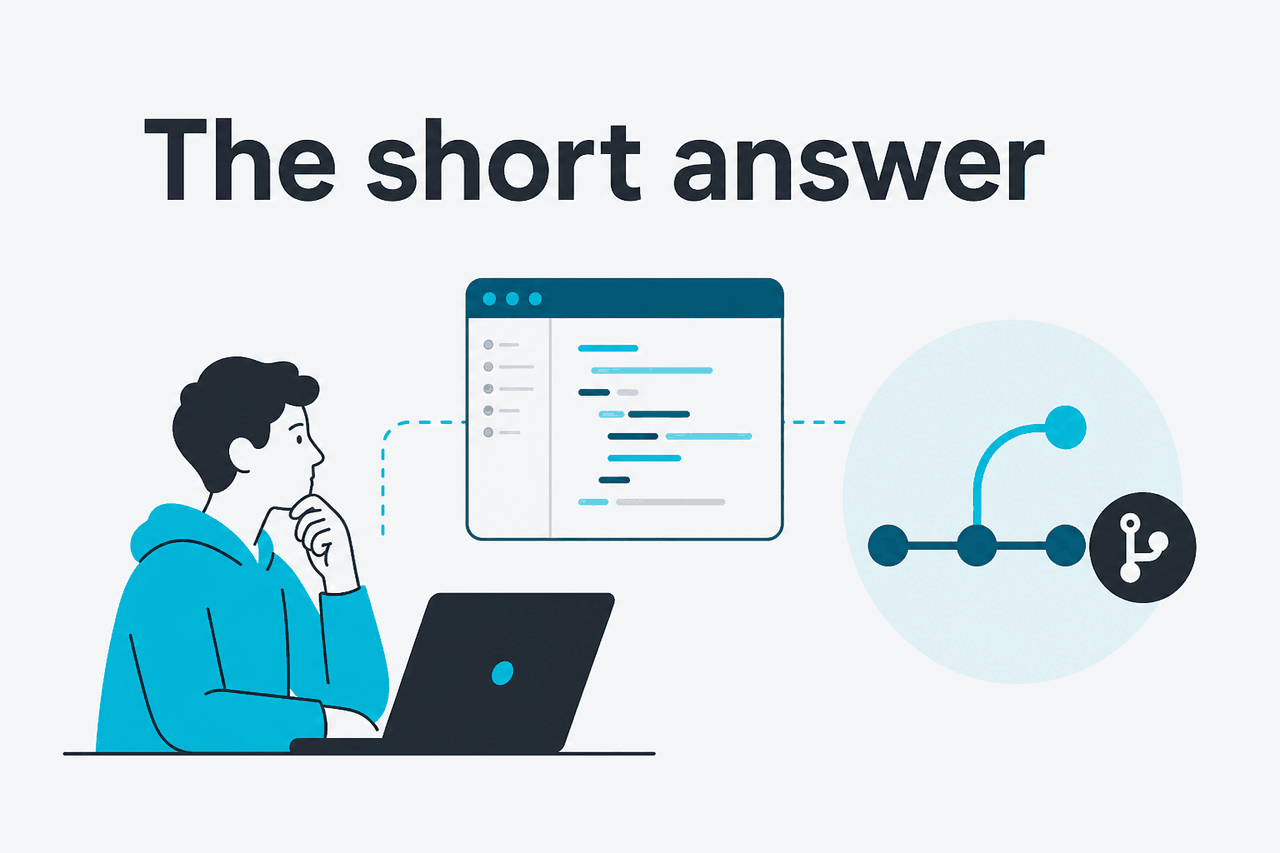
Claude code git usually means using Claude Code as an AI coding assistant inside a local Git-backed project so you can inspect files, make changes, discuss diffs, and move through a normal branch, commit, and review process with AI help. It is for developers and technical teams who want help with code changes inside a real repository, not just one-off snippets in a chat window.
- What it does · Reads repos, edits code, explains diffs, helps with commits and reviews
- Where it runs · In your development workflow around local repositories and Claude tools
- What it costs · Pro from $20/month; Max from $100/month; API from $1/$5 to $5/$25 per million tokens depending on model
- Who it’s for · Individual developers, power users, and teams working in Git every day
The key point is simple: Claude does not replace Git. It sits inside your existing workflow and helps with the slow parts such as understanding a codebase, tracing a bug across files, preparing a refactor, or turning a messy diff into a cleaner patch. If you are comparing product options first, see our Claude pricing guide and the broader Claude features overview.
For developers, the appeal is context. Claude can reason across multiple files and longer prompts, and Anthropic documents long context support and model options through the official models overview. That matters in Git work because many tasks are not about a single file. They are about how a change affects tests, docs, configuration, migrations, and edge cases elsewhere in the repo.
How it works

In practice, the workflow is straightforward. You open a repository, give Claude Code a task, let it inspect the relevant files, and ask it to propose or apply changes. The useful part is not just code generation. It is the back-and-forth: “show me the files involved,” “explain this error path,” “update tests,” “keep the public API unchanged,” or “write a safer migration.” Git stays the source of truth, and your normal review process still matters.
That means Claude Code fits best when your work already has some structure: a branch strategy, tests, linting, and code review. It can help you move faster through those steps, but it cannot guarantee that a patch is correct just because it looks plausible. You still need to inspect the diff, run tests, and check whether the change matches your team’s conventions. If you also use Claude through the API, our Claude API guide explains the model and pricing side.
Anthropic positions Claude across consumer and developer products, with plan details on Claude pricing and technical docs on docs.claude.com. For Git-heavy work, the practical question is less “can it write code?” and more “can it follow the shape of a real repository without losing the plot?” That is where Claude is often most useful.
-
Open or clone your repository
Start in a normal Git project with your existing branch and remote setup. Claude works best when the repo already has clear structure, tests, and a documented way to run the app.
-
State the task with constraints
Be specific: “Fix the failing auth refresh flow, keep the public endpoint unchanged, and update tests.” Good constraints produce better diffs.
-
Ask for inspection before edits
Have Claude identify relevant files, trace the execution path, and explain likely causes before changing code. This reduces broad but shallow edits.
-
Apply changes on a branch
Keep work isolated in a feature branch. Review changed files with
git diff, then run tests, linters, and type checks locally. -
Use Claude for review cleanup
After the first patch, ask for a clearer commit message, a PR summary, test notes, or a second pass on edge cases discovered during review.
If your repository is large, model choice can matter. Anthropic lists Claude Opus 4.7 as the flagship model at $5 per million input tokens and $25 per million output tokens, Claude Sonnet 4.6 at $3 and $15, and Claude Haiku 4.5 at $1 and $5, with long context support documented for the larger models. For teams doing repeated codebase analysis, prompt caching and Batch API discounts can also change the economics materially.
90% off
cached input tokens with prompt caching
What you’d actually do with it
The most useful Git tasks are usually not “write me an app.” They are narrower and more realistic: fix a regression, refactor a subsystem without changing behaviour, explain a large diff before review, or generate a cleaner commit history from a rough draft. Below are examples that match how developers actually use these tools.
1) Trace and fix a bug across files. A common prompt is: Inspect the login timeout issue. Find the request path from middleware to token refresh, explain the root cause, patch it with the smallest change, and update tests. This works well because the task gives Claude a bounded goal and asks for reasoning before edits.
2) Prepare a safe refactor. Example prompt: Find duplicated validation logic in this repo. Propose a shared utility, list every file that will change, and refactor without changing public function signatures. Git helps here because you can review whether the refactor stayed scoped or drifted into unrelated cleanup.
3) Review a diff before opening a pull request. Example prompt: Summarise this branch diff for a reviewer. List risky changes, migration impact, missing tests, and any backwards compatibility concerns. Claude is often strong at turning a noisy set of edits into a readable PR summary.
git checkout -b fix/auth-refresh-timeout
git diff --stat
git diff
git add .
git commit -m "Fix auth refresh timeout and cover retry path"
4) Generate commit messages and PR notes from actual changes. This is a good fit after you already have a diff. Prompt example: Based on the current diff, write a conventional commit message, a short PR description, and a reviewer checklist. That saves time without handing over technical judgment.
Worked example
Using Claude to clean up a messy Git patch
refactor/input-validationThe value is not that Claude “does Git” for you. The value is that it helps you turn an untidy working branch into something another human can review.
5) Understand an unfamiliar repository. Example prompt: Map this repo. Identify the app entry points, config loading path, test framework, and where background jobs are scheduled. Then suggest the safest place to add feature X. This is often the fastest route for onboarding to a new codebase, especially when docs lag behind reality.
Pick when
- You need help understanding a multi-file change
- You want cleaner PR summaries and commit messages
- You work in repos with tests and review discipline
- You need support on refactors, debugging, and code explanation
Skip when
- You expect fully autonomous changes with no review
- Your repo has no tests and weak rollback practices
- You only need quick single-file autocomplete
- Strict data rules prevent using hosted AI tools in your workflow
If your main need is broad product context rather than developer workflow, start from our independent Claude guide. If you are deciding whether Claude Code is the right product at all, see the main Claude Code page for the higher-level breakdown.
Vs. the alternatives
Claude Code is not the only way to get AI help in Git workflows. Cursor, GitHub Copilot, and Cody all target similar jobs, but they differ in where they live, how much repo context they handle well, and how much of the workflow stays visible to the developer. The right choice depends on whether you want an IDE-first assistant, inline completion, or a stronger emphasis on repository-level reasoning.
| Tool | Best fit | Strength in Git work | Main limitation |
|---|---|---|---|
| Claude Code | Developers who want repo-aware assistance and strong reasoning across files | Good for planning changes, explaining diffs, refactors, PR summaries, and codebase understanding | Still requires careful review; not a substitute for tests or Git discipline |
| Cursor | Developers who want an IDE-centric AI workflow | Fast editing loop inside the editor and useful multi-file changes | Experience is tied closely to the editor workflow you adopt |
| GitHub Copilot | Developers who mainly want completion and broad IDE integration | Strong for inline suggestions and routine coding support | Can feel weaker for long-form repository explanation and structured change planning |
| Cody | Teams focused on code search and repository context | Helpful for navigating and querying larger codebases | Fit depends heavily on your tooling stack and workflow preferences |
The trade-off is simple. If you want short, continuous autocomplete inside an editor, Copilot-style tools may feel more immediate. If you want to reason through a codebase, discuss a patch, or ask for a safer plan before making changes, Claude often has the better shape for that job. Neither removes the need for Git review, and none can tell whether a change matches business intent unless you provide that context clearly.
On the cost side, the pricing model also differs. Claude consumer plans start with a Free tier, then Pro at $20/month or $17/month annual, and Max from $100/month. Team plans start at $25/seat/month or $20/seat/month annual, with a Premium tier at $125/seat/month or $100/seat/month annual. Enterprise uses a $20/seat base plus usage at API rates. For many engineering teams, the practical choice is whether they want user-seat pricing, API usage pricing, or both.
Other questions readers ask
The honest take
Claude Code is a strong fit for Git-based engineering work when you need help understanding a repository, planning safe changes, cleaning up diffs, and writing clearer review notes. It is less compelling if all you want is basic autocomplete or if your team expects AI to operate without human review. The real advantage is not that it replaces Git. It is that it makes Git work easier to reason about.
If you already work with branches, tests, and pull requests, Claude can save time in the parts of development that are usually slow and fuzzy. If you do not have those basics in place, AI will not fix that. Start with a normal workflow, then add Claude where it reduces friction. For plan and feature context, compare pricing and features before you commit to a setup.
Independent guide. Not affiliated with Anthropic. For the official Claude product, visit claude.ai.
Last updated: 2026-05-12