
Claude Max is Anthropic’s high-usage individual subscription for Claude: it starts at $100/month and adds 5x or 20x Pro usage, higher output limits, early feature access, and priority traffic.
c-ai.chat is an independent guide. We are not Anthropic, and we do not operate claude.ai. If you are comparing plans, start with our Claude pricing guide, then use this page to decide whether Max fits your workload.
- The bottom line
- What Max includes
- Is Max worth it?
- Lower-cost or better-fit alternatives
- The honest take
- FAQ
- Sources
The bottom line
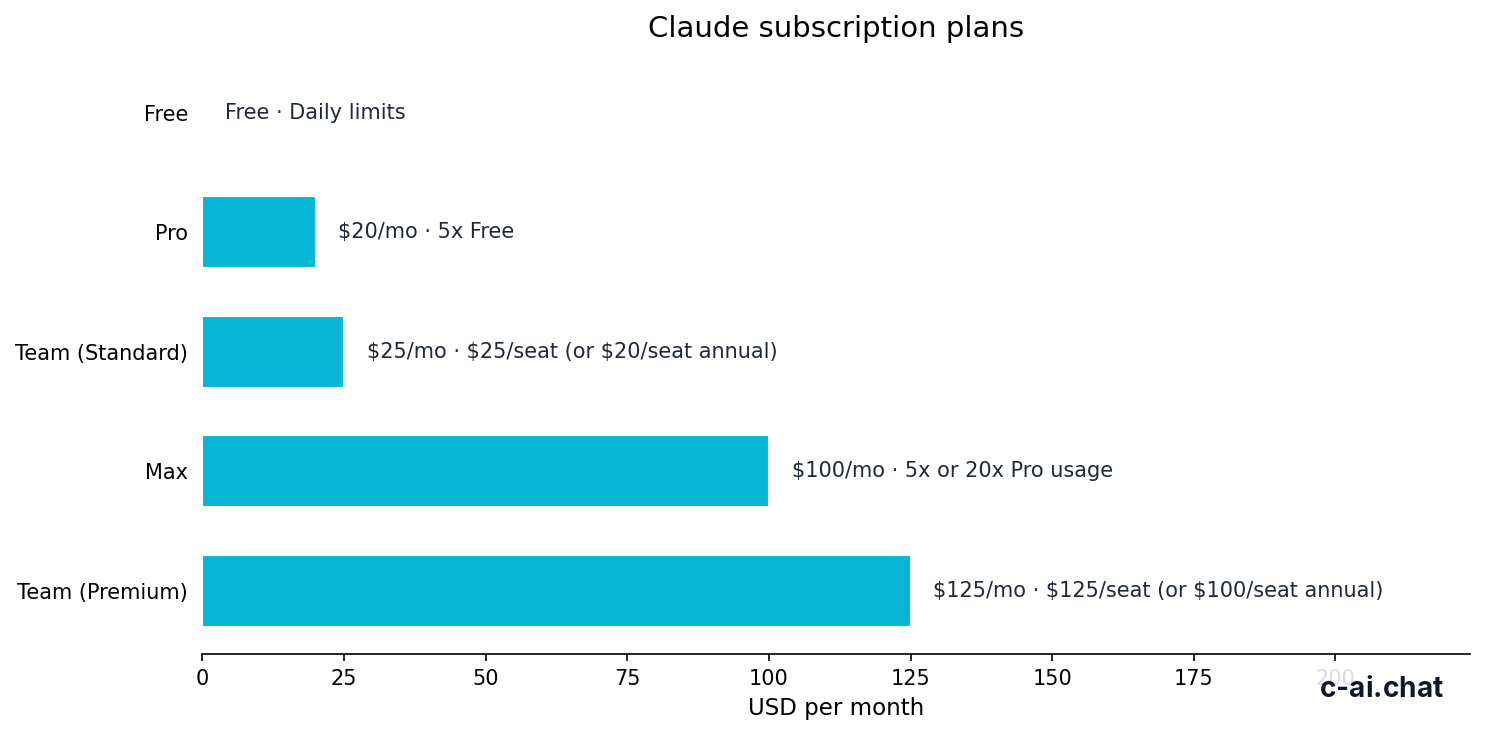
Claude Max is for people who regularly hit Pro limits during serious personal work. It is not the default choice for casual use. It is also not the same as paying for the Claude API.
From $100/month
for 5x or 20x Pro usage, higher output limits, early feature access, and priority traffic
Think of Max as extra capacity. Pro gives individuals more access than Free. Max is for users who need that access more often, especially for long writing sessions, coding, research, analysis, and repeated document work.
Max remains an individual plan. If you need shared administration, a managed workspace, or organization controls, compare Team plans. If you need programmatic access for scripts, apps, or backend workflows, review our Claude API guide instead.
What Max includes
Claude Max includes the individual Claude experience with higher usage capacity. Anthropic describes Max as offering 5x or 20x Pro usage, higher output limits, early feature access, and priority traffic.
Free
$0/month
For occasional Claude use
- Access to Claude with usage limits
- Good starting point for testing the product
- No paid subscription required
Pro
$20/month
For regular individual users
- More usage than Free
- Individual access to supported Claude features
- $17/month when billed annually
Max
From $100/month
For high-usage individual users
- 5x or 20x Pro usage
- Higher output limits
- Early feature access
- Priority traffic
- Individual plan, not a team admin plan
Max does not mean unlimited Claude. Anthropic still manages usage through plan limits and system capacity. Priority traffic helps when demand is high, but it is not a guarantee that every request will run instantly.
The plan is most relevant when your work happens inside claude.ai and Claude’s apps. If your workload is automation, product integration, or backend processing, compare Max with API billing.
| Included area | What Max gives you | What it does not solve |
|---|---|---|
| Usage capacity | 5x or 20x Pro usage | It is not advertised as unlimited use |
| Output allowance | Higher output limits | Very large jobs may still require planning or API use |
| Traffic handling | Priority traffic | It does not replace service availability monitoring |
| Features | Early feature access | Early access does not mean every feature is permanent |
| Administration | Individual account experience | It does not add team controls or a shared workspace |
For current plan details, use Anthropic’s official pricing page at claude.com/pricing. For model and token pricing, use the official platform documentation at platform.claude.com.
Is Max worth it?

Claude Max is worth considering when Claude is already part of your working day and Pro is the bottleneck. Do not buy it just to try Claude. Buy it when lower tiers interrupt work with measurable value.
Pick Max when
- You hit Pro usage limits during paid or time-sensitive work.
- You use Claude for long writing, coding, analysis, or research sessions.
- You need longer outputs for drafts, reports, refactors, or structured documents.
- You want early feature access without moving to a team plan.
- You work mainly inside Claude’s official apps rather than through API calls.
Skip Max when
- You use Claude a few times a week and rarely see limits.
- You need shared team administration or workspace controls.
- You are building an app and need token-based API billing.
- Pro fits your budget and the extra capacity would sit unused.
- You need a fixed throughput agreement for business operations.
The strongest fit is a solo professional who uses Claude as a production tool. Examples include a developer using Claude for coding help, a founder preparing documents and analysis, a researcher working through long source material, or a marketer revising large content sets.
The weaker fit is a user who wants the highest-priced individual plan without a clear workload. If you are still learning what Claude can do, start with Free or Pro. Test Projects, document analysis, coding support, and the main Claude features before paying for a high-capacity tier.
Max is also a weak fit for small companies that need central control. Multiple Max subscriptions may work for loose personal use, but they do not replace onboarding, offboarding, workspace management, or organization-level settings.
Worked example
When Max is easy to justify
The case is strongest when the extra capacity protects time you already know is valuable.
Lower-cost or better-fit alternatives
Claude Max is not the only sensible option. Free, Pro, Team, Enterprise, or the API may be cheaper or better, depending on whether your problem is usage volume, collaboration, governance, or automation.
| Option | Price | Better when | Trade-off |
|---|---|---|---|
| Free | $0/month | You only need occasional Claude access | Usage limits are tighter |
| Pro | $20/month or $17/month billed annually | You want regular individual Claude use without Max-level volume | Less capacity than Max |
| Max | From $100/month | You need 5x or 20x Pro usage and higher output limits | Costs more and remains an individual plan |
| Team Standard | $25/seat/month or $20/seat/month billed annually | You need a shared team plan | Designed for teams, not solo high-volume use |
| Team Premium | $125/seat/month or $100/seat/month billed annually | You need a higher-priced team tier | Higher per-seat cost |
| Enterprise | $20/seat base plus API rates | You need an enterprise arrangement and API-based usage pricing | More administration and procurement |
Pro is the closest cheaper alternative. If you do not regularly hit Pro limits, Pro is usually the more rational individual plan.
Team Standard is the closest organizational alternative. It is not Max for teams. It solves a different problem: shared work and administration. A small team should compare Team against multiple individual subscriptions before choosing a plan family.
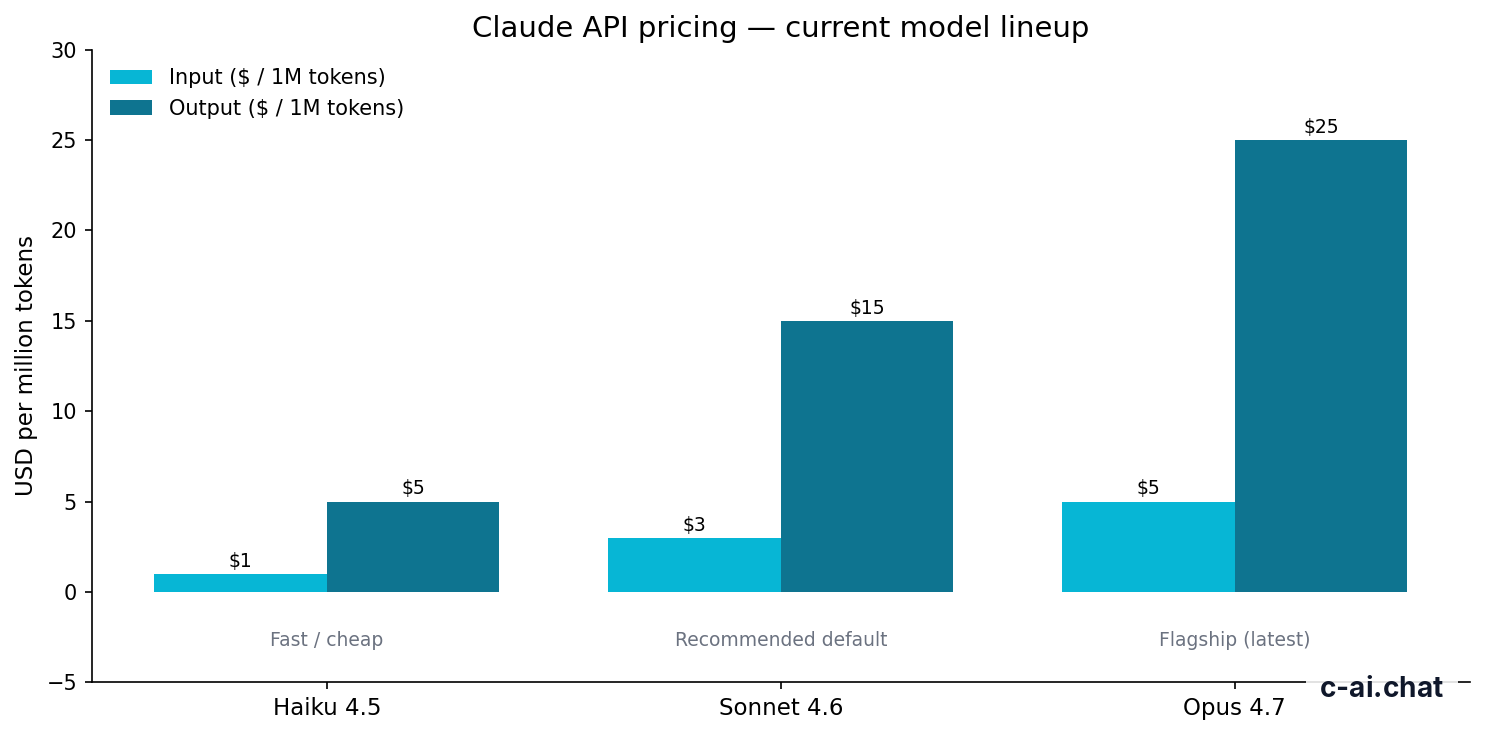
The API is the better alternative for developers building repeatable systems. API pricing is per million tokens. Current model pricing includes Claude Opus 4.7 at $5/M input and $25/M output tokens, Claude Sonnet 4.6 at $3/M input and $15/M output tokens, and Claude Haiku 4.5 at $1/M input and $5/M output tokens. Opus 4.7 and Sonnet 4.6 support 1M context. Sonnet 4.6 supports up to 128K output.
90% off
cached input tokens with prompt caching
Prompt caching can reduce cached input token cost by 90%. The Batch API can reduce both input and output costs by 50%. Those discounts matter for repeated prompts and non-urgent workloads.
That does not mean the API is always cheaper. API cost depends on how many tokens you send and receive, which model you choose, and whether your prompts repeat. A heavy claude.ai user may prefer Max because the workflow is simpler. A developer sending thousands of structured tasks through a backend should model API cost directly.
If you are unsure, ask three questions. Are personal usage limits blocking you? Max may fit. Are team management needs blocking you? Look at Team. Are automation or product integration needs blocking you? Price the API and review the Claude model lineup.
The honest take
Claude Max is a practical plan for heavy individual users. It is not a prestige tier everyone should buy. The value is straightforward: more Claude usage than Pro, higher output limits, priority traffic, and early feature access.
If you are not already hitting limits, do not start with Max. Use Free or Pro, learn your real pattern, and upgrade only when capacity becomes the constraint. For teams and developers, Max may be the wrong tool. Compare Team and API pricing first.
FAQ
How much does Claude Max cost?
Claude Max starts at $100/month. Anthropic describes it as offering 5x or 20x Pro usage, with higher output limits, early feature access, and priority traffic.
Is Claude Max unlimited?
No. Max increases usage capacity compared with Pro, but Anthropic does not describe it as unlimited. Usage can still be subject to plan limits and service conditions.
Does Claude Max include API usage?
Do not assume that. API usage is billed separately through Anthropic’s developer platform on a token basis. If you are building tools or automations, use our Claude API documentation guide and Anthropic’s official API pricing.
Is Claude Max better than Pro?
Only if you need the extra capacity. Pro is better value for many individuals because it costs $20/month or $17/month billed annually and may already cover their workload.
Should a small business buy Max or Team?
Choose Team if the business needs a shared plan and central administration. Choose Max only when the main problem is one person’s heavy individual usage.
Which Claude model should Max users choose?
Use the model that fits the task. Opus 4.7 is the flagship model. Sonnet 4.6 is the balance choice. Haiku 4.5 is the fastest and lowest-cost API model. For more detail, see our Claude models guide.
Where can I check Claude service availability?
Use Anthropic’s official status page at status.claude.com. Priority traffic is a plan feature, but service availability is tracked separately.
Where can I find more Claude help?
Start with our Claude FAQ for common questions or the Claude resources hub for guides, references, and comparison pages.
Independent guide. Not affiliated with Anthropic.
Last updated: 2026-05-12
This article is part of the Claude pricing & plans hub on c-ai.chat.