
Claude agent teams are not a single official Claude product; the term usually means a multi-agent workflow where Claude is assigned specialised roles for planning, execution, review, and governance. c-ai.chat is an independent guide, not Anthropic or claude.ai, and this page explains how the pattern works, when it helps, and when a simpler Claude setup is enough. For the broader map, start with our Claude AI guide.
- What this is
- How it works
- What you can build
- Limits and watch-outs
- FAQ: other questions readers ask
- The honest take
- Sources
What this is
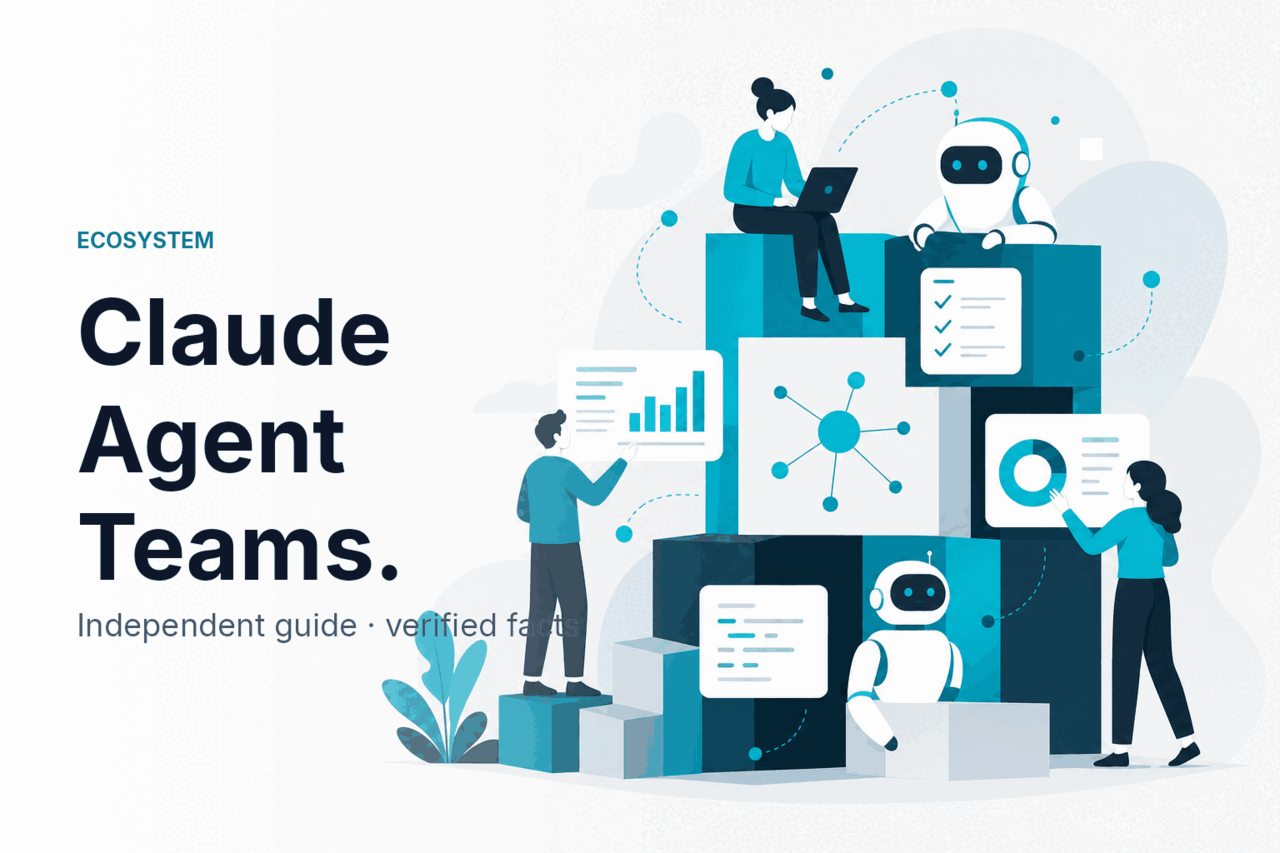
A Claude agent team is a design pattern for coordinating several Claude-powered roles around one task. One agent may plan, another may write code, another may review the result, and another may check policy or tests. Anthropic documents Claude, Claude Code, models, tools, and API patterns, but “agent teams” is best understood as a workflow you build around Claude rather than a separate official feature you buy at claude.ai.
| Term | What it means in practice | How it relates to Claude agent teams |
|---|---|---|
| Skills | Reusable instructions, procedures, or capabilities that help Claude perform a defined task more consistently. | A team member can use a skill, such as “write a test plan” or “summarise a contract,” but the skill is not the agent itself. |
| Agents | Goal-directed Claude instances or configurations with their own role, context, tools, and instructions. | An agent team combines multiple agents with separate responsibilities and a coordination rule. |
| Plugins | External integrations or tool connections, depending on the product or framework using the term. | Plugins can give agents access to systems, but the team still needs permissions, routing, and human oversight. |
How it works
The basic mechanism is orchestration. A user gives one objective to a controller layer. That controller may be a human prompt, a Claude Code workflow, a backend service using the Claude API, or a script that calls Claude several times. It breaks the task into subtasks, sends each subtask to a specialised agent, collects the outputs, and decides what to do next. Check Anthropic’s model documentation before you design the workflow.
Each agent usually has four parts: a role, an instruction set, a context window, and allowed tools. A planner may only create steps. A builder may edit files through Claude Code. A reviewer may inspect the output against a rubric. A security agent may flag risky dependencies or sensitive data. The team helps when these roles reduce confusion, not when they merely add more prompts.
Define the shared objective
Write one sentence that states the final outcome, such as
create a migration plan for moving the billing service to a new API version. If the outcome is vague, the agents will multiply the vagueness.Choose the roles
Start with three roles: planner, implementer, and reviewer. Add specialist agents only when a real constraint needs them, such as legal review, test coverage, or data classification.
Set the handoff format
Require each agent to return structured output. Useful fields include
task,assumptions,result,open_questions, andrisk_level.Limit tool access
Give each role only the tools it needs. A reviewer often needs read access, not write access. A planning agent usually does not need production credentials.
Add a human checkpoint
Place approval gates before actions that affect money, customer data, production systems, legal claims, or public content.
For software work, this pattern often appears in Claude Code. One Claude-driven process can inspect a repository, propose a plan, make edits, run tests, and ask for review. In a custom product, the same idea can run through API calls, queues, tool permissions, and logs. See our Claude features guide and Claude models guide before choosing an implementation.
Haiku 4.5
$1/M input · $5/M output
Use for routing, classification, extraction, and simple checks.
Sonnet 5
$2/M input · $10/M output (introductory through 31 August 2026; standard $3/$15 from 1 September 2026)
Use as the default for planning, drafting, coding, and review. It supports a 1M context window and 128K max output.
Opus 4.8
$5/M input · $25/M output
Use for the hardest reasoning, design, and high-stakes review steps. It supports a 1M context window.
What you can build
Claude agent teams work best when a task has clear stages, real review needs, and enough complexity to justify separate roles. These are practical patterns, not official Anthropic templates.
Worked example
Repository refactor team
A good setup keeps write access with the builder and review authority with a separate role.
1. Software refactoring assistant. A planner reads the issue and repository structure. A builder edits code. A test agent runs commands or drafts test cases. A reviewer checks the diff before a human merges it. This can help with low-risk migrations, dependency upgrades, and repeated code cleanup.
2. Research and brief production. A research agent works from source material supplied by the user. A synthesis agent extracts themes. A critique agent checks claims against the cited material. A writing agent produces the final brief. This pattern is safer when the system requires citations and blocks unsupported claims.
3. Customer support triage. A classifier labels incoming tickets. A policy agent checks refund, privacy, or escalation rules. A drafting agent writes a response. A supervisor flags cases that need a human. This can speed up repetitive work, but final actions should follow the company’s support rules and data controls.
4. Marketing content review workflow. One agent drafts campaign copy. Another checks brand voice. A compliance agent flags prohibited claims. A localisation agent adapts the copy for a region. This works only if review agents have concrete policies to apply. Vague “make it better” instructions do not create reliable governance.
5. Data analysis assistant. A requirements agent turns a business question into an analysis plan. A query agent writes SQL or Python. A validation agent checks column definitions and obvious anomalies. A narrative agent explains the result for stakeholders. If sensitive data is involved, connect only approved data sources and log tool use.
{
  "objective": "Prepare a safe refactor plan for the billing webhook service",
  "agents": [
    {
      "name": "planner",
      "role": "Break the task into ordered steps. Do not edit files.",
      "tools": ["repo_read"]
    },
    {
      "name": "builder",
      "role": "Apply approved code changes only.",
      "tools": ["repo_read", "repo_write", "test_runner"]
    },
    {
      "name": "reviewer",
      "role": "Review the diff for regressions, missing tests, and unclear assumptions.",
      "tools": ["repo_read", "test_runner"]
    }
  ],
  "handoff_format": {
    "summary": "string",
    "files_touched": ["string"],
    "assumptions": ["string"],
    "risks": ["string"],
    "next_action": "approve | revise | escalate"
  },
  "human_approval_required_for": [
    "production_deploy",
    "schema_change",
    "customer_data_access"
  ]
}
This configuration is intentionally conservative. It separates planning, writing, and review. It also names the actions that require approval. In real systems, enforce those limits in code, not only in a prompt.
Pick when
- The work has distinct roles or stages.
- You need independent review before an action.
- The task repeats often enough to justify setup.
- You can define tool permissions clearly.
Skip when
- A single prompt gives a good enough answer.
- The task requires undocumented product capabilities.
- You cannot audit what each agent did.
- The workflow would act on sensitive systems without approval gates.
Limits and watch-outs
Multi-agent workflows can be useful, but they add failure modes. More agents do not automatically mean better answers. They can create duplicated work, conflicting assumptions, higher cost, and more places for sensitive data to leak.
- Not an autonomy layer by itself. Claude can help plan and execute tasks, but you still need orchestration, permissions, monitoring, and fallback behaviour.
- Not always an official feature name. “Claude agent teams” is commonly used to describe a pattern. Check platform.claude.com and Anthropic’s model docs for documented capabilities.
- Prompt boundaries are not security boundaries. Do not rely on role instructions alone to protect files, credentials, or customer records. Enforce access at the tool and infrastructure layer.
- Context can become noisy. If every agent sends long outputs to every other agent, the workflow can lose signal. Use summaries, schemas, and strict handoff rules.
- Costs can rise quickly. Multiple agents mean multiple model calls. If you use the API, check Anthropic’s official pricing at platform.claude.com.
- Reviews can agree on the wrong thing. If all agents share the same flawed assumptions, a reviewer may validate a bad plan. Give review agents explicit criteria and source material.
- External tools need governance. Calendar, email, code, database, and ticketing integrations should use least-privilege permissions and clear audit logs.
- Long-running workflows need recovery logic. Plan for partial failure, rate limits, unavailable services, and duplicate actions. Check service health at status.claude.com when debugging availability issues.
- Enterprise use needs policy alignment. Teams handling regulated or sensitive data should review Anthropic’s trust and security materials at trust.anthropic.com and apply their own internal controls.
90% off
cached input tokens with prompt caching
Cost optimisation matters for agent teams because the same instructions, policies, and reference material may be reused across agents. Anthropic documents prompt caching and Batch API pricing in its platform materials. Batch API gives 50% off both directions, which can help with offline workloads that do not need immediate responses.
Claude plan pricing also matters if your workflow starts inside the official product rather than the API. Free is $0. Pro is $20/month, or $17/month on annual billing. Max starts at $100/month. Team and Enterprise plans add higher capacity and admin controls for organizations (see our pricing guide). For a fuller comparison, see our Claude pricing guide.
FAQ: other questions readers ask
These questions usually appear near searches for Claude agent teams because people are trying to decide whether they need a product, a prompt pattern, or a developer framework.
If you are deciding between Claude’s built-in capabilities and a custom system, compare the task against our Claude resources. A manual workflow may be enough for early testing. API orchestration becomes more valuable when you need repeatability, access control, and measurable outcomes.
The honest take
Claude agent teams are useful when you have a real coordination problem: planning, execution, review, and governance are distinct jobs. They are less useful when the task is small, the requirements are unclear, or the workflow adds agents just to look more sophisticated. Start with one Claude prompt. If you keep needing separate reviewers, specialists, or approvals, then move to a team pattern.
The strongest setups treat agents as constrained workers, not free-floating decision makers. Give each agent a narrow role, limited tools, structured handoffs, and a clear escalation path. Keep humans in the loop for irreversible actions. That gives you most of the benefit without pretending that more agents automatically create more reliability.
Independent guide. Not affiliated with Anthropic. For the official Claude product, visit claude.ai.
Last updated: July 16, 2026